
Highlights
- Unauthorized sellers avoid MAP pricing by keeping the product page price compliant while shifting the real discount to areas that MAP does not cover, such as cart discounts, coupon codes, loyalty rewards, or bundled offers that only appear after the product page.
- MAP governs publicly advertised pricing only. It does not control the final price a shopper pays at checkout, and this gap between advertised price and final price is where nearly every MAP loophole lives.
- Unauthorized sellers have no obligation to follow your MAP policy. They never signed a distribution agreement with your brand, so there is no contractual relationship binding them to your pricing rules.
- A strong MAP policy in 2026 should explicitly cover any price shown before the transaction is complete, including the product detail page, the shopping cart, email promotions, coupon-applied pricing, loyalty program pricing, and per-unit pricing within bundles or kits.
- Cart-level pricing, coupon codes, and loyalty discounts change by the hour. Manual spot checks and weekly reports miss most of these tactics. Continuous, automated monitoring catches violations before they trigger a pricing chain reaction across sellers.
The Price You Set vs The Price They Pay
There is an open secret in MAP enforcement. The sellers who most often violate your pricing are rarely the ones you can see doing it.
Unauthorized sellers have learned that the fastest way around a MAP policy is not to break it on the product page. It is to move the discount somewhere MAP does not reach: into the cart, behind a coupon code, or buried in a bundled offer. The listed price stays compliant. The price the shopper actually pays does not.
According to a Harvard Business Review study, unauthorized retailers violated MAP policies roughly 50% of the time, while even authorized sellers broke them about 20% of the time. These are not just random price drops. They are calculated tactics designed to stay invisible to standard monitoring tools and competitor price crawlers.
This guide covers exactly how unauthorized sellers avoid MAP pricing, the specific loopholes they use, and what brands can do to close them. MetricsCart’s MAP monitoring solution helps brands catch these violations across retailers in real time, but fixing the problem starts with seeing how it works.
An unauthorized seller is any retailer or reseller who sells your products without a direct agreement with your brand. These sellers typically source inventory through grey market channels, liquidation sales, diverted stock, or unauthorized distributors. Because they have no formal relationship with your brand, they are not bound by your MAP policy and have no incentive to follow it.
How Do Unauthorized Sellers Avoid MAP Pricing?
Unauthorized sellers avoid MAP pricing by keeping the product page price compliant while moving the real discount to places that MAP does not cover. The listed price looks clean. The actual price the shopper pays is lower, delivered through cart discounts, coupons, loyalty rewards, or bundled offers that only show up after the product page.
This works for two reasons.
- Unauthorized sellers have no obligation to follow your MAP policy. They never signed a distribution agreement with your brand. They typically acquire your products through diverted stock, liquidation sales, or grey market channels, which means there is no contractual relationship that binds them to your pricing rules.
- MAP only governs publicly advertised pricing. It does not control the final price a shopper pays at checkout. As long as the product page shows a MAP-compliant number, sellers can reduce the actual cost through mechanisms that happen after the listing, in the cart, through a code, or behind a login. Most monitoring tools only scan the product page, which is why these violations go undetected.
The combination of these two factors- no policy obligation and a built-in gap in what MAP covers- is what makes unauthorized sellers so difficult to control. The tactics themselves are straightforward once you understand this foundation.

Building on what Megan Harmon shared in Season 2, Episode 1 of the Digital Shelf Insider, this is the core challenge brands face with unauthorized sellers. They have no agreement with your brand, no obligation to follow your pricing rules, and no reason to care about your MAP policy. Without active monitoring and distribution control, these sellers operate freely.
Tune into the full episode here:
Common Loopholes Unauthorized Sellers Use to Avoid MAP Pricing Policy
| MAP Tactic | Appears on the Product Page? | Visible to Price Crawlers? | Usually Detected Manually? |
| Cart pricing | No | No | Rarely |
| Coupons | No | No | Rarely |
| Loyalty pricing | No | No | Rarely |
| Bundles | Sometimes | Partially | Difficult |
Here are the most common tactics unauthorized sellers (and sometimes authorized ones) use to sell below MAP without appearing to break the policy:
“See Price in Cart” Pricing
The product page shows the MAP-compliant price. But when a shopper adds the item to their cart, the price drops below MAP. Sellers argue that a shopping cart is a “private space” and the cart price is not publicly advertised. This tactic also hides the lower price from competitors’ price crawlers, so other retailers cannot automatically match it.
Coupon Codes and Promo Offers
The listed price meets MAP, but a coupon code, browser plugin discount, or promotional offer brings the final price below the minimum. Because the reduction does not appear on the product page itself, sellers argue it falls outside MAP’s scope. This includes retailer-specific coupons, influencer discount codes, and affiliate deals that surface at checkout.
Site-Wide and Category-Wide Sales
Instead of discounting your specific product, a retailer runs a blanket promotion like “15% off everything” or “buy two, get one free.” Your product page still shows the MAP price, but the site-wide deal effectively drops it below MAP at checkout. Since the discount is not tied to your product specifically, sellers claim it is not a violation.
Loyalty and Membership Programs
Some retailers offer exclusive pricing to members of their rewards or subscription programs. The public-facing price stays at MAP, but logged-in members see a lower price. Subscribe & Save discounts on Amazon (typically 5-15% off) fall into this category. The discount is invisible to non-members and to most MAP monitoring tools.
Bundling and Multi-Pack Pricing
A seller bundles your product with accessories or complementary items at a total price that makes the per-unit cost of your product fall below MAP. For example, a $300 MAP product sold in a “$350 bundle” with $100 worth of extras implies your product is being offered for $250.
Strike-Through and Comparison Pricing
The seller shows a higher “original” price crossed out next to a lower current price that sits below MAP. The visual framing of a deal trains shoppers to expect discounts on your products and pressures other retailers to match.
Each of these tactics works because MAP, by design, only governs publicly displayed pricing. Anything that moves the discount behind the product page, into the cart, behind a login wall, or into a bundled offer can fall outside a loosely worded MAP policy.

READ MORE | 10 Common MAP Policy Loopholes That Would Cost Your Brand
How Can Brands Fix Repeated MAP Violations?
The tactics above succeed for two reasons: vague policy language and slow detection. Fixing repeated violations requires brands to address both.
Tighten Your MAP Policy Language
Redefine what “advertised price” means in your policy. A strong MAP policy in 2026 should explicitly cover any price shown before the transaction is complete:
- The product detail page
- The shopping cart (before payment confirmation)
- Email promotions and retargeting ads
- Coupon-applied pricing
- Loyalty program, subscription, or membership pricing
- Per-unit pricing within bundles or kits
If a shopper can see a below-MAP price before they pay, your policy should treat it as a violation. Removing this ambiguity takes away the gray area that sellers rely on.
Control Your Distribution to Cut Off Supply
Unauthorized sellers cannot sell your products if they cannot access your inventory. Audit your distribution chain to identify where stock is leaking to unauthorized channels. Tighten distributor agreements to restrict resale to approved partners only.
Impose clear penalties on distributors who supply unauthorized third-party sellers, including suspension of replenishment or contract termination. If you can control who gets your products, you cut off the problem at its source.
Use Test Buys to Trace Inventory Leaks
Purchase your own product from the unauthorized seller. Then use covert serial codes, lot numbers, or QR codes embedded in your packaging to trace exactly which distributor or retail partner sold that unit into an unauthorized channel.
This gives you documented proof of where the leak originated, which is far more effective than guessing. Once you identify the source, you can take targeted action against the specific distributor rather than tightening terms across your entire network.
Use Marketplace Brand Protection Programs
Marketplaces like Amazon do not directly enforce your MAP policy. But they do offer brand protection tools that help you control who can sell your products. Enroll in Amazon Brand Registry if you have an active trademark.
File IP infringement claims against unauthorized sellers using the “material difference” argument, which means the product they are selling is not backed by your warranty, lacks customer support, or is missing original packaging.
Use serialization programs like Amazon Transparency, which assigns a unique scannable code to every unit you manufacture. Without a valid code, unauthorized sellers cannot even get their inventory received by Amazon’s warehouses.
Build a Tiered Enforcement Process
Brands that treat every violation the same lose credibility. A clear escalation framework keeps enforcement consistent:
- First violation: formal warning with the MAP policy attached and a 24- 48-hour correction deadline.
- Second violation: temporary order hold or reduced product allocation.
- Third violation: supply cut or termination of the retailer relationship.
This graduated approach signals to authorized sellers that the policy is real while creating a documented trail for action against repeat offenders.
Monitor Continuously, Not Periodically
Cart-level pricing, coupon codes, and loyalty discounts change by the hour. Manual spot checks and weekly reports miss most of the tactics described in this guide. Brands that rely on periodic reviews always discover violations after the damage has spread. Continuous, automated monitoring catches violations before they trigger a pricing chain reaction across sellers.
READ MORE | How To Strengthen MAP Enforcement in 2026: A 5-Step Action Plan
How MetricsCart Helps Brands Enforce MAP Pricing
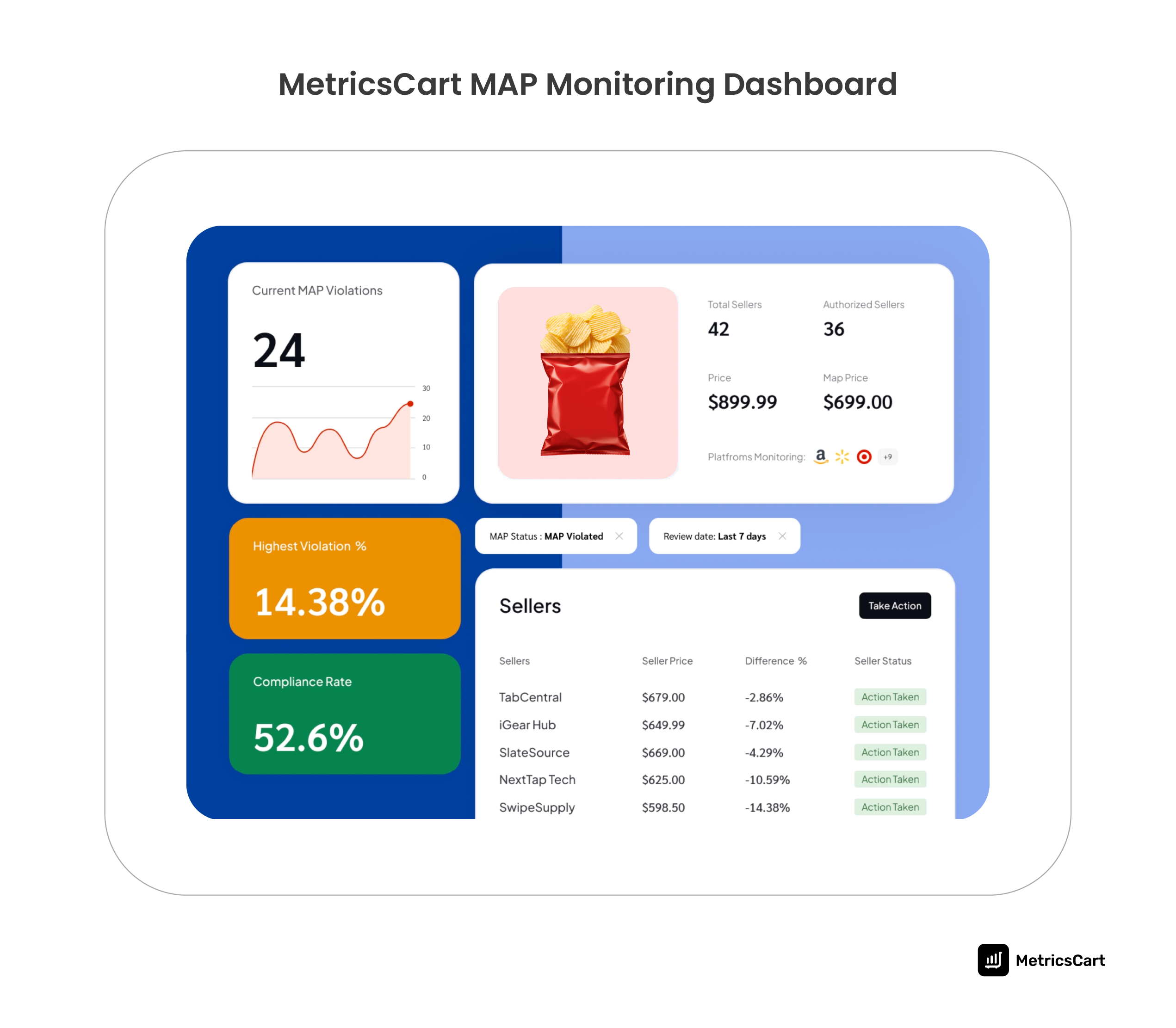
Unauthorized sellers keep finding new ways to break MAP pricing. The tactics evolve from cart-level discounts to coupon stacking to bundled offers that slip past basic monitoring tools. For brands managing hundreds of SKUs across multiple retailers, manually catching these violations is no longer feasible.
MetricsCart’s MAP monitoring and enforcement solution continuously tracks pricing across Amazon, Walmart, and other retail partners.
It flags violations as they occur, identifies the sellers responsible, and provides brands with the documentation they need to act. The platform also tracks seller count, Buy Box ownership, and pricing trends alongside MAP data, so brands can see how unauthorized seller activity connects to broader pricing erosion across their channels.
For brands that want to move from reacting to violations to preventing them, the combination of tighter policy language, controlled distribution, and real-time monitoring is what closes the gap.
The Floor Only Holds If You Watch It
Unauthorized sellers will continue finding creative ways to sell below MAP for as long as there are gaps in policy language, leaks in distribution, and delays in detection. The tactics will keep changing. See-price-in-cart will evolve into something new. Coupon stacking will get harder to trace. AI-driven repricing tools will move faster than any manual review.
The brands that hold their pricing do three things well: they write policies that leave no room for interpretation, they control who gets access to their inventory, and they monitor pricing across every channel in real time. Everything else is cleanup.
Stop Unauthorized Sellers Before They Rewrite Your Price Floor.
FAQs
Yes, you can remove them, but Amazon will not do it based on MAP violations alone. You need to enroll in Amazon Brand Registry, file IP claims using the “material difference” argument, and use serialization programs like Amazon Transparency to block unauthorized units from being received at Amazon’s warehouses.
Through Amazon Brand Registry. Once enrolled, you can report sellers through the “Report a Violation” tool by filing a trademark or IP infringement claim. The material difference approach, in which the unauthorized product lacks your warranty, packaging, or customer support, is the most effective path to removal.
Yes. MAP only governs the publicly advertised price. Sellers can legally sell below MAP as long as the lower price is not publicly displayed. This includes cart-only discounts, coupon codes at checkout, and loyalty program pricing. This is why tightening your MAP policy language to cover pre-transaction pricing is critical.
Automated, continuous monitoring. Manual spot checks miss cart-level, coupon-based, and membership-based violations because they change by the hour. Real-time monitoring tools that track pricing beyond the product page across multiple retailers give brands the speed needed to catch and act on violations before they spread.
The biggest risk is crossing into vertical price fixing, which violates U.S. antitrust law under the Sherman Act. MAP policies must remain unilateral, meaning the brand sets the terms independently. Any negotiation, threat, or agreement with retailers regarding pricing can turn a legal MAP policy into an illegal price-fixing arrangement.