Highlights
- MAP monitoring tracks whether a seller’s advertised price for a product stays at or above the floor a brand has agreed to with its retailers, while competitor price tracking monitors what other sellers charge across the wider market.
- Competitor price tracking operates across three layers: direct competitor pricing, cross-retailer price gaps on a brand’s own listings, and marketplace-specific pricing differences across platforms such as Amazon, Walmart, and Target.
- The listed price alone does not show the real cost to a shopper; effective price includes shipping fees, coupons, bundle discounts, financing options, and seller-level pricing differences.
- MAP monitoring identifies unauthorized sellers by matching seller names against a brand’s approved list and flagging sellers who price below MAP, since they have no obligation to follow the brand’s policy.
- The same infrastructure that detects a MAP violation already collects competitor prices, seller identities, and price history, which is why MAP monitoring can double as a price-tracking tool.
Ask a pricing team how competitors are pricing this week, and they’ll have an answer ready. Ask the same team whether their own resellers are still following MAP, and the room tends to go quiet
That is the real problem. Competitor price tracking tells you where you stand in the market. MAP monitoring tells you whether your own pricing is actually holding up behind the scenes. Most brands watch only one of these closely, which is a costly habit. Pricing precision matters more than most teams assume; a 1% price increase translates into an 8.7% lift in operating profit on average, assuming no loss in volume.
This guide walks through what competitor price tracking involves, where MAP monitoring fits in, and how MetricsCart’s MAP monitoring and enforcement platform brings both views together in real time.
MAP monitoring tracks online product advertisements across e-commerce channels to detect retailer pricing that falls below a manufacturer’s specified Minimum Advertised Price floor.
What Is Competitor Price Tracking?
Competitor price tracking is the continuous process of monitoring, collecting, and analyzing real-time pricing data from rival brands and retailers to optimize your own pricing strategy, defend profit margins, and maintain market share. It sounds straightforward. In practice, it means monitoring hundreds or thousands of SKUs across dozens of sites, with updates multiple times a day.
For most CPG and consumer brands, it works across three layers.
Direct Competitor Pricing
Direct competitor price tracking involves monitoring the prices of products that compete directly with your own. These are products with similar features, target customers, and use cases. For example, if you sell a premium protein powder, you would track the prices of other premium protein powders from competing brands.
This type of tracking helps brands decide whether to match a competitor’s price, maintain a premium position, or adjust promotions in response to changes.
Category Price Tracking
Category price tracking focuses on the broader pricing trends within an entire product category rather than on a few direct competitors. Instead of monitoring only specific brands, it analyzes the pricing distribution across all relevant products in a category.
For instance, a coffee brand may track the average price range of ground coffee, whole beans, and single-serve pods across multiple retailers. This provides insights into market pricing trends, seasonal fluctuations, and category-wide discounting, helping brands position their products competitively while protecting profitability.
Marketplace Price Tracking
Marketplace price tracking monitors product pricing across online marketplaces such as Amazon, Walmart, Target, and other e-commerce platforms. Unlike direct competitor tracking, it examines seller-level activity, including Buy Box ownership, promotional discounts, third-party seller pricing, and unauthorized sellers.
Since prices on marketplaces can change multiple times a day due to automated repricing tools, this type of tracking enables brands to detect pricing violations, identify unauthorized sellers, monitor competitor strategies, and respond quickly to changes that could impact sales, margins, or brand perception.
The goal across all three is not to chase the lowest price on the market. It is to understand the competitive landscape well enough to price with confidence and avoid getting blindsided by a rival’s sudden discount.
What Pricing Data Should Brands Track Beyond the Listed Price?
The sticker price is the easiest number to see, and often the least useful one on its own. Two products can carry the same listed price and still leave a shopper paying very different amounts. Brands that want the full picture should track:
- Shipping and delivery fees, which change the effective price without touching the headline number.
- Coupons, promo codes, and instant rebates applied at checkout.
- Bundle and multipack pricing, since a “buy two, save 15%” offer can undercut a single-unit price by more than it appears to on the surface.
- Buy Now, Pay Later and financing options that shift how affordable a product feels, even when the price stays the same.
- Seller-level pricing, since the same listing can carry different prices depending on which seller currently holds it.
- Historical price trends, which show whether a competitor’s low price is a lasting shift or a short-term promotion.
A product priced five dollars higher, with free shipping and a two-day delivery guarantee, can outsell a cheaper listing that adds a nine-dollar shipping charge at checkout. Effective price, not the listed price, usually determines the sale.
What Most Brands Track vs What They Should Track
| Most Brands Track | What They Miss |
| Listed price on the product page | Effective price after coupons, Subscribe & Save, and loyalty discounts |
| Competitor pricing at a single point in time | Promotional frequency and discount depth over weeks and months |
| Price across one or two retailers | Buy Box holder, seller count, and fulfillment method, which determine the price shoppers actually see and the conversion rate that follows |
The gap between what most brands track and what actually drives purchase decisions is where competitor price tracking breaks down. Filling that gap is where MAP monitoring comes in.

Why is MAP Monitoring Essential for Competitor Price Tracking?
Competitor price tracking tells you what prices exist in the market. MAP (Minimum Advertised Price) monitoring explains why those prices are changing and whether they represent legitimate competition or pricing violations. Without MAP monitoring, brands risk making pricing decisions based on distorted data.
Here are the key reasons why MAP monitoring is an essential part of competitor price tracking:
Helps Identify Misleading Pricing Signals
Not every low price reflects a competitor’s pricing strategy. In many cases, the price drop comes from an unauthorized seller or a retailer violating your MAP policy. If brands treat these violations as genuine market prices, they may unnecessarily lower their own prices, triggering avoidable price wars. MAP monitoring helps distinguish legitimate competitive pricing from policy violations, ensuring pricing decisions are based on accurate market intelligence.
Filters Out “Noise” and Identifies True Competitors
When you crawl a retailer’s site for competitor pricing, unauthorized third-party resellers or automated algorithmic pricing bots can create a race to the bottom. This results in a massive amount of pricing anomalies (outliers) that do not reflect the actual market positioning of your true competitor.
- Without MAP Monitoring: Your tracking software flags a competitor’s 30% price drop, signaling a threat. You might instinctively lower your price to match it.
- With MAP Monitoring: You realize the drop was caused by a rogue, unauthorized reseller violating that competitor’s MAP policy. Your actual competitor hasn’t changed their strategy at all, saving you from an unnecessary, margin-destroying price war.
Spotting Sellers Outside Your Network
Unauthorized sellers are one of the biggest sources of pricing disruption on online marketplaces. Since they often acquire inventory outside authorized distribution channels, they have little incentive to follow MAP policies.
Can MAP Monitoring Identify Unauthorized Sellers?
Yes. MAP monitoring platforms track every seller listing your products across marketplaces and retail websites. When a seller outside your authorized distribution network appears on a listing, the platform flags them.
This identification happens through seller name matching against your approved list, pricing behavior analysis (unauthorized sellers frequently price below MAP because they have no obligation to follow it), and tracking new sellers who appear on established product listings.
Identifying unauthorized sellers through MAP monitoring is critical for tracking competitors’ prices, as these sellers can distort your pricing data. If an unauthorized seller is advertising your product at $19.99 while your MAP is $29.99, any competitive analysis that uses $19.99 as your market price is wrong. Removing or addressing unauthorized sellers restores pricing accuracy and protects competitive positioning.
READ MORE| Grey Market Sellers: How They Operate, and Why Brands Should Care
Uncovers Your Competitors’ Supply Chain Vulnerabilities
Tracking a competitor’s price tells you what they are charging; tracking their MAP violations tells you how well they control their business.
Frequent MAP violations on a competitor’s product line generally point to two major weak spots:
- Leaky Distribution: They have poor control over their wholesale and distributor networks, allowing inventory to slip into the grey market.
- Excess Inventory: Distributors or retailers are sitting on too much stock and breaking MAP rules just to liquidate it.
By identifying these patterns, your sales and marketing teams can aggressively target those specific accounts or categories where the competitor is losing their grip.
It Provides Context for Competitive Pricing
A competitor’s lower price may seem like an aggressive pricing move, but the real reason could be unauthorized discounting, clearance inventory, or a temporary MAP violation. By combining competitor price tracking with MAP monitoring, brands gain the context needed to understand whether a price change reflects a strategic decision or an isolated compliance issue. This prevents unnecessary pricing reactions.
It Strengthens Pricing Strategy and Retail Relationships
Consistent MAP enforcement creates a healthier pricing environment for authorized retailers. Brands that actively monitor MAP can demonstrate to retail partners that they are protecting margins across the channel rather than allowing price undercutting. At the same time, competitor pricing data helps brands evaluate whether their own prices remain competitive. Together, these insights support smarter pricing decisions while maintaining retailer confidence and brand value.
READ MORE | MAP Monitoring as a Channel Strategy: Why It’s Core to Brand Profitability
How MetricsCart Brings Pricing Intelligence and MAP Compliance Together
Most pricing tools do one job well. They track competitor prices, or they monitor MAP compliance, rarely both. Brands end up switching between platforms just to get a full picture of pricing.
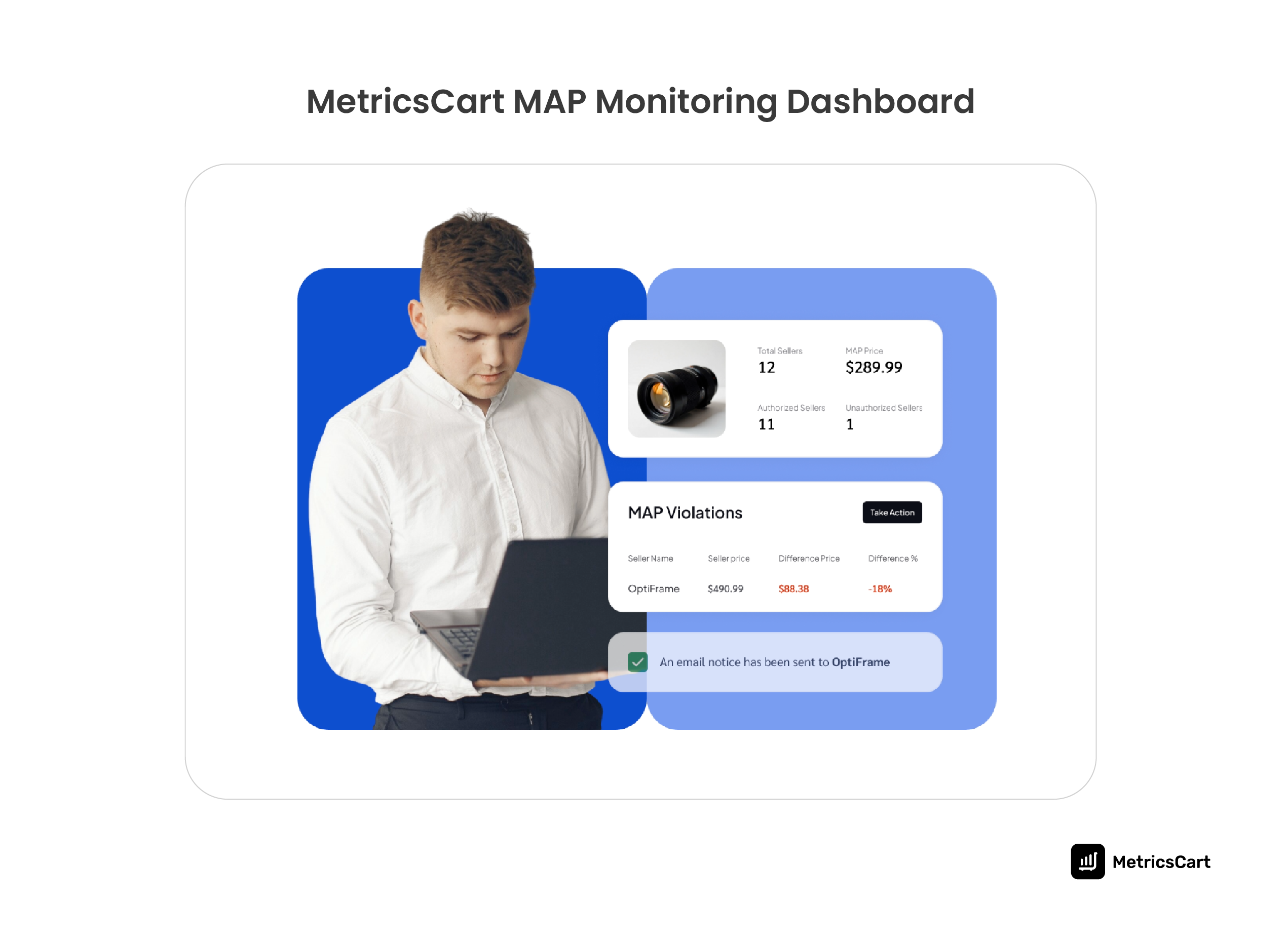
MetricsCart closes that gap. It tracks pricing at the SKU level across Amazon, Walmart, and other retail partners, covering listed price, seller identity, Buy Box ownership, and MAP compliance in one dashboard. When a violation occurs, it flags the seller and logs the evidence needed to take action.
Because pricing and compliance data live in one system, a brand can see how it’s priced relative to competitors and where MAP violations are quietly eroding its position, without having to stitch together spreadsheets.
Competitor price tracking and MAP monitoring are often treated as separate priorities, managed by different teams with different tools. That separation is where most pricing blind spots begin.
The brands that make better pricing decisions in 2026 are the ones that see both sides of the equation in a single view: how competitors price, how their own sellers price, and where the gaps between the two create risk.
Track competitor pricing and MAP compliance in one place with MetricsCart.
FAQs
MAP monitoring tracks whether retailers are advertising a product at or above the brand’s minimum advertised price (MAP). It matters because unchecked violations erode margins, create inconsistent pricing across retailers, and pressure other sellers to lower their prices as well.
MAP monitoring tools collect seller identities, listed prices, and price history to catch violations. That same data set shows how the broader market is priced, which is why MAP monitoring can also double as a competitor price-tracking tool.
MAP monitoring identifies unauthorized sellers by checking every seller on a listing against the brand’s approved seller list. Sellers outside that list, especially those pricing below MAP, are automatically flagged.
Unauthorized sellers typically source inventory through grey market or third-party channels rather than directly from the brand. Since they never agreed to the brand’s MAP policy, they have no obligation to follow it.
Brands selling through multiple retailers and marketplaces benefit most, particularly in beauty, baby products, pet care, and electronics. These categories attract more resellers, which increases the risk of MAP violations.