Highlights
- Amazon no longer just reacts to competitor prices. It sets them, scanning regional retailers, DTC promotions, and bundle pricing to close gaps before shoppers notice them.
- A lower price on a brand’s own DTC website can initiate a price alignment on Amazon within hours, pulling the entire listing into territory that violates the brand’s own MAP floor.
- Amazon’s pricing system evaluates the effective price, which is what a customer actually pays after coupons and discounts, not just the listed shelf price.
- When Amazon adjusts its price on a high-volume SKU, third-party sellers reprice to protect their Buy Box share. What starts as a single retailer’s discount becomes a category-wide pricing shift that no individual seller chose.
- Brands that only monitor Amazon miss where the pricing pressure starts. By the time a competitor’s discount appears on Amazon, it has already moved through regional sellers, DTC channels, and third-party listings.
- Price consistency across retailers is not just good practice. Amazon actively uses it as a signal to determine Buy Box eligibility and listing visibility. A pricing gap elsewhere can quietly cost a brand its placement on the platform.
- Structured competitor price monitoring is not about watching what competitors charge. It is about understanding which price signals Amazon is already watching and getting there first.
A MAP policy without enforcement is just another promise no one is keeping.
53% of unauthorized retailers violate MAP policies. On Amazon, where 1.9 million sellers compete for the same listings, one violation is all it takes. The Buy Box moves to the seller who undercut your floor, your ad budget keeps pouring money into that same listing, and every click you paid for lands on an offer you never signed off on.
The part that keeps brand teams up at night? It all plays out while the numbers on your dashboard still look fine.
Amazon has made its stance clear; MAP is your agreement, not theirs. The platform will not track it, flag it, or lift a finger to fix it. So the only thing standing between your pricing and a slow, quiet erosion is how fast you can spot a violation and act on it.
This guide covers what Amazon MAP enforcement actually involves, what causes violations, how they spread, and how to build an enforcement workflow that catches them before the repricing cascade does the damage.
READ MORE | Confused about selecting the right MAP monitoring software? Check out the best MAP monitoring software you should consider for e-commerce
What is Amazon MAP Enforcement and Why is it Essential?
Amazon MAP enforcement is the process of identifying, documenting, and addressing MAP violations across Amazon listings. It is not the same as having a MAP policy. A policy sets the rules. Enforcement makes sure they are followed and takes action when they are not.
On Amazon, enforcement differs from that in other sales channels. Prices move faster, more sellers compete on the same listing, and the platform itself does not support enforcement in any form. Without a proper enforcement workflow, violations are not found, evidence goes uncollected, and the window to act closes before it ever opens.
What Is a Minimum Advertised Price (MAP) Policy?
A minimum advertised price policy is a brand’s written agreement with its resellers. It sets the lowest price at which a product can be publicly advertised. It controls the advertised price, not the selling price.
A reseller can close a deal below MAP in private, but they cannot display a price below the floor on product pages, in search results, in ads, or in promotional emails.
MAP controls what a reseller displays. MSRP is just a suggestion; resellers can ignore it entirely. UPP goes furthest, controlling the actual transaction price, not just what’s advertised. Most brands write MAP policies but unknowingly enforce them as UPPs, exerting control over the final sale price rather than just the listed price. That distinction is the line between a defensible pricing policy and antitrust exposure.
In the US, MAP policies are set unilaterally by the brand and applied consistently across all resellers. They follow principles established under the Colgate Doctrine, which allows manufacturers to define the terms under which they do business with resellers without entering into price-fixing agreements.
READ MORE | Want to make sure your MAP policy holds up? Check out MAP Policy Enforcement for Brands: Avoid These 10 Common Mistakes
Does Amazon Enforce MAP Policies?
Does Amazon enforce MAP pricing? No. Amazon does not recognize, monitor, or enforce MAP policies. This is not a gap in their system. It is how the platform is built.
Amazon runs on a simple loop: lower prices bring more customers, more customers bring more sellers, more sellers bring more competition, and more competition brings lower prices. Your MAP policy sits outside that loop. Amazon considers it a private matter between you and your resellers, and has said so publicly. Its own guidelines are clear: violations of distribution agreements do not count as intellectual property infringement.
In practical terms, Seller Central has no MAP alert, no price-based takedown mechanism, and no way to report a seller for pricing below your floor. Amazon will not remove a listing because someone broke your distribution agreement. Their position is clear: that is your agreement, not theirs.
But Amazon does not just stay neutral. Its systems actively make violations worse. When a seller drops below MAP, Amazon’s repricing engine interprets it as a new competitive signal. Third-party repricing tools on other sellers detect it and follow.
If Amazon carries the product through its own retail channel, it may match the lower price as well. What starts as one seller’s pricing decision becomes a listing-wide price drop, often within hours.

As Michael shared on Episode 40 of the Digital Shelf Insider, the policy itself is not the problem. The problem is whether you can identify who is breaking it and act fast enough to stop the damage from spreading.
Watch the full episode here:
What Causes Amazon MAP Violations?
MAP violations on Amazon do not come from one source. They follow patterns, and understanding those patterns is what makes enforcement easier and more strategic.
Unauthorized Sellers (Gray Market and Distribution Leakage)
These are the most persistent sources of MAP violations on Amazon. Unauthorized sellers acquire your product through liquidation channels, gray-market sourcing, or wholesale leakage, and they list it at prices well below your MAP floor because their acquisition cost allows them to profit even at those prices.
They never signed your MAP agreement. They have no incentive to follow it. And they frequently rotate storefront names, making manual tracking nearly impossible.
Repricing Software and Automated Price Wars
One seller drops below MAP. Every other repricing tool on the listing picks up the lower price and adjusts to match or beat it. Within hours, the price floor your MAP policy set has been replaced by one no human chose.
What makes this especially damaging on Amazon is that repricing tools often operate at the account level rather than the product level. A single MAP violation on a top-selling product can drag pricing down on other products in the same seller’s catalog that were never directly violated.
Coupons, Subscribe & Save, and Bundled Pricing
Not every violation shows up in the listed shelf price. The most commonly missed violations on Amazon hide behind:
Coupon-adjusted pricing. Sellers attach digital coupons independently. A listing priced at MAP with a 15% coupon is a violation at checkout, not on the product page. Most enforcement workflows never see it.
Subscribe & Save discounts. Amazon’s subscription program automatically applies a 5-15% discount to recurring orders. A seller sitting exactly at your MAP floor is breaching it on every subscription order.
Bundle per-unit pricing. Any seller can create a bundle on Amazon without brand approval. If the per-unit price within that bundle falls below MAP, it does not appear in ASIN-level monitoring because the bundle has a different ASIN.
If your enforcement only monitors the shelf price, these violations will continue without triggering a single alert.
Distribution Chain Leakage
This is the root cause behind most unauthorized seller activity. A brand sells to a regional distributor. That distributor sells to a smaller wholesaler. That wholesaler sells to an Amazon reseller. By the time a MAP violation is flagged, the product has passed through multiple hands, and the brand has no direct relationship with the end seller.
Liquidation adds another layer. When brands sell excess inventory to recover value on overstock, that inventory often reaches bulk buyers who list it on Amazon at prices well below MAP because they acquired it at a fraction of wholesale cost.
Enforcement that targets only the seller on Amazon, without tracing the supply chain, is always reactive. The same inventory keeps showing up under different names.
The Real Cost of Ignoring Amazon MAP Violations for Brands and Marketplaces
MAP violations on Amazon do not stay contained. They compound across your brand, your reseller network, your ad performance, and your pricing power on every other channel.
Buy Box Loss and Ad Spend Waste
The Buy Box carries over 82% of Amazon purchases. When a below-MAP seller wins it, your Sponsored Products campaigns keep spending, but the clicks land on their offer rather than yours. Campaigns are tied to the ASIN, not to who holds the Buy Box. Your budget burns while your return drops, and nothing in the ad dashboard tells you a MAP violation is the cause.
Brand Value Erosion Across Channels
When customers keep seeing your product below MAP on Amazon, the lower price becomes the real price in their minds. That expectation follows your brand to your DTC site, to retail partners, and into distributor negotiations. One channel’s pricing problem quietly becomes every channel’s.
Reseller Network Breakdown
The sellers you lose first are not the ones breaking rules. They are the ones following them. When compliant resellers see unauthorized sellers undercutting MAP with no consequences, some stop reordering. Others start violating MAP themselves. The trust erodes slowly. Rebuilding it costs far more than catching the violation would have.

Amazon MAP Enforcement Framework (5-Step Process)
Having a MAP policy is one thing. Enforcing it on Amazon is another. Here is a five-step framework that covers the full process of detection, documentation, and enforcement.
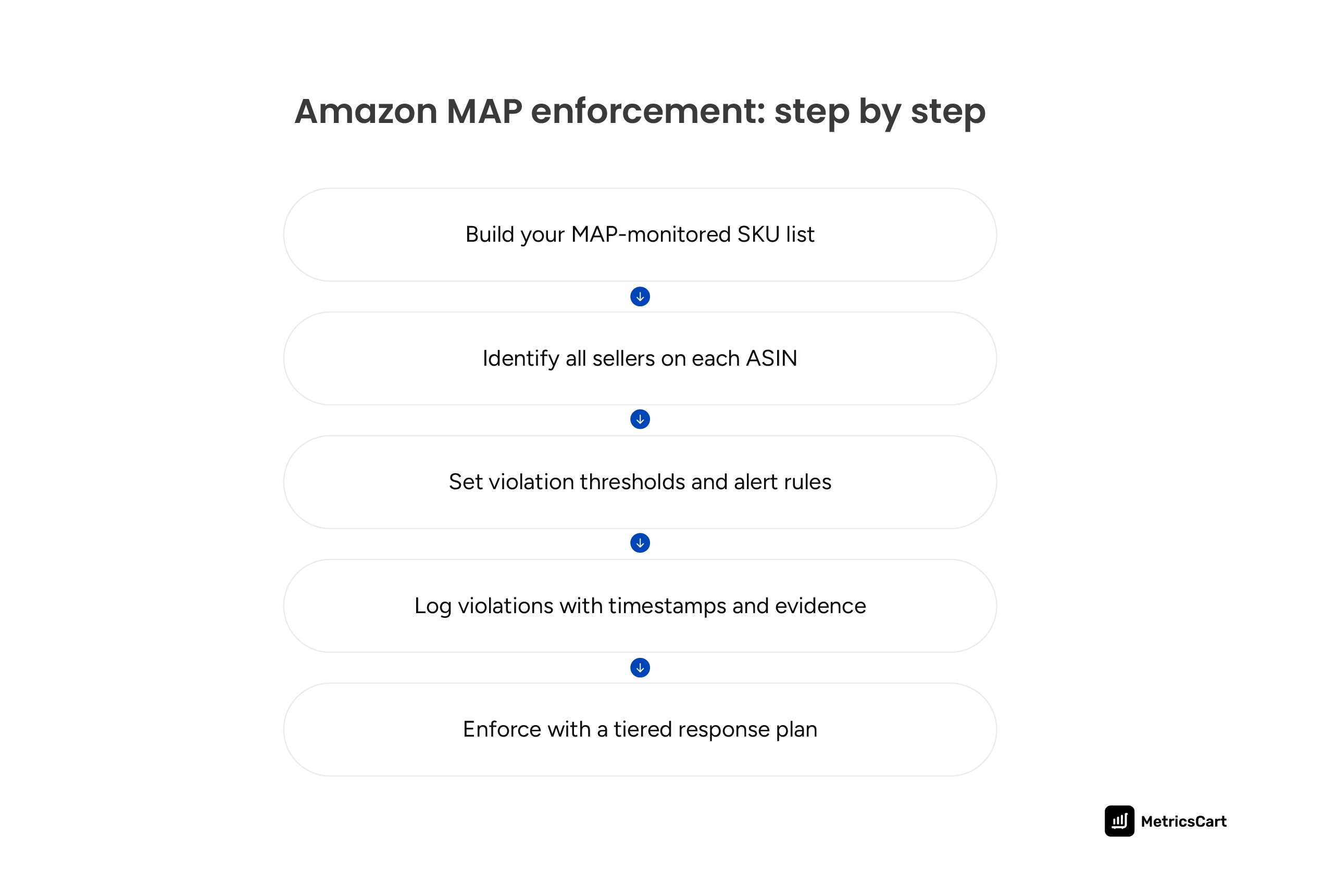
Step 1 — Build Your Enforcement-Ready SKU List
Prioritize high-revenue ASINs and products with the most visibility on Amazon. These carry the highest violation risk. Go deeper into variants. A seller undercutting on a specific size, color, or bundle is still a violation even if the parent listing looks compliant. Define a MAP price floor for each variant. Calculate per-unit cost for bundles and multipacks.
Step 2 — Identify Every Seller on Every ASIN
Map every seller active on each listing using automated tools. Do not rely on your reseller list alone. Sellers acquire inventory through gray-market channels, liquidation, and wholesale diversion under names your team will not recognize. A MAP monitoring solution cross-references seller IDs against your authorized list and flags the ones that do not belong. Catching the name is half the job. Tracing how they got your product is the other half.
Step 3 — Set Detection Thresholds and Automated Alerts
Define what counts as a violation. Any price below MAP, or only past a certain percentage? How long before an alert fires? Go beyond the shelf price. Account for coupon-adjusted pricing, Subscribe & Save discounts, and bundle per-unit calculations. If your alerts only monitor the listed price, the violations that matter most go undetected.
Step 4 — Capture Timestamped Evidence
Every violation needs a complete record: seller ID, ASIN, listed price, effective price (what the customer actually pays), timestamp, and a screenshot. Automated capture is critical. Transient violations, where a seller drops below MAP for a few hours and then corrects, are the hardest to catch manually and the easiest to deny. A violation history also helps identify repeat offenders and makes it easier to justify escalation.
Step 5 — Execute Tiered Enforcement Actions
First violation: formal notice with full evidence. Repeat: written warning with clear consequences. Persistent: supply suspension, contract termination, or MAP enforcement escalation. When a pricing breach overlaps with IP misuse, Amazon Brand Registry provides a direct reporting channel through the Report a Violation portal. It will not act on price alone, but an IP angle changes that
The five steps above give you the framework. But every brand’s catalog, seller network, and enforcement reality is different.
The MAP Monitoring Masterclass goes deeper into how brands apply these steps across Amazon and other platforms, covering real enforcement scenarios, common mistakes in threshold setting, and how teams handle repeat offenders without burning reseller relationships.
What to Look for in an Amazon MAP Enforcement Platform
Not all MAP enforcement tools are built the same. Some scan once a day and call it real-time. Others track the shelf price but miss coupons, subscriptions, and bundle pricing entirely. Before evaluating any map enforcement platform, brands should understand exactly what the difference between a monitoring tool and a monitoring system.
At a minimum, look for a scan frequency of at least once per day. If your products sell across Amazon US and Canada, multi-marketplace coverage matters too.
How MetricsCart Helps Brands Enforce Minimum Advertised Pricing Violations on Amazon?
Here is how MetricsCart approaches Amazon MAP enforcement, mapped against the criteria above.
Real-Time Violation Detection
Brands stop finding out about violations after the repricing cascade has already spread. MetricsCart continuously monitors Amazon and 150+ retail sites, sending automated alerts the moment a seller drops below your MAP floor.
READ MORE | Check out Why MetricsCart Is the Best MAP Monitoring and Enforcement Software for Brands in 2026
Unauthorized Seller Identification
Chasing anonymous listings wastes enforcement time. Every seller on every listing is automatically mapped against your authorized reseller list, so your team knows exactly who to go after and can skip the guesswork.
Evidence That Holds Up
Violations that cannot be proven cannot be enforced. Every breach is logged with the seller’s details, the effective price, timestamps, and screenshots. Reports are organized around your catalog, not a generic template, and are exportable for internal reviews or external enforcement action.
Enforcement Workflow Built In
Knowing about a violation and acting on it are two different things. MetricsCart’s tiered escalation workflow comes with pre-built templates for first notices, formal warnings, and supply suspension. Your team moves from detection to action without having to rebuild the process each time.
Content Compliance Alongside Pricing
Pricing violations and content violations, such as wrong images, unauthorized descriptions, and incorrect titles, usually come from the same unauthorized sellers. Monitoring both together gives your enforcement a stronger position and a cleaner digital shelf.
See how this works in practice.
A kitchen electronics brand used MetricsCart to eliminate 65% of MAP violations and protect $1.2M in brand value. Read the full case study.
Content Compliance and Digital Shelf Visibility. For brands that want complete control of how their products appear on Amazon, MetricsCart’s MAP enforcement works alongside content compliance monitoring. Pricing and content violations, such as incorrect images, unauthorized product descriptions, or wrong titles, often come from the same unauthorized sellers. Monitoring both together gives brands a stronger position in enforcement.
Give your enforcement the same speed as the repricing tools working against it.
FAQs
It is the process of detecting, documenting, and acting on MAP violations across Amazon listings. Amazon does not enforce MAP, so brands must monitor pricing, identify sellers who violate it, capture evidence, and take enforcement action themselves.
No. Amazon does not recognize, monitor, or enforce MAP policies. Enforcement is entirely the brand’s responsibility. Amazon’s platform prioritizes competitive pricing for customers, and MAP agreements between brands and resellers fall outside Amazon’s enforcement scope.
Four primary sources: unauthorized sellers who acquire inventory through gray-market or liquidation channels; automated repricing tools that cascade a single violation across the listing; hidden violations through coupons, Subscribe & Save, and bundle pricing; and distribution chain leakage, where inventory reaches Amazon through uncontrolled resale channels.
A five-step framework: build your enforcement-ready SKU list with per-variant MAP floors, identify every seller on every ASIN, set detection thresholds that cover effective price beyond the shelf price, capture timestamped evidence automatically, and execute tiered enforcement from formal notices through supply suspension.
By catching violations before repricing cascades spread them, identifying who is responsible, and providing the evidence to act. Without enforcement, one violation can trigger a listing-wide repricing reset that persists for weeks, eroding margins, wasting ad spend, and driving compliant resellers away from the brand.
Yes, and more. MetricsCart delivers everything a dedicated MAP enforcement platform does: continuous violation detection, seller tracking, automated alerts, and enforcement workflows. It also combines MAP enforcement with deeper pricing intelligence, seller analytics, and digital shelf visibility across 150+ retailers, so teams can identify violations, understand who is behind them, how they spread, and their impact on margins.