Highlights
- Health and beauty brands lose brand value faster than most categories when MAP is violated because price directly signals product quality and authenticity to consumers.
- A MAP violation on one platform quickly spreads to others as authorized retailers reprice to stay competitive, making multi-channel monitoring essential.
- Specialty and pharmacy platforms like Sephora, Ulta, CVS, and Walgreens need to be monitored with the same priority as Amazon and Walmart for health and beauty brands.
- Grey market sellers are the hardest MAP violators to catch in health and beauty, and the most damaging because they operate entirely outside authorized distribution.
- MAP enforcement in health and beauty requires pattern detection across sellers and SKUs, not just individual violation alerts, to identify the root cause before it scales.
- Premium beauty brands need legal-ready audit trails built into their MAP platform because chronic violations frequently escalate beyond notices into formal legal proceedings.
When a consumer finds a premium skincare product listed well below its usual price by an unfamiliar seller, their first reaction is rarely “great deal.” More often, it is “is this real?” That instinct is what sets health and beauty apart from almost every other consumer category.
In electronics or home goods, lower prices attract buyers. In beauty and wellness, it raises doubt about whether the product is genuine, properly stored, or worth what it claims to be.
MAP monitoring software for beauty brands exists for a simple reason. Most brands have no idea how many violations are actually happening on their listings. According to i2o Retail, only about 30% get caught. The remaining 70% keeps chipping away at prices, retailer trust, and brand value without anyone stepping in.
When you consider that the global beauty and personal care market is worth $698 billion, even a small share of unchecked violations adds up to serious damage. Here is what health and beauty brands need to know about MAP risks and how to stay ahead of them.
Why Is a MAP Monitoring Software Important for Beauty and Health Brands?
Health and beauty brands need MAP monitoring because their consumers do something shoppers in most other categories do not: they treat a lower price as a reason to doubt the product, not a reason to buy it.
The core issue is consumer psychology. Research from Salsify’s 2025 Consumer Research Report found that 87% of shoppers are willing to pay more for a brand they trust. In most consumer categories, that trust is built through product performance, customer service, and brand reputation. In health and beauty, consistency in pricing is also important.
The reason is rooted in how consumers evaluate products in this market. A $75 vitamin C serum carries a promise: its formulation, clinical testing, and ingredient quality justify the price.
When that same serum appears on a third-party marketplace listing at a 40% discount, the consumer’s first instinct is not to buy it. It is worth questioning whether the product is genuine, whether it has been stored correctly, or whether the brand is in decline. In beauty and wellness, discounting does not drive conversion the way it does in other categories. It undermines it.
This is what makes MAP policy for brand protection essential for health and beauty brands, not something to deal with later. The policy does not just protect the margin. It protects the perception of quality that enables the margin.
READ MORE | MAP Policy Compliance: A Complete Guide (2026)
Why Health and Beauty Brands Face Higher MAP Risk Than Other Categories
- Price signals quality. Consumers in this category judge a product’s effectiveness by its cost. A steep discount does not attract buyers, but raises doubt.
- Wide retail distribution. A single brand may sell through Amazon, Walmart, Sephora, Ulta, Target, CVS, Walgreens, international marketplaces, and DTC channels. Each partner invests in the brand’s positioning through shelf space, promotions, and trained staff. That investment depends on the brand maintaining consistent pricing. When unauthorized sellers break that consistency, the partnership starts to erode.
- Large, complex catalogs. Health and beauty brands routinely manage hundreds or thousands of SKUs, with seasonal launches, limited editions, and regional pricing variations. Monitoring all of that manually across every channel is not realistic.
- Grey market and unauthorized seller activity. Products sourced from lower-priced international markets are frequently resold domestically below MAP, resulting in violations that are hard to detect without automated tools.
Tracking MAP monitoring and enforcement across all of these products and channels through manual processes is not feasible. At this scale, there is no way to keep up without automated monitoring.
What Happens When a MAP Violation Goes Unchecked
A single MAP violation on a beauty or health product never stays small for long. What starts as one unauthorized seller listing your serum or supplement below MAP on Amazon sets off a chain reaction most brands do not see coming.
How it spreads: Most sellers on Amazon and Walmart use automated repricing tools built to win the Buy Box. Price is one of the fastest ways to get there. So when one seller drops below MAP, these tools pick up the lower price and match it within hours. By the time your team spots the first violation, there could be five more.
Who gets affected: Your authorized sellers, the ones following your MAP policy, are now the highest-priced option on the page. They either hold and lose sales or drop their price and become part of the problem. At the same time, retail partners like Sephora, Ulta, and pharmacy chains see the same product available online for less than what they charge in-store. Some ask questions. Others just cut their next order.
What happens when nobody acts: Every day a violation stays live without consequences, it tells the rest of the market that your brand does not enforce its pricing. New unauthorized sellers show up. Grey market inventory starts moving. The average selling price continues to drift further from MAP. For popular beauty and health products, this entire sequence can unfold in weeks.
READ MORE | How to Do Amazon MAP Monitoring to Protect Your Brand: 6 Steps
What Do MAP Violations Look Like in Health and Beauty?
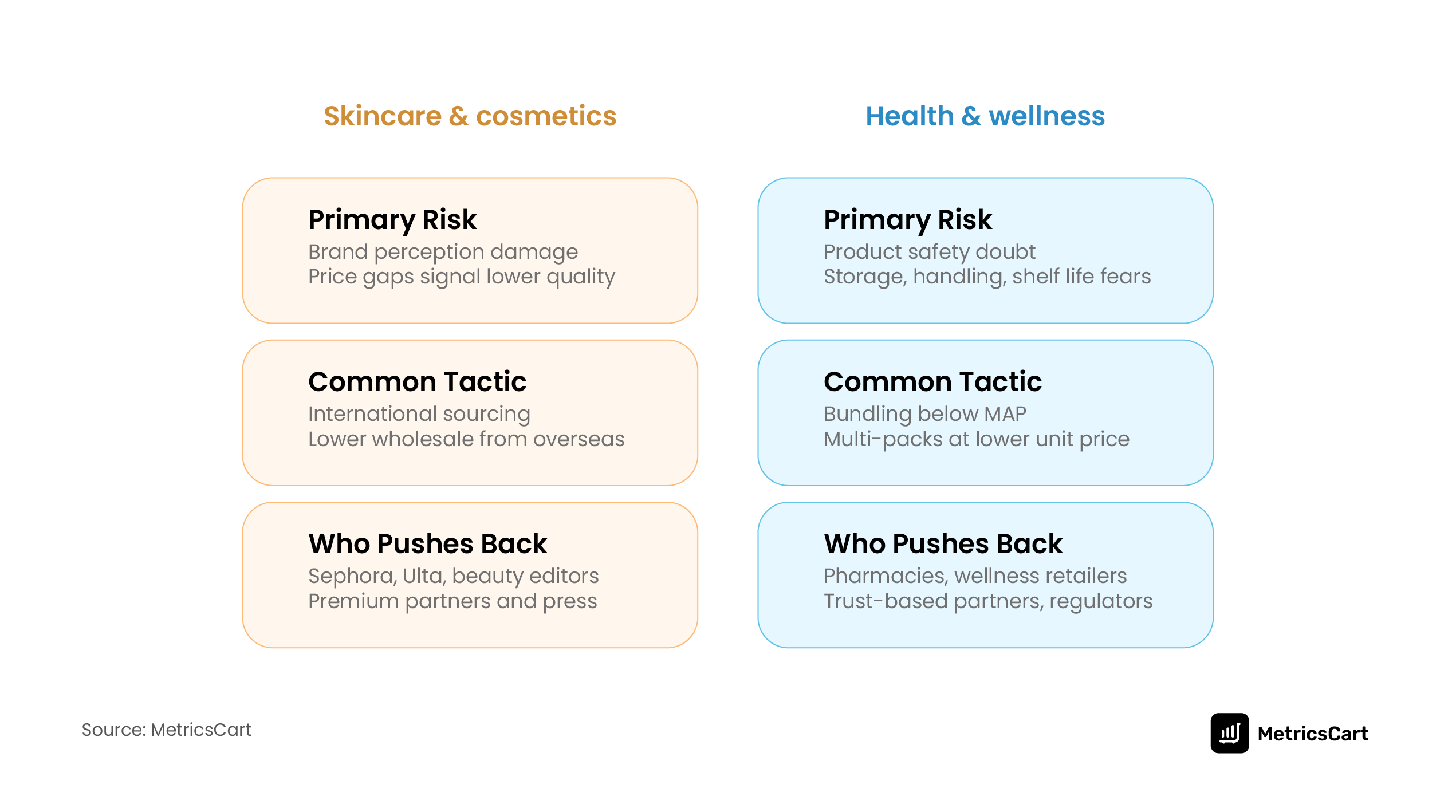
MAP violations show up differently in beauty and health. The products are different, the buyer concerns are different, and the kind of damage each violation causes is different. Understanding these patterns helps brands know what to watch for.
How MAP Violations Affect Skincare and Cosmetics Brands
In beauty, MAP violations typically start with unauthorized sellers listing prestige products on Amazon or eBay at 25% to 40% below MAP. These sellers often source inventory from international distributors who sell at lower regional wholesale prices.
The products may be genuine, but the listings often differ from the brand’s official assets, leading consumers to question authenticity. Amazon Q&A threads and review sections fill up with “is this real?” posts, and that doubt spreads about whether the product is legitimate.
A prestige retinol serum with an $85 MAP showing up at $52 from unfamiliar sellers creates a visible pricing gap between Sephora’s in-store price and the price that appears on Amazon. That inconsistency reaches retail partners, beauty editors, and influencers. Coverage and partnerships that depend on premium credibility become harder to maintain.
Where beauty brands feel MAP violations most:
- Consumer trust is lost due to questions about authenticity in product listings and review sections.
- Retail partners like Sephora and Ulta push back on pricing inconsistencies between in-store and online.
- Editorial and influencer coverage becomes harder to secure when the product’s premium image is in question.
How MAP Violations Affect Health and Wellness Brands
Health and wellness violations follow a different pattern. The most common tactic is bundling, where a grey market seller buys inventory in bulk and lists it on Walmart Marketplace or Amazon at a per-unit price well below MAP. A probiotic supplement with a $44 MAP might appear in a two-pack for $68, putting the effective unit price at $34.
The consumer concern here is about product safety, not brand image. Supplements, probiotics, and vitamins are sensitive to storage conditions, temperature, and shelf life. A steep discount from an unfamiliar seller raises immediate questions about whether the product has been handled and stored correctly.
Pharmacy chains and wellness retailers take this seriously. When they see the same product available for 22% less from an unknown online seller, they reconsider their shelf space, staff training, and order volumes.
There is also a regulatory layer that beauty brands do not face in the same way. Health products sold through unauthorized channels with unknown handling histories can create liability exposure if a consumer reports an adverse reaction.
Where health and wellness brands feel MAP violations most:
- Product safety concerns arise when consumers question the storage, handling, and shelf life of discounted products.
- Pharmacy and wellness retail partners reduce orders or exit the relationship when they cannot compete with unauthorized online pricing.
- Regulatory and liability risk increases when products move through channels the brand cannot verify or control.
What to Look for in MAP Monitoring Software for Health and Beauty Brands
The complexity of this category places specific demands on MAP monitoring software that go beyond what a general-purpose tool can deliver. Broad marketplace coverage, deep SKU-level visibility, and a tight connection between detection and enforcement are the three capabilities that separate effective solutions from inadequate ones.
Multi-Channel Coverage That Includes Specialty and Pharmacy Retail
MAP software for health and beauty needs to monitor specialty and pharmacy platforms with the same depth it covers Amazon and Walmart. Sephora, Ulta, CVS, Walgreens, iHerb, and regional pharmacy e-tailers are not secondary channels in this category. They are where a significant share of brand positioning happens.
Gaps in platform coverage are not just blind spots. Authorized retailers watch each other’s prices, and a violation that goes undetected on one platform is enough to start a pricing shift across others.
Cross-Border Seller Detection
Grey market activity in health and beauty is heavily cross-border. Products sourced from the UK or Southeast Asia at lower wholesale prices are regularly relisted in the US below MAP by sellers who do not appear on any authorized reseller list.
A tool that limits seller identification to domestic listings will miss this category of violator entirely. The software needs to match listings to your product catalog across regions and surface unauthorized sellers regardless of where they operate.
SKU-Level Segmentation With Different Thresholds Per Product Line
Health and beauty catalogs are not uniform in terms of pricing risk. A $150 prestige serum and a $15 face wash sit at opposite ends of the brand sensitivity spectrum, and a MAP violation on each carries a very different consequence.
A MAP monitoring software that applies a single monitoring rule across the entire catalog fails in both directions. It either generates noise on low-risk products or misses the violations that directly damage brand equity on high-value lines. The tool needs to support different thresholds by product line, price tier, and retailer type.
Violation Data That Shows Patterns, Not Just Individual Incidents
A one-time violation from an unfamiliar seller is a routine enforcement case. A pattern of the same seller undercutting across multiple SKUs over several weeks is a distribution problem that requires an entirely different response.
The software needs to connect violation data across products, sellers, and time so that structural problems become visible before they scale. Without that pattern-level view, enforcement stays reactive, and the root cause goes unaddressed.
Enforcement Built Into the Platform
In health and beauty, the window between detection and action is narrow. Automated repricing tools on Amazon and similar platforms can spread a single violation across dozens of seller accounts within hours.
Software that identifies violations but hands enforcement off to a separate system loses that window. The MAP monitoring and enforcement solution needs to send notices, track responses, escalate unresolved cases, and automatically log every interaction, all within the same system where the violation was detected.
Legal-Ready Audit Trails
Chronic MAP violations in health and beauty frequently move beyond notices into formal legal proceedings. At that point, a violation history assembled from screenshots and email threads is neither complete nor usable.
The software needs to produce exportable records that include the seller’s identity, listed price, platform, and timestamp, in a format ready for legal or compliance use without additional preparation. For brands with premium positioning, this is a core enforcement requirement, not an optional reporting feature.
How does MetricsCart Monitoring and Enforcement Software Work for Health and Beauty Brands?
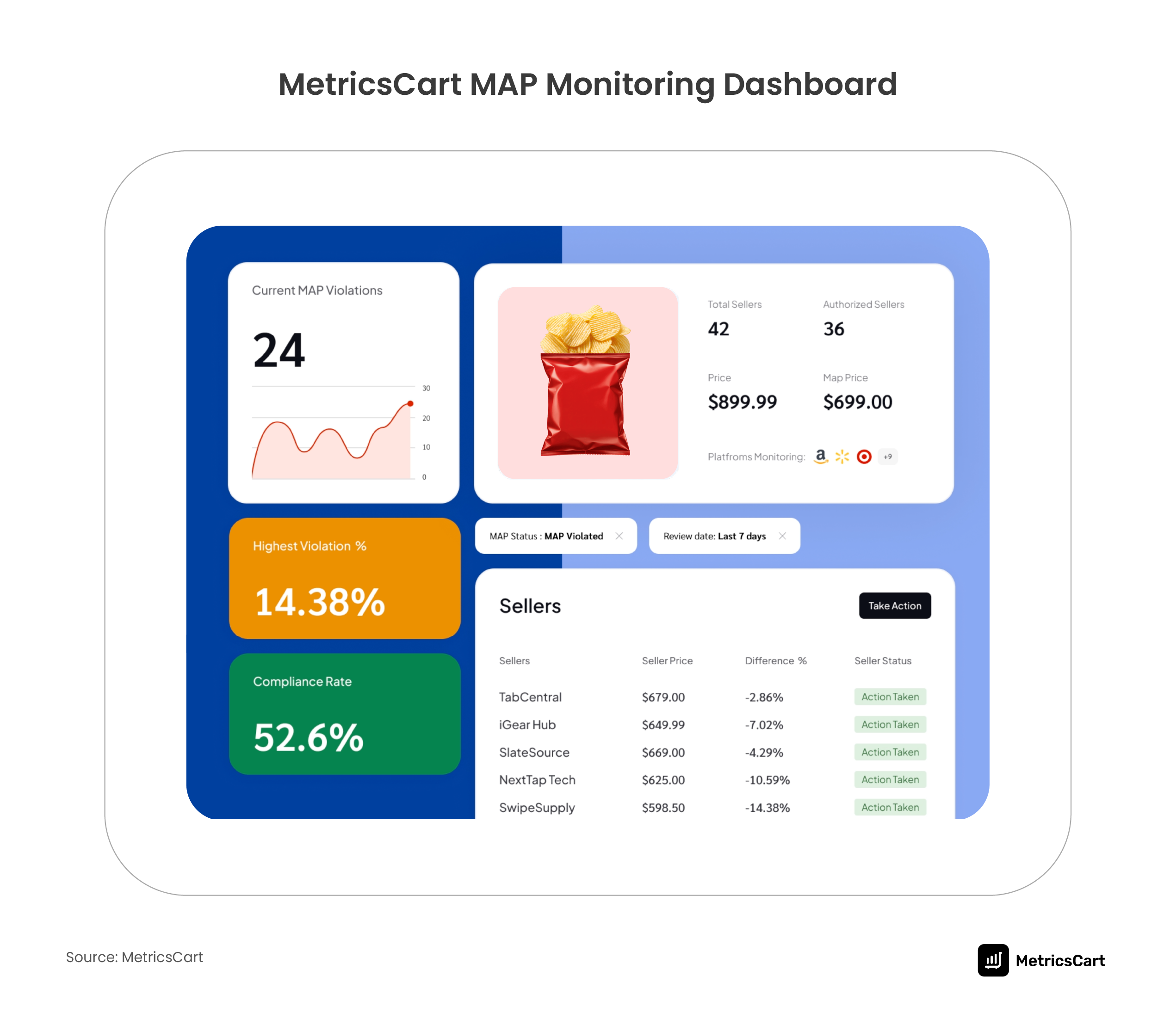
Health and beauty is a category where brand positioning and pricing integrity are inseparable. The number of sellers, the presence of grey-market supply, and the speed at which a single price drop spreads across retail accounts make MAP enforcement uniquely demanding here.
MetricsCart is built for exactly that. The platform monitors 150+ retailers, identifies the seller behind every violation, and routes enforcement-ready evidence directly to your compliance or legal team, covering everything from major marketplaces to specialty beauty and pharmacy channels.
With automated violation notices, built-in escalation, and exportable audit trails, MetricsCart gives health and beauty brands the speed and documentation needed to act on violations before they affect brand value.
MAP monitoring and enforcement in health and beauty is not something brands can afford to treat as an afterthought. The category is built on trust, and that trust is harder to rebuild than it is to lose. Retailer relationships, consumer perception, and brand positioning all depend on pricing remaining consistent across all channels. The right software does not just surface violations. It gives brands the tools to act quickly enough to make a difference.
Start catching MAP violations across every channel where your health and beauty products are sold.
FAQs
MAP monitoring software tracks product listings across online stores and marketplaces to check if any seller is advertising below a brand’s Minimum Advertised Price. It scans listings automatically, compares prices against the brand’s MAP, and sends alerts when a violation is found.
Through automated software that monitors product listings, Buy Box prices, and third-party seller offers around the clock. It also catches hidden violations from coupons, Subscribe & Save discounts, and cart-level pricing that do not appear on the main product page.
It varies by catalog size and the number of platforms covered. Some providers charge per SKU, others offer monthly subscriptions. MetricsCart starts at $300/month with no long-term commitment and covers 150+ retailers.
Yes. Brands can set a MAP policy and choose to stop working with sellers who violate it. This is legal in the US under the Colgate doctrine as long as the policy is applied independently and does not involve coordinated pricing agreements with retailers.
The cost goes beyond lost margin on discounted units. It includes higher marketing spend to rebuild brand perception, weaker retail partnerships as authorized partners reduce orders, and missed category growth while the team focuses on cleanup. For popular beauty and health products, a single violation can spread to multiple sellers within days.