Pricing a product takes real thought. It reflects the cost of building it, the value it delivers, and the market position you’ve worked to earn. But the moment it reaches multiple resellers, that price is no longer entirely yours.
53% of unauthorized sellers routinely advertise products below a brand’s minimum advertised price. One listing goes lower, others follow, and repricing tools do the rest automatically. What starts as a single violation quickly resets the entire market’s expectations for what it will pay. And recovering from that shift? It is far harder than preventing it.
This is exactly the problem a MAP policy is built to solve. It controls what customers see across marketplaces, ads, and product pages, keeping your pricing consistent and your brand positioned the way you intended.
In this guide, we’ll show how to build and enforce a MAP policy for brand protection in 2026.
Highlights
- A MAP policy controls advertised prices across marketplaces, helping brands maintain consistent pricing and protect margins.
- Price erosion often begins with one seller but spreads quickly as other sellers match lower prices to stay competitive.
- The price customers see online becomes the reference point, directly affecting how they judge product value and quality.
- Without real-time tracking, MAP violations go unnoticed and can reset pricing across multiple sellers within hours.
- Strong MAP enforcement helps brands maintain pricing discipline, avoid unnecessary discounts, and stay competitive without losing value.
Why do Brands Need a MAP Policy for Brand Protection?
Why Do Brands Need a MAP Policy for Brand Protection?
A MAP policy sets the lowest price your resellers can publicly display. The keyword is advertised. A retailer can still close a deal below that price privately, but they cannot show it on product pages, the Amazon Buy Box, Google Shopping listings, ads, or promotional emails.
That distinction matters because the advertised price is what the market reacts to. It’s what customers compare, what platforms use to surface listings, and what other sellers watch when setting their own prices.
What happens without it
Price erosion builds gradually. One seller lists your product lower to move stock. Others follow to stay competitive. Within days, that number is the one showing up everywhere,and your intended price starts to look out of place. Customers see the lower price enough times that it becomes the expectation. At that point, the market has already moved without you.
The impact runs deeper than margins:
- Shopper Behavior: When the same product appears at different prices across platforms, shoppers don’t investigate. They default to the lowest number.
- Brand Perception: A product that keeps appearing at lower prices loses its quality association. That shift in perception is slow to build and hard to reverse.
- Pricing Power: Once customers settle on a lower price as the norm, the original feels unjustified. Recovering that ground across the market is an uphill task.
Your retail partners carry this burden too. Sellers who followed your pricing standards are losing sales to those who didn’t. When compliance starts costing them business, authorized partners either match the lower price or step back from your product entirely. Either way, your distribution takes a hit.
That’s why MAP is not just about setting a price floor. It’s about maintaining consistency and ensuring that both customers and retail partners experience your product as you intended.
Is your MAP policy actually protecting your brand? Or is inconsistent pricing slowly weakening your positioning across marketplaces?

Adding to what Matthew Kelly shared in episode 7 of the Digital Shelf Insider, having a MAP policy is not enough. If you’re not actively monitoring pricing and catching violations early, your brand value and partner trust are always at risk.
Tune into the full episode here:
That’s why MAP is more than a pricing rule. It helps brands protect their product positioning, and avoid being pulled into constant price cuts. In the US, MAP policies are set by the brand and applied uniformly. They follow principles like the Colgate Doctrine, which allows brands to define how they work with sellers without entering into price agreements.
READ MORE | 10 Common MAP Policy Loopholes that Would Cost Your Brand
How does Price Erosion Happen?
Once you understand that MAP controls the visible price, the next step is to understand how it helps brands prevent pricing from slipping over time. Price erosion follows a clear pattern, and MAP works by stopping that pattern early.
Here’s how it plays out:
- Step 1: A Price Drops Below Your Set Level: It starts when a seller lists your product at a price below your MAP. This is usually done to stand out or move inventory faster.
- Step 2: That Lower Price Becomes Visible Everywhere: The new price appears on product pages, in search results, and in ads. Customers and other sellers see it right away.
- Step 3: Other Sellers Start Matching It: To stay competitive, other sellers adjust their prices. Some do it manually, others rely on automated tools.
- Step 4: Lower Prices Get More Exposure: Platforms tend to favor lower-priced listings. These listings get more clicks and conversions, which pushes them higher in search results.
- Step 5: Customer Expectations Shift: Customers begin to expect a lower price. Listings at your original price now feel expensive, even if nothing about the product has changed.
- Step 6: The Market Settles at a Lower Price: At this point, the lower price becomes the norm. Sellers are forced to match it to stay relevant, and your margins take a hit.

Implementing MAP for Brand Protection: Actionable Steps
A MAP policy only works when it’s clearly set up and consistently applied. These steps help brands move from having a policy on paper to actually controlling pricing in the market.
Identify All Sellers Across Your Channels
Before anything else, know who is selling your product and where.
- List all authorized resellers and their active channels
- Audit marketplaces like Amazon and Walmart for unknown sellers
- Identify unauthorized or gray-market listings
- Track how often new sellers appear
Without a clear view of your seller network, pricing control is incomplete. Most price erosion starts from sellers you didn’t even know existed. Mapping your seller base is not a one-time task. Sellers enter and exit frequently, and new listings can appear overnight. Regular audits help you catch these early before they start influencing pricing across the market.
Draft a Clear, Unilateral MAP Policy
Your policy should be easy to understand and leave no room for confusion.
- Define MAP pricing clearly (by SKU or category)
- Specify where MAP applies:
○ Product pages
○ Amazon Buy Box
○ Google Shopping
○ Ads and email promotions - Define what counts as a violation
- Outline enforcement actions upfront
Keep the policy brand-controlled and consistent across all sellers. The more specific your policy, the easier it is to enforce. Vague definitions lead to disputes and delays. Sellers should know exactly what is allowed and what is not, across every channel where pricing is visible to customers.
Track MAP Violations Across Marketplaces
Pricing online changes fast. You need ongoing tracking, not periodic checks.
- Monitor pricing across Amazon, Walmart, and retailer sites
- Track ad pricing (Google Shopping, sponsored listings)
- Identify which sellers are violating MAP
- Capture proof (timestamps, screenshots)
The goal is to catch issues early, before they spread. But this is where most brands lose control. A single violation can remain live for hours, be picked up by platform algorithms, and prompt other sellers to match the lower price. By the time it’s identified manually, the market has already adjusted.
This is why continuous, real-time tracking is essential. With platforms like MetricsCart, brands can monitor pricing across marketplaces as it changes, not after the fact. It shows exactly which seller dropped below MAP, how far below they went, and how pricing is shifting across other sellers in response. Each violation is recorded with timestamps and historical data, giving teams a clear view of what happened.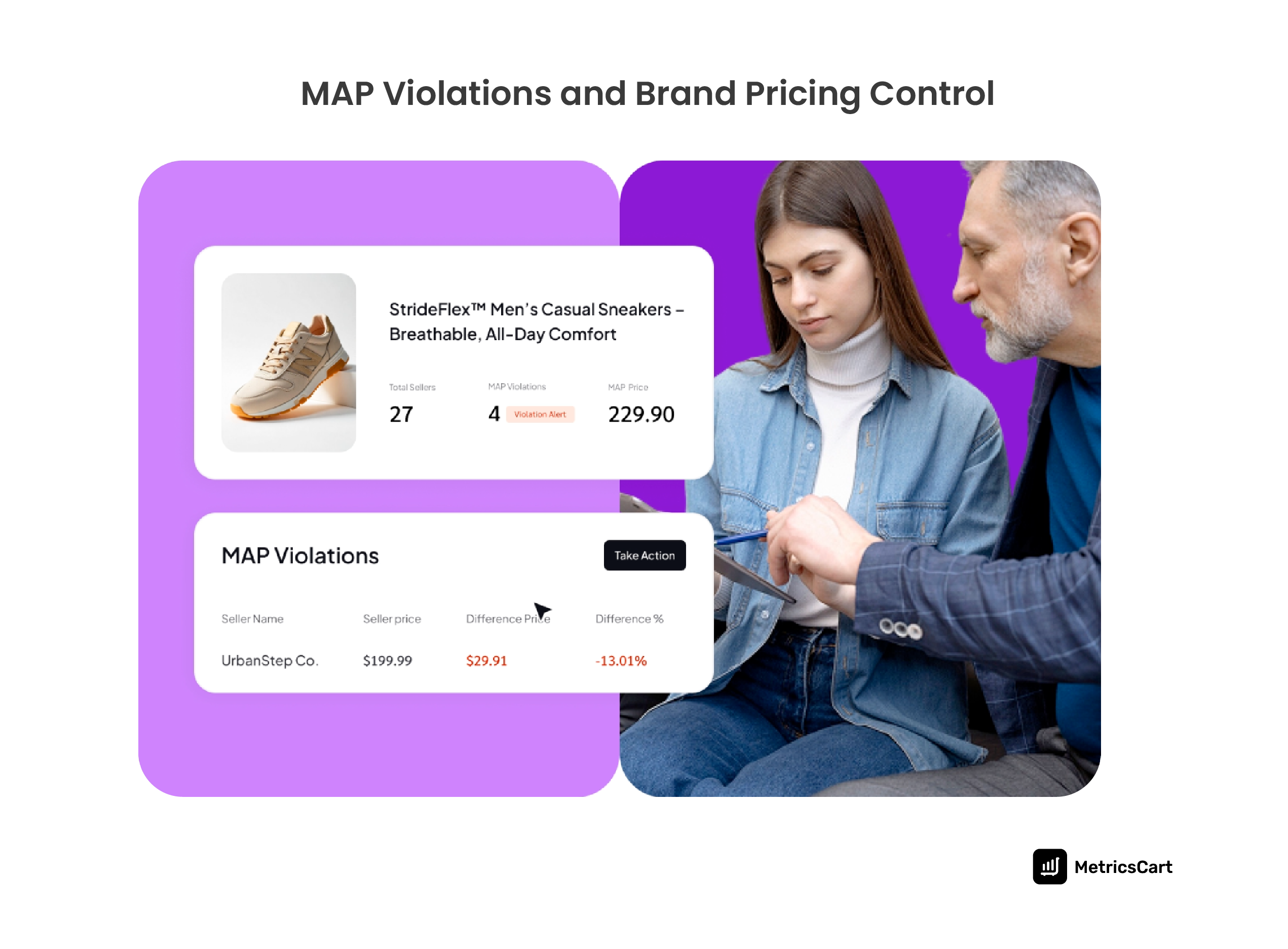
Build a Tiered Enforcement Workflow
A clear enforcement structure helps maintain consistency and fairness.
| Tier | Trigger | Action |
|
|
First violation | Warning with correction window |
|
|
Repeat violation | Temporary restrictions (e.g., marketing support removed) |
|
|
Continued non-compliance | Suspension or removal as a reseller |
|
|
Any violation | Marketplace takedown or escalation |
Every action should follow the same process so sellers know what to expect. Without a structured workflow, enforcement becomes difficult to scale. Some violations get ignored, others are over-penalized, and sellers receive mixed signals.
A tiered system ensures that every violation is handled based on history and severity. It also creates a clear record of actions taken, which is important when dealing with repeat offenders or escalating issues with marketplaces.
With MetricsCart, this process becomes easier to manage. Violations are logged with seller-level history, making it clear who is repeatedly non-compliant. Instead of tracking enforcement manually across emails and spreadsheets, you have a centralized view of violations, actions taken, and what needs to happen next.
Train Your Retail Partners
Many violations happen due to gaps in understanding, not intent.
- Explain where and how MAP applies
- Share examples of common violations (ads, bundles, discounts)
- Provide clear guidelines for promotions
- Create a simple channel for questions or clarifications
When partners understand the rules, compliance improves, and issues decrease. Most sellers are trying to stay competitive, not violate policy. When you clearly explain how MAP works and where it applies, you reduce accidental violations and make enforcement smoother.
Training also helps align expectations. Sellers know how to run promotions without breaking MAP, and your team spends less time correcting avoidable mistakes.
Turning MAP into a Long-Term Brand Advantage
A MAP policy sitting in a PDF on your partner portal doesn’t protect your brand. It’s just a document. What makes it work is simple: clear rules and consistent action when something goes off track. It also means applying the policy the same way across all sellers, without exceptions. When MAP is treated as an active process, not just a policy, it starts to do what it’s meant to do: keep pricing steady and protect how your brand shows up in the market.
The brands winning on the digital shelf in 2026 are not the ones with the longest MAP policy documents. They are the ones who know which seller is violating MAP before 8 AM, send the violation notice immediately, and resolve the compliance issue before price erosion can spread.
With MetricsCart, brands have a clear view of how their products are priced across marketplaces. It shows exactly where pricing is off and who is causing it, so you can fix issues quickly and keep pricing consistent.
READ MORE| 7 Reasons Why MetricsCart Is the Best for MAP Monitoring & Enforcement: A Brand’s Perspective
Make sure your MAP policy actually holds in the market.
FAQs
A MAP policy helps brands control how their products are priced in public. It keeps pricing consistent across marketplaces, ads, and retailer sites. This protects your margins, supports your retail partners, and keeps your product positioned the way you intended.
MAP sets a minimum advertised price that sellers must follow. When one seller drops below it, others usually follow. MAP helps stop this early by setting a clear price floor and allowing brands to catch and fix issues before they spread.
Customers compare prices across multiple platforms before buying. If they see different prices, it creates confusion and reduces trust.
MAP helps by:
1. Keeping prices consistent across channels
2. Supporting a stable product image
3. Avoiding constant discounting
A violation can quickly affect the rest of the market. Other sellers may lower their prices, and customers begin to expect the lower price.
Brands should respond with a clear process, starting with a warning and moving to stricter actions if the issue continues.
Start by identifying all sellers and creating a clear MAP policy. Track pricing across marketplaces and set up a consistent enforcement process. Training your partners also helps reduce violations and keeps everyone aligned.