Price erosion starts small. Sometimes it is a coupon or a hidden discount. Then there is a reseller who drops the advertised price. Before long, your pricing strategy no longer belongs to you.
In 2026, pricing moves faster than ever. Many brands have a MAP policy on paper, but not on the digital shelf where it actually matters. As marketplaces expand, enforcing consistent pricing across retailers has become increasingly complex.
Algorithms react to visible discounts within hours. Unauthorized sellers operate across multiple marketplaces, and minor violations quickly lead to broader price drops. This is hard to reverse.
This guide breaks it down clearly: what MAP policy compliance actually means, where brands often cross the line without realizing it, and how to regain control before pricing slips any further.
What is MAP Policy Compliance?
MAP policy compliance means ensuring your products are advertised at or above the minimum advertised price set by your brand. It does not control the final selling price. It focuses only on the price shoppers see across listings, ads, and promotions.
For many e-commerce brands, even a small advertised price drop can impact Buy Box ownership and resellers’ trust. In practice, most MAP issues come from small changes that are easy to miss. Coupons, bundle offers, or add-to-cart discounts can lower the visible price without clear signals.
For example, a product with a $199 MAP may appear compliant on the listing, but a visible 15% coupon can lower the advertised price and initiate a violation.
When multiple sellers follow the same pattern, pricing consistency across marketplaces starts to break down. MAP compliance helps brands monitor these changes and maintain a consistent pricing standard without overstepping legal boundaries.

Michael Murphy, in Episode 40 of the Digital Shelf Insider Podcast, highlights how mastering MAP enforcement is key to protecting your brand’s pricing power. He says that MAP enforcement lets you control the price game, protecting your brand’s value and dominance.
Watch the full episode here:
MAP Policy Compliance: Understanding the Legal Boundary
The real challenge brands face is knowing where the line is between enforcing MAP pricing policy and crossing into price control. Making the wrong move can lead to antitrust violations and put the brand at serious risk.
Marketplaces like Amazon and Walmart update prices dynamically, and even minor violations can quickly escalate into bigger problems. Brands need to be proactive in monitoring and enforcing their MAP policies to avoid losing control of their pricing strategy.
READ MORE | Want to learn more about MAP enforcement? Check out A Beginner’s Guide to MAP Enforcement in E-Commerce.
What Counts as Permissible MAP Enforcement?
Permissible MAP enforcement is unilateral. The brand defines its own policy and communicates it directly to sellers. Each manufacturer sets its MAP independently. Retailers remain free to choose their final selling price, as long as the advertised price stays at or above MAP.
For example, a premium blender launches with a $299 MAP. A retailer may sell it for $279 inside the cart or through a private promotion. What they cannot do is display $279 on the product page, in ads, or in visible coupons. The brand protects price perception while allowing normal retail competition.
Brands that stay compliant usually follow a few consistent practices:
- Policies are written clearly and shared across all partners
- Enforcement relies on documented, advertised price violations
- Communication focuses on visibility, not resale pricing
- Actions are applied evenly across authorized and unauthorized sellers
Today, many brands are moving toward data-led MAP monitoring rather than manual checks. With marketplaces like Amazon and Walmart constantly updating pricing, structured MAP enforcement helps prevent violations.
Where MAP Enforcement Crosses into Risk
Risk begins when MAP enforcement shifts from independent action to coordinated behavior.
Common red flags include:
- Competitors adopting identical MAP levels or enforcement timelines
- Industry groups promoting standardized pricing rules
- Retailers report to each other to maintain a shared advertised price
- Internal pressure to influence how products are sold, not just advertised
Consider a scenario in which two electronics brands agree to maintain a $499 advertised floor price across marketplaces to avoid margin pressure. Even without a written agreement, this can appear as horizontal/vertical price fixing.
The better approach is to rely on clear policy language, consistent monitoring, and structured enforcement workflows. Understanding this boundary sets the stage for the next section, where we look at lawful MAP compliance best practices that help brands stay protected as they scale enforcement.

MAP Policy Compliance: Best Practices for Brands and Sellers
Staying compliant with MAP policies is important for both brands and sellers. With more competition in online shopping, following the right MAP enforcement practices helps protect pricing consistency and avoid legal risks.
Here’s an updated checklist of best practices to keep MAP compliance on track in 2026:
1. Set Clear and Independent MAP Guidelines
AI-driven algorithms and repricing tools can adjust prices within minutes, making it essential for brands to define a MAP strategy that’s independent and based on their own product positioning and long-term goals.
For example, a brand launching a product with a $299 MAP can’t afford to let automated tools or competitors dictate price decisions. Setting independent MAP policies ensures that the brand controls its price perception without falling into price wars or legal traps.
Key takeaways for brands:
- MAP decisions should be based on brand strategy, not what competitors are doing.
- Rely on internal data and market insights to define MAP levels.
- Avoid aligning MAP with industry-wide standards that could be seen as price coordination.
2. Ensure Transparent Communication with Retailers
Once MAP policies are established, the next step is to ensure retailers fully understand and comply with them. Clear communication is essential to prevent misunderstandings and ensure compliance.
Brands should communicate MAP through formal, one-way channels such as email or a dedicated retailer portal. For example, send an email saying: “Brand X requests that you advertise Model A at no less than $499.” This helps avoid any perception that MAP enforcement is part of a collective agreement, which can lead to legal issues.
Best practice:
- After sending the initial communication, ask retailers to confirm receipt and understanding of the MAP policy.
- Periodic reminders and updates keep MAP policies top of mind and help ensure that sellers continue to comply with the rules.
READ MORE | Best MAP Monitoring Software You Should Consider for E-Commerce.
3. Avoid Influencing Resale Prices
MAP does not dictate how products are sold at checkout. When brands push retailers to match certain resale prices, either directly or indirectly, they cross the line from legitimate MAP enforcement into price control. This can raise antitrust concerns and reduce retailer independence.
For example, a brand might insist that retailers advertise at a specific price and then subtly suggest how low they can sell at checkout. This behavior could be viewed as illegal price-fixing. Instead, brands should focus on monitoring advertised prices across all platforms while allowing retailers to set their own final selling prices.
Key insight:
- MAP compliance only covers advertised pricing. Resale prices are the retailer’s responsibility.
- Minimum advertised price control is legal; resale price control is not.
READ MORE | Want to learn how MAP monitoring drives profitability? Check out our blog on MAP Monitoring as a Channel Strategy: Why It’s Core to Brand Profitability
4. Act Independently in Enforcement
MAP enforcement should always be independent. Brands must take action themselves when a retailer violates the MAP policy, whether through price drops or other violations. Do not rely on third parties, such as distributors or trade associations, to enforce MAP. This avoids the risk of creating an appearance of coordinated pricing.
For instance, if a retailer advertises a product below MAP, the brand should directly notify the retailer and request compliance. Brands can also set up automated alerts to flag violations as they happen, enabling quick action.
Best practice:
- Use automated MAP monitoring tools, such as MetricsCart, to track violations.
- Take immediate action when violations are detected, sending clear communication about the breach.
5. Review and Update MAP Policies Periodically
Brands should review their MAP policies at least once a year, or more frequently if needed, to ensure compliance. Work with legal teams to stay on top of changes in antitrust laws and regulations that could impact your MAP policy.
Internal training helps prevent mistakes and keeps everyone in the company on the same page when enforcing MAP.
Best practice:
- Schedule annual MAP reviews with legal counsel to stay compliant.
- Conduct internal training sessions to ensure your team understands the distinction between MAP enforcement and price control.
How MetricsCart Helps Enforce MAP Policy Compliance
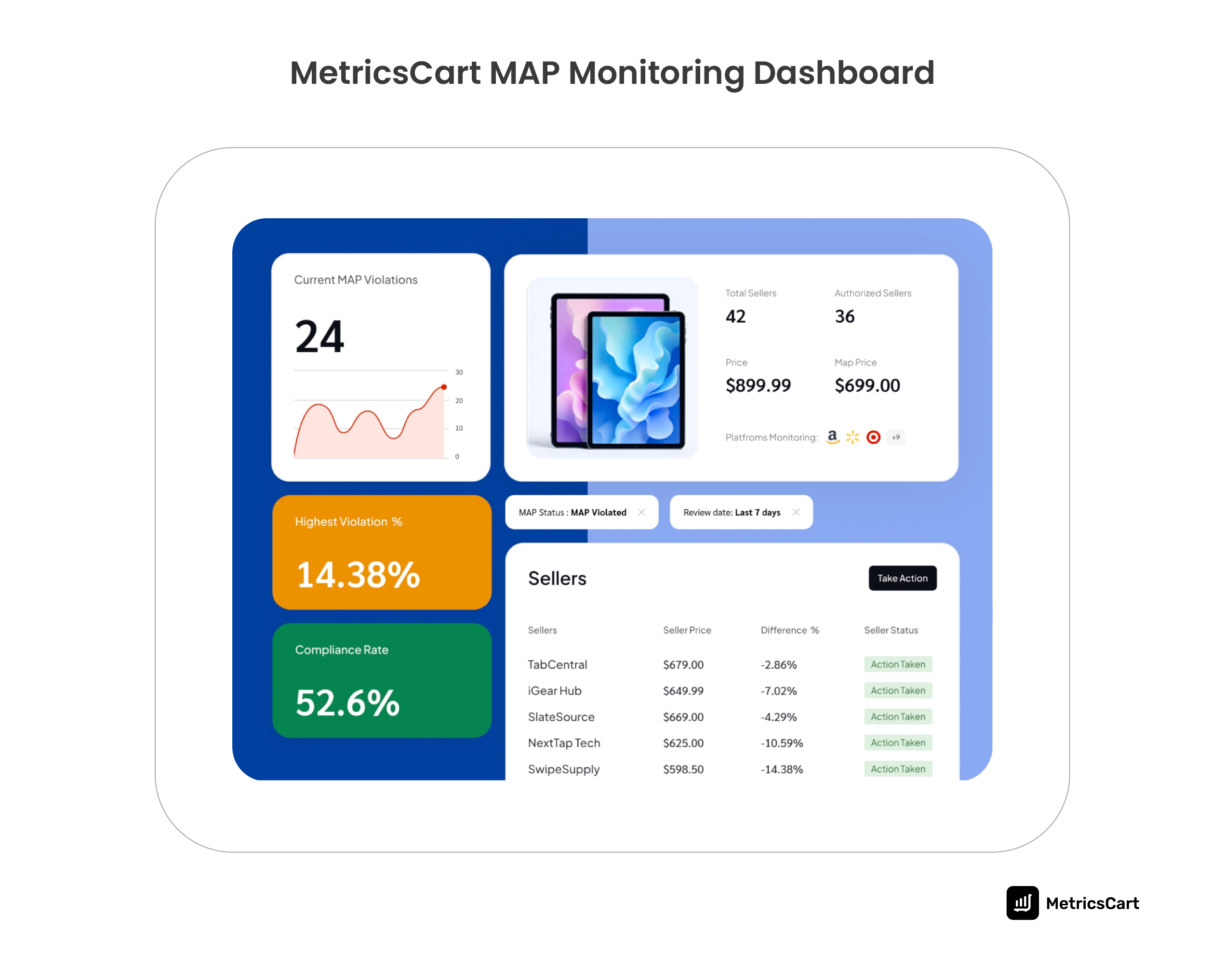
Let’s look at how MetricsCart can monitor and enforce MAP:
Detects MAP Violations Across Marketplaces
MetricsCart scans product listings across 100+ marketplaces, such as Amazon, Walmart, and eBay, to identify advertised price drops. This allows brand and channel teams to quickly detect when sellers display prices below MAP and intervene before the violation spreads across other listings.
Identifies Repeat Violators and High-Risk Sellers
MAP violations are rarely one-off events. MetricsCart tracks recurring violations and highlights sellers who repeatedly break MAP guidelines. This helps brands prioritize enforcement efforts and focus on sellers who consistently create pricing pressure.
Captures Proof of Violations Automatically
Every MAP violation needs documentation for enforcement. MetricsCart automatically records the advertised price and captures screenshots when violations occur. This provides reliable evidence that brands can use when communicating with sellers or escalating enforcement.
Tracks Resolution Time and Enforcement Effectiveness
MetricsCart allows teams to monitor the speed at which violations are resolved. By tracking Time to Resolution (TTR), brands can measure enforcement performance, identify slow responses, and improve how violations are handled across sellers.
Automates Seller Notifications and Enforcement Workflows
Instead of manually contacting sellers, MetricsCart enables structured enforcement workflows. Automated notices can be sent to violating sellers using predefined MAP violation templates, helping brands escalate enforcement in a consistent and efficient way
By being proactive, MetricsCart helps you avoid violations before they impact your margins.
READ MORE | Want to see why brands trust MetricsCart for MAP monitoring? Discover the 7 key reasons that set us apart from the competition.
| Feature/ Benefit | MetricsCart | Manual Monitoring |
| Real-time Price Tracking | Instant alerts | Delayed data, no instant alerts |
| Marketplace Coverage | Tracks MAP across Amazon, Walmart, eBay, and more | Limited coverage, often missing key platforms |
| Automation | Automated violation alerts & enforcement | Requires constant manual checks |
| Enforcement Efficiency | Automated workflows for fast action | Time-consuming and error-prone |
| Compliance Rates | Increased compliance by 20% | Low compliance due to oversight |
Holding the Line
Keeping your prices consistent is crucial to protecting your brand and profits. A small price drop here and there can quickly snowball, damaging your margins and your relationships with resellers. The key is staying on top of violations before they get out of hand.
MetricsCart makes MAP enforcement simple and efficient. With real-time monitoring, automated alerts, and easy-to-use enforcement tools, you’ll stay in control and prevent pricing violations that could harm your brand.
Take Control of Your Pricing. Start Enforcing MAP Policies Today!
FAQs
MAP compliance means ensuring that a product is advertised at or above the brand’s minimum price. It ensures that prices stay consistent across retailers and prevents price erosion. By maintaining MAP compliance, brands protect their market value and avoid undercutting by unauthorized sellers.
A MAP policy is a rule set by a brand that determines the lowest advertised price for its products. It helps maintain consistent pricing across retailers while allowing them to set their own final selling price. This policy is designed to protect the brand’s image and maintain fair competition in the marketplace.
A MAP violation occurs when a retailer advertises a product at a price below the brand’s minimum price. This can include price drops, discounts, or promotions that reduce the advertised price. Violating the MAP policy can lead to legal actions and damage a brand’s reputation.
Retailers can ensure adherence to MAP rules by regularly monitoring product listings and ensuring that their advertised prices meet or exceed the brand’s minimum price. This includes reviewing promotional strategies, such as discounts and bundles, to avoid unintentional violations.
MAP compliance is important because it protects a brand’s pricing integrity, prevents price wars, and maintains trust with authorized resellers. It ensures consistent pricing across retailers, helping to safeguard brand value and profitability. Non-compliance can lead to revenue loss and damage relationships with resellers.