Highlights
- Dual-tier pricing by design: 94% of Medicube’s Amazon catalog is priced under $50, while device bundles anchored by the Booster Pro range from $126 to $209. That gap is core to Medicube’s business model.
- Toner Pads lead all sales: The brand’s top-selling product category carries an average discount of 42%, suggesting that Medicube’s marketing strategy relies on heavy promotional pricing to capture volume and search rank velocity on Amazon.
- Sentiment is split: Only 44% of listed products carry positive sentiment. The remaining 56% is neutral or negative. For a brand growing this fast, that mixed perception carries real implications for Medicube’s brand strategy.
- Mid-January pricing swing: Prices peaked at $38 around January 7-9, dropped to a low of $29.40 on January 15, then recovered to $36.80 the next day. This volatility points to a possible flash sale or Amazon-side promotion.
- Devices get the clicks and bundles get the stars: Beauty devices like the Age-R ATS Air Shot pull the highest engagement (upvotes) despite mixed ratings (3.4–4.4). Meanwhile, skincare bundles and masks consistently score 4.5 to 5.0. This two-speed pattern defines Medicube’s business strategy on Amazon.
About This Report
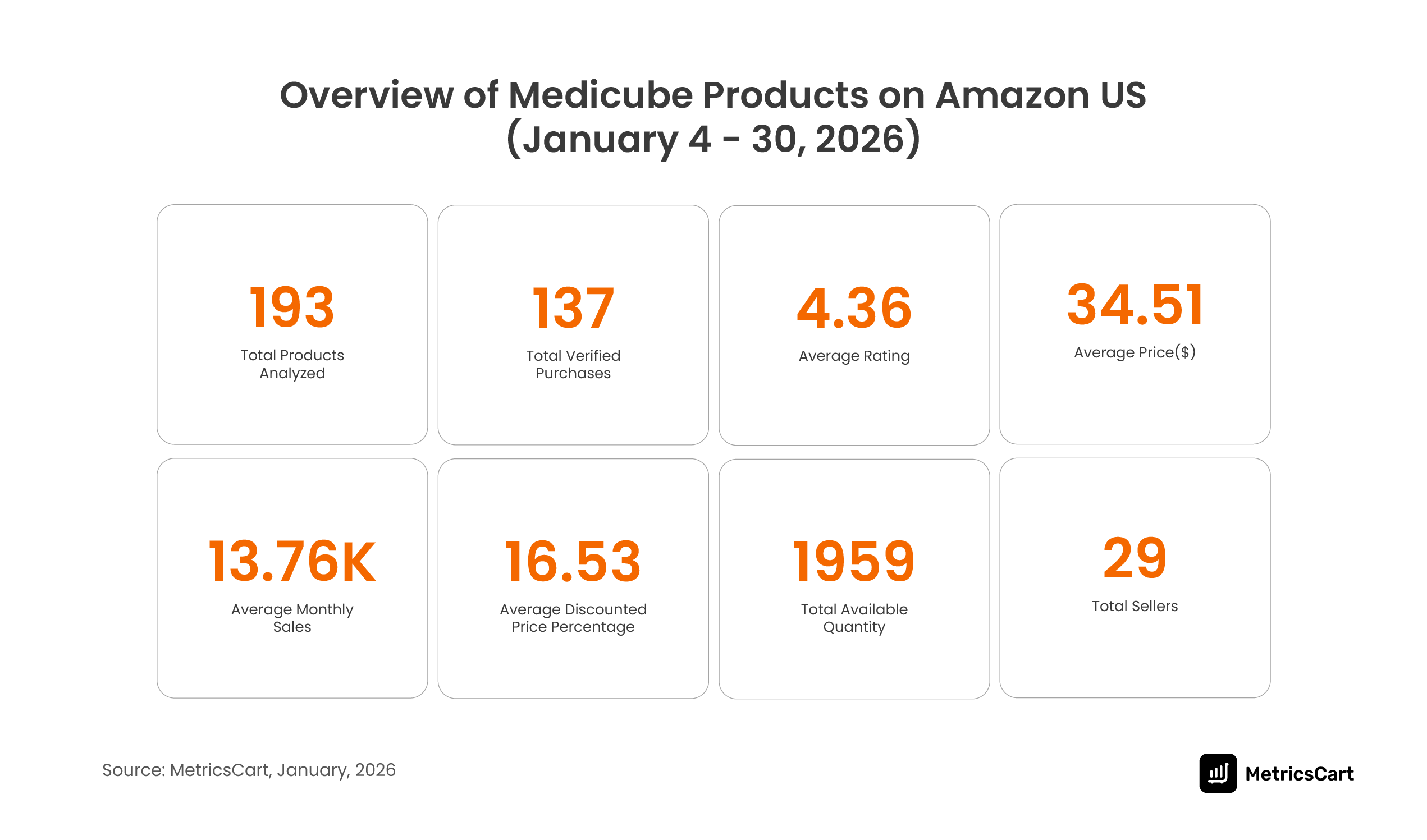
This analysis is based on data collected by MetricsCart’s digital shelf analytics, from Medicube’s Amazon US listings between January 4 and January 30, 2026. The data findings cover pricing distributions, discount intensity, top-selling product categories, customer sentiment breakdowns, review themes, and product-level engagement metrics.
We will examine how its products are priced, how deeply they are discounted, what is actually selling, what customers say in their reviews, and what it all says about Medicube’s brand strategy and competitive positioning on the world’s largest marketplace.
Why Is Medicube Having Its Moment in the US?
The Seoul-based brand, owned by APR Corp, went from accounting for 0.1% of Amazon’s beauty sales in December 2024 to 4.2% by mid-2025.
During Amazon Prime Day in July, 2025, Medicube was the most searched and clicked brand on Amazon.
By Q1 2026, that share had grown to 14.1%, making Medicube the single largest beauty brand on Amazon by sales share, nearly double the next competitor, Nutrafol.
The brand’s parent company posted $1.1 billion in 2025 revenue, with 80% coming from international markets. At the center of this growth sits a focused product ecosystem: the AGE-R Booster Pro device (which has sold over 6 million units worldwide), alongside a growing roster of skincare consumables that feed into that device-driven routine.
Medicube’s K-beauty marketing strategy does not depend on a single viral moment. Instead, it is built on a social-first education process that rewires consumer behavior and a layered system of pricing, product architecture, and community-driven demand that starts on TikTok and converts on Amazon.
Medicube’s Best-Selling Products on Amazon: Toner Pads Win, But Devices Drive the Conversation
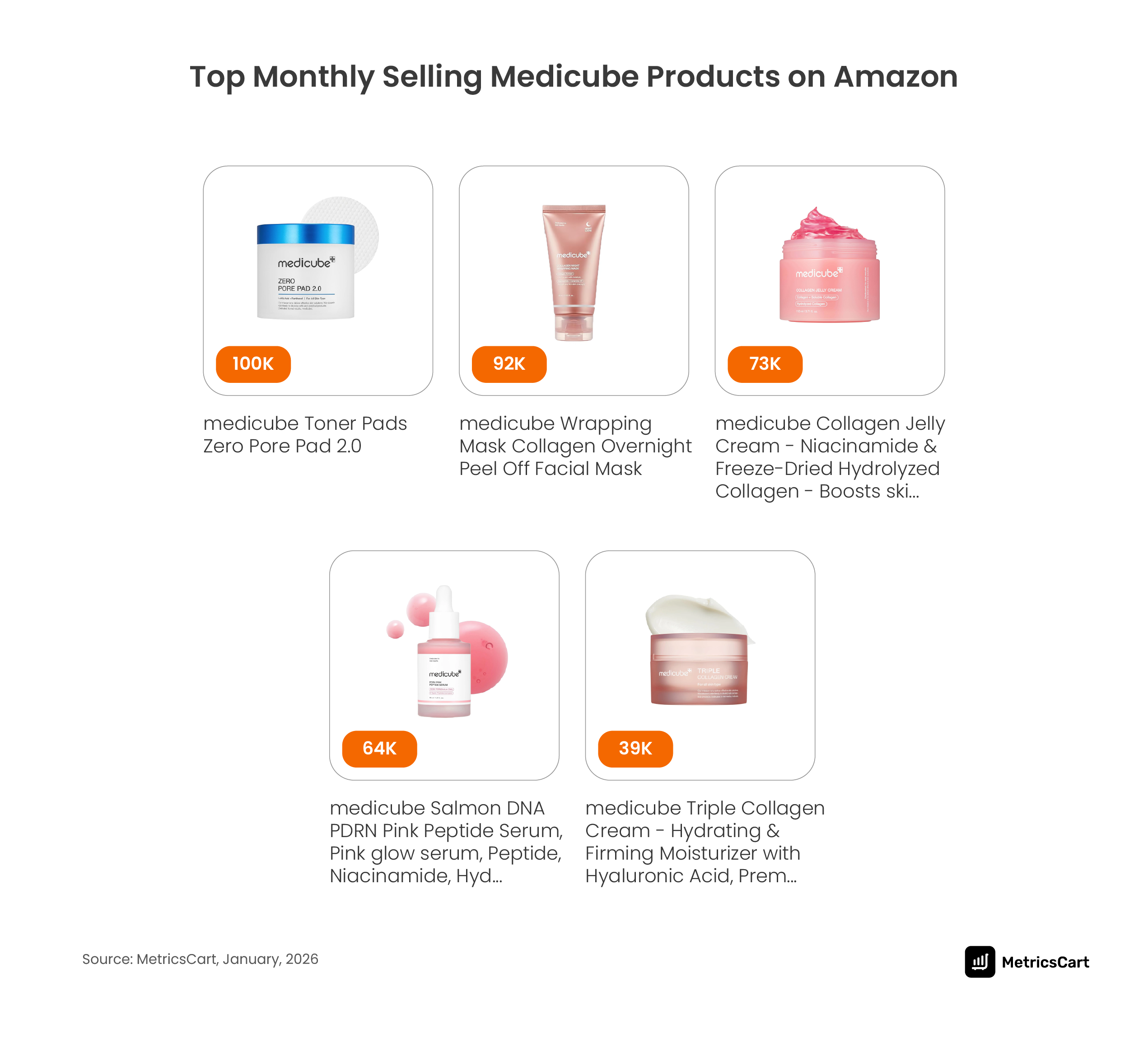
MetricsCart’s findings show that the top-selling Medicube products on Amazon are Toner Pads, followed by Creams and Masks. Within that mix, the Collagen Overnight Face Mask has emerged as a trending breakout, riding the broader momentum of collagen-based skincare across the beauty category.
Toner Pads carry most of the weight on volume. Paired with the 42% average discount, they function as the primary traffic and conversion driver for Medicube on Amazon. They attract new customers, accumulate reviews, build search relevance, and open the door to cross-selling across the rest of the catalog.
BeautyMatter’s Q1 2026 Amazon analysis ranked the Medicube Toner Pads Zero Pore Pad 2.0 as the number one beauty and personal care product on Amazon for the quarter. And APR Corp’s Q3 2025 earnings confirmed that the PDRN line (which includes the Zero Pore Pad) had surpassed 15 million cumulative global sales.
READ MORE | The e.l.f. Effect: How Smart Marketing, Reviews, and Pricing Drive Gen Z Loyalty
Medicube’s Pricing Architecture: From a $2.80 Trial Kit to a $209 Device Bundle
If you want a quick way to understand Medicube’s business model, the pricing tells most of the story.
On Amazon US, Medicube’s products range from $0.70 to $209.50. Around 94% of the catalog falls in the $0 to $50 bracket.
Only about 5% qualifies as premium. So the vast majority of what Medicube sells on Amazon is accessible, everyday skincare priced for volume. But the products that carry the brand’s identity, its highest margins, and its positioning story sit at the very top of the range.
What this creates is two distinct paths into the brand. A curious first-timer can spend $2.80 on a trial kit. A committed buyer can invest $200+ in a device-and-skincare bundle. Both paths lead to the same product ecosystem. That structural duality is the engine behind Medicube’s business strategy on Amazon.
What the Most Expensive Products Tell Us About Medicube’s Brand Strategy
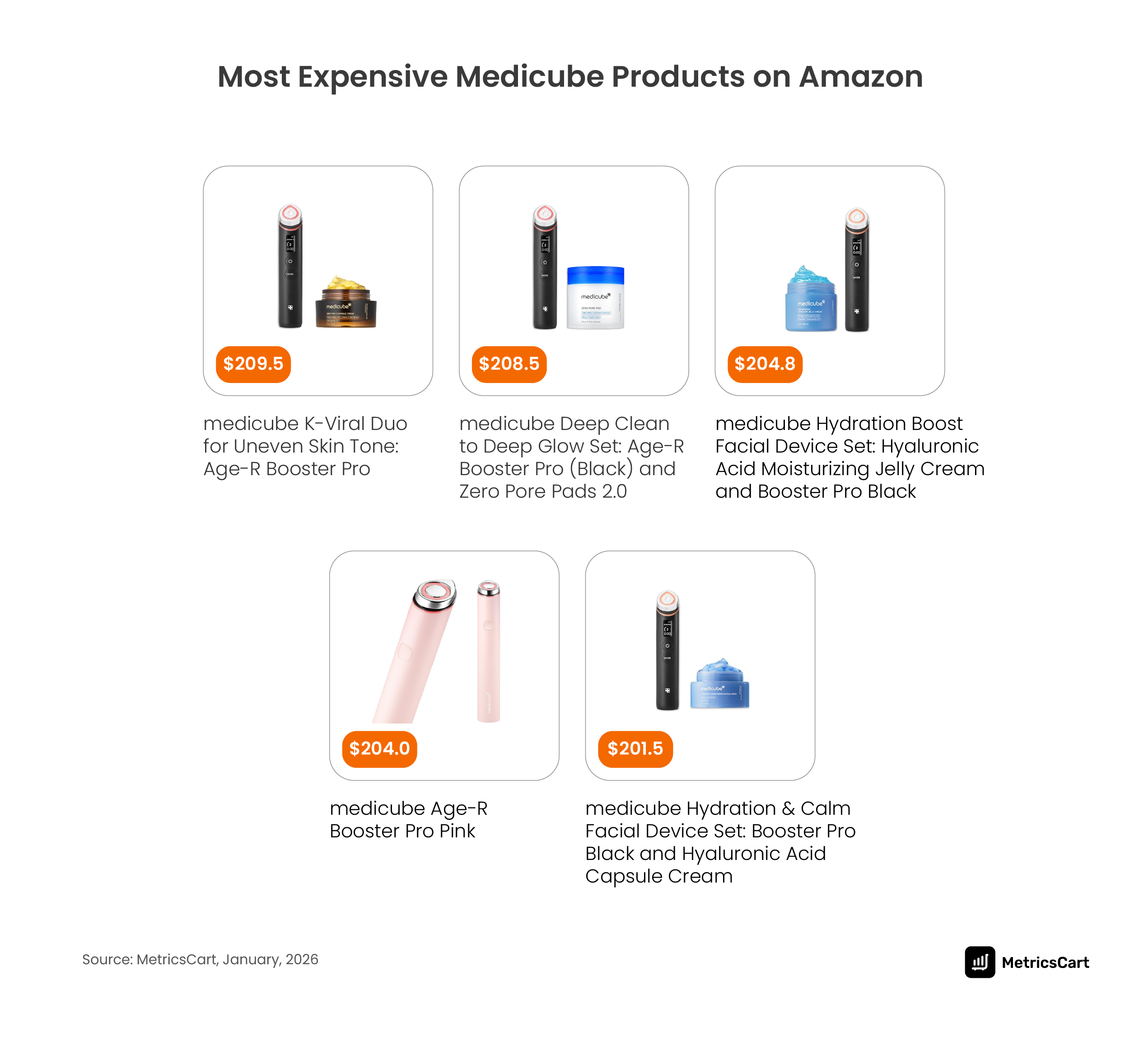
Medicube’s most expensive Amazon products cluster between $126.60 and $209.50, with the majority sitting in the $189 to $209 band. Nearly all of these are device-and-skincare bundle sets, and almost every one includes the Booster Pro.
The Booster Pro is Medicube’s hero product. Bundle it with creams, serums, or masks, and you have a $200 transaction that introduces the customer to multiple product categories at once. It boosts average order value while simultaneously seeding future repurchase behavior across the skincare range.
Founder Kim Byung-Hoon confirmed to Glossy that devices typically account for 30 to 40% of the brand’s annual revenue. APR Corp’s Q3 2025 earnings release added that the beauty device division generated $71 million in quarterly revenue (up 39% year-over-year), with cumulative AGE-R device sales surpassing 5 million units globally as of September 2025. More than half of those device sales came from overseas.
For Medicube’s brand strategy, this pricing setup sends a very specific signal: the brand positions itself around clinical-grade technology rather than focusing only on ingredients or aesthetics. The device is the credibility anchor, and the skincare catalog borrows from that positioning to boost consumer confidence.
The Affordable End: Accessories, Trial Kits, and a $2.80 Entry Point
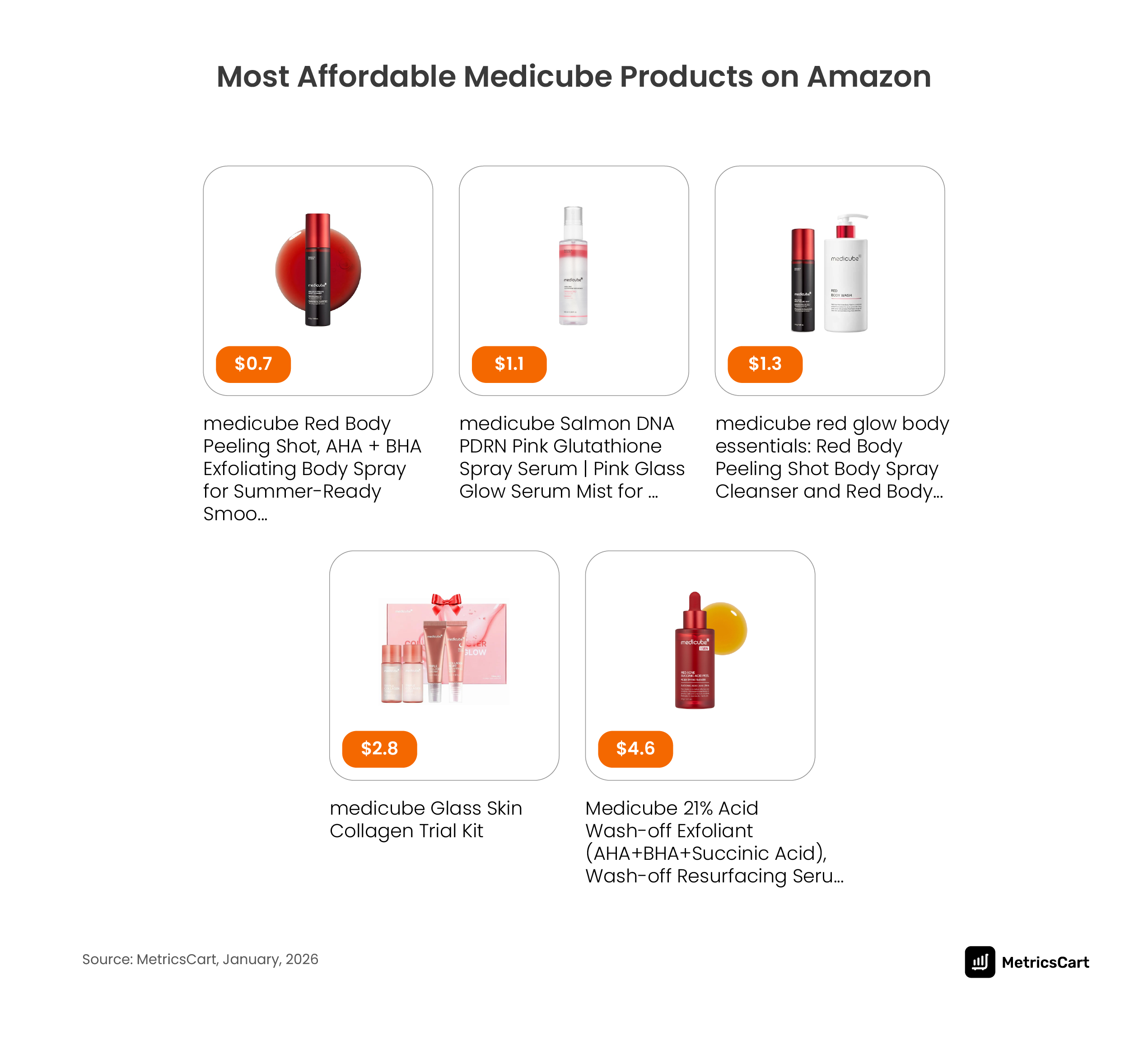
At the opposite end, Medicube lists sprays, toners, masks, and brushes priced between $0.70 and $10.80.
The most telling product in this tier is the Glass Skin Collagen Trial Kit at $2.80. At that price, the goal clearly is not margin. It is customer acquisition. For less than a coffee, someone can experience Medicube’s formulations, form an impression, and decide whether the brand deserves a bigger place in their routine.
This is a textbook K-beauty marketing strategy. Korean beauty brands have long understood the power of trial-size, sample-driven acquisition. Get the product onto the skin first. Let the experience do the selling for the repurchase. Medicube’s $2.80 trial kit is the Amazon-native version of that approach, sitting at the base of a pricing ladder that extends all the way up to $209.50.
The gap between the two tiers is massive, and deliberately so. Medicube is not trying to fill the $30 to $100 middle with a spread of mid-range options. Instead, there are two clear entry points: try it cheaply, or commit fully. Either way, you land inside the same ecosystem. And once you own the device, the consumables become part of your routine. That is the structural logic of Medicube’s business model on Amazon.
READ MORE | Beauty & The Bestsellers: Walmart’s Beauty Shelf Insider
The Most Discounted Medicube Products on Amazon And What That Tells You
Using MetricsCart’s price intelligence, we identified a mid-January volatility that standard scrapers would miss. This demonstrates the necessity of real-time monitoring to catch ‘flash-sale’ tactics used by K-Beauty leaders.
The most heavily discounted products see markdowns between $35.40 and $53 off their listed prices. Those discounts land squarely on skincare consumables, not devices. The most marked-down SKUs include the Zero Pore Pads 2.0 and various Exosome product variants, with many of them packaged as duo sets.
Which Products Get the Deepest Discounts, and Why
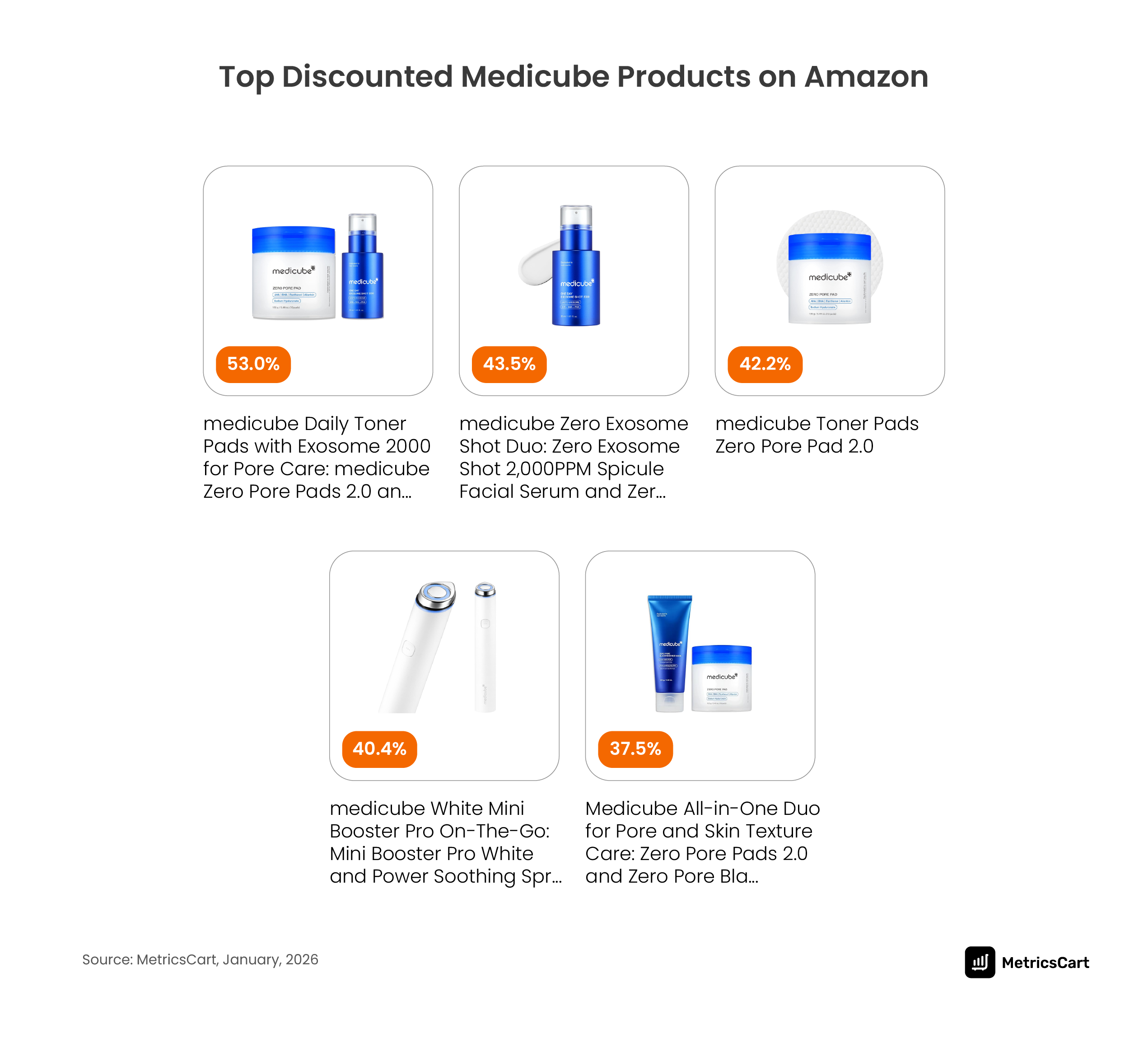
Discounts are largely applied to consumables and skincare products, while devices hold pricing more firmly.
Devices sell on technology, social proof, and aspiration. They do not need aggressive markdowns. Skincare consumables, though, compete in a crowded space on Amazon where visibility is directly tied to sales velocity, and sales velocity can be bought with the right discount.
Toner Pads, the top-selling Medicube product on Amazon, carry an average discount of 42%. When you are discounting your bestseller by 42% on an ongoing basis, you are investing margin to buy rank, reviews, and algorithmic momentum. Medicube’s marketing strategy treats that trade-off as a growth lever.
We can see this approach amplified during peak events. During Amazon Prime Day in July 2025, Medicube’s Zero Pore Pads were priced at $15.12, a 51% discount from the original price.
That pricing helped the brand capture 9.3% of total beauty sales share among the top 100 bestselling products during the four-day event, nearly double the share of Nutrafol in second place.
The Mid-January Price Dip: Flash Sale or Amazon Promotion?
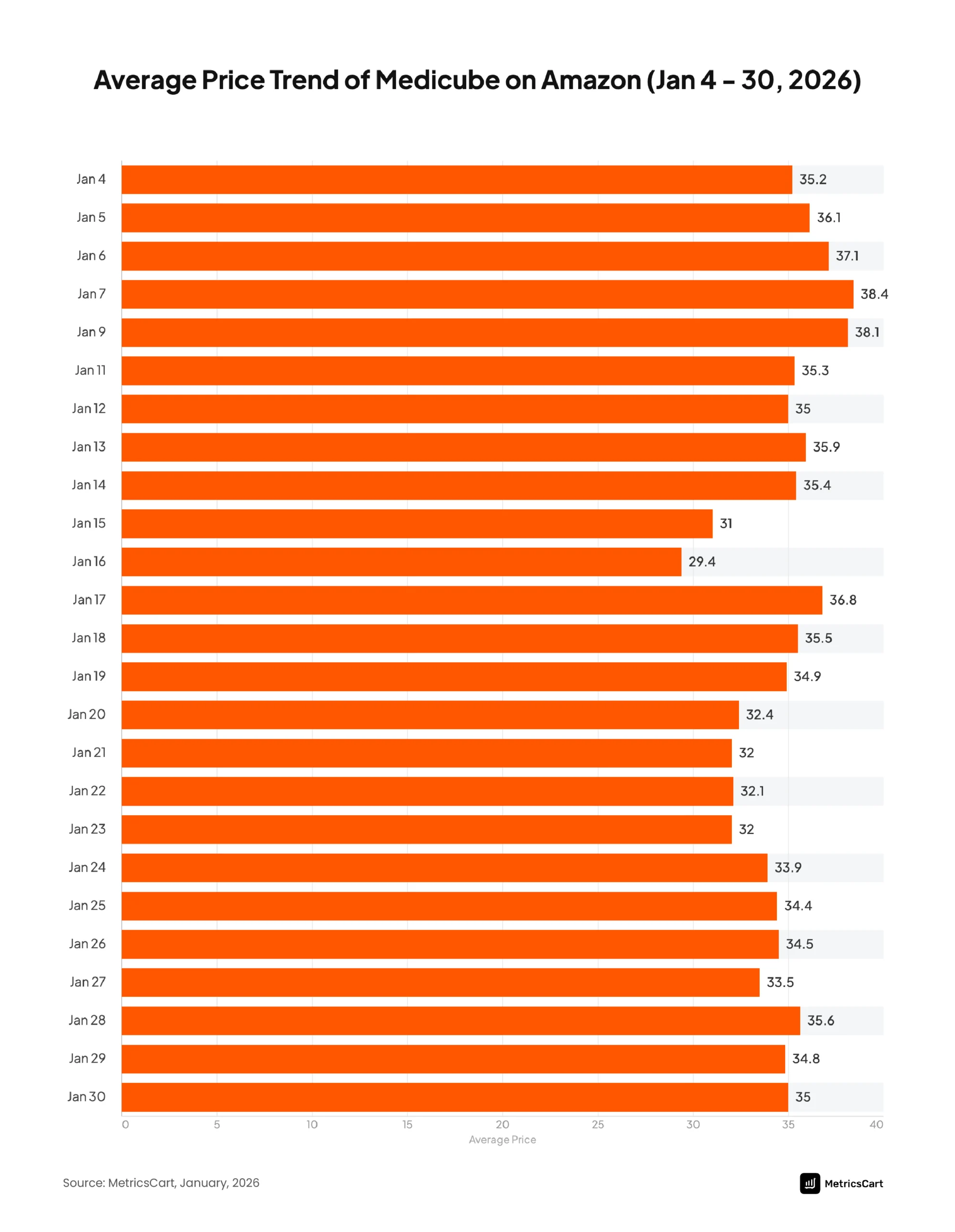
According to MetricsCart’s findings, average product prices rose around January 7 to 9, reaching approximately $38. Then came a sharp drop to the month’s lowest point of $29.40 on January 15. The very next day, January 16, prices recovered to $36.80.
From January 20 onward, prices settled between $32 and $35 for the remainder of the month.
Medicube’s business model actively manages promotional cycles within a single month, likely testing elasticity and using short-term price drops to spike sales velocity before returning to a baseline range. That is a characteristic behavior of brands treating Amazon as a performance channel.
READ MORE | Formulating Retail Success: Insights Into Physicians Formula’s Marketing Strategy
What Customers Are Actually Saying: Effectiveness, Quality, and a Mixed Verdict
Customer reviews are where the brand story faces a fact check. For Medicube on Amazon, that encounter is more complicated than the headline growth numbers would suggest.
What Shows Up Most in Reviews: Top Review Themes
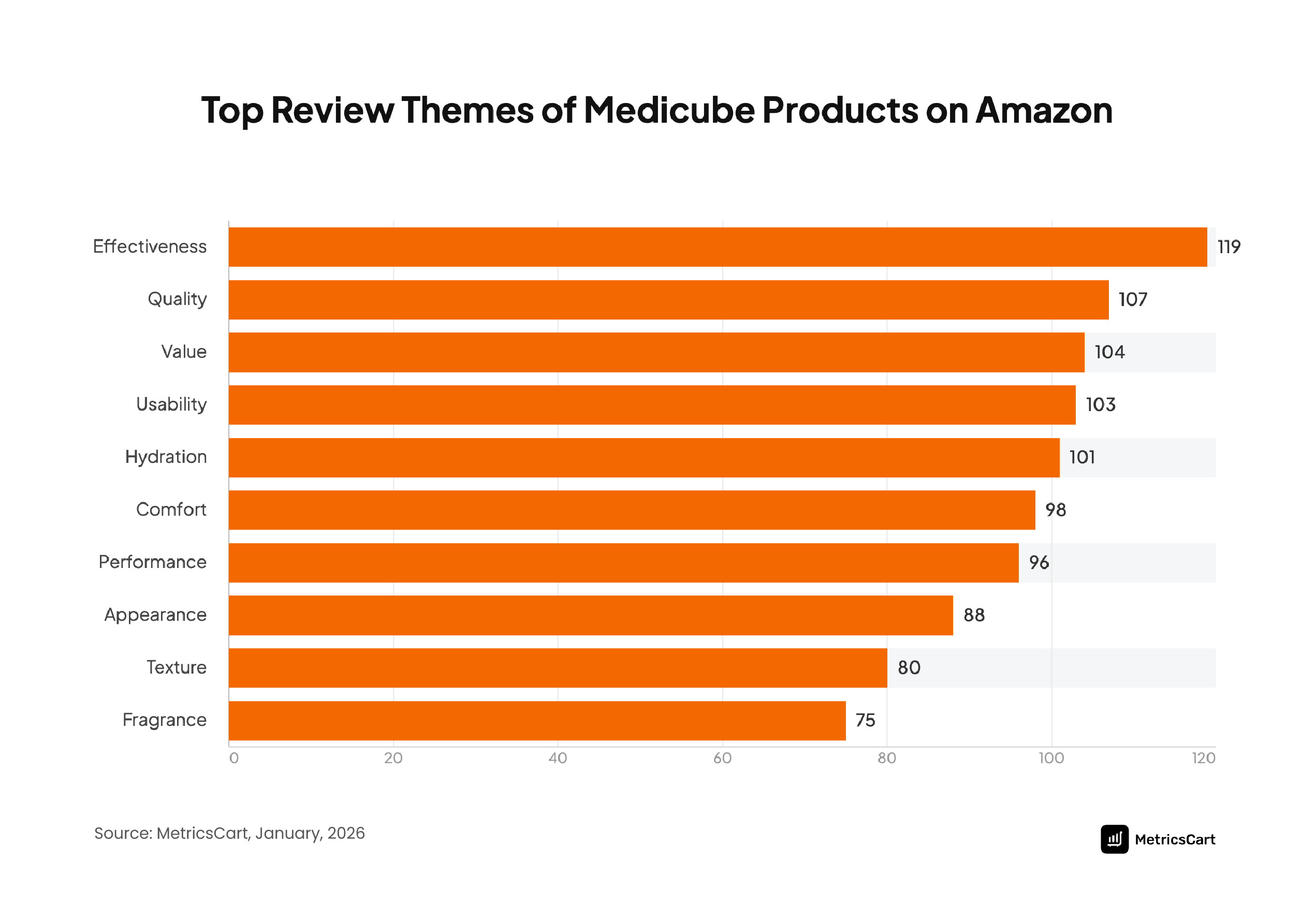
MetricsCart’s thematic review analysis found that effectiveness was the most dominant theme, appearing 119 times. Customers are judging Medicube products primarily on whether they deliver visible results and noticeable improvements.
The next most cited review themes are Quality and Value. For skincare and especially device-based products, ease of use, performance and value for price are the biggest discussion points to determine overall satisfaction.
Now there’s an interesting pattern here with effectiveness and performance being two separate themes.
Customers appear to think about immediate results (did my skin look better today?) differently from long-term product functioning (does this device still work well after weeks?)
For a brand that sells both single-use consumables and reusable high-end devices, this is a meaningful split. First-time buyers are looking for the instant payoff. Repeat users are evaluating durability and consistency, keeping price value in mind.
Where Is the Brand Perception Gap?
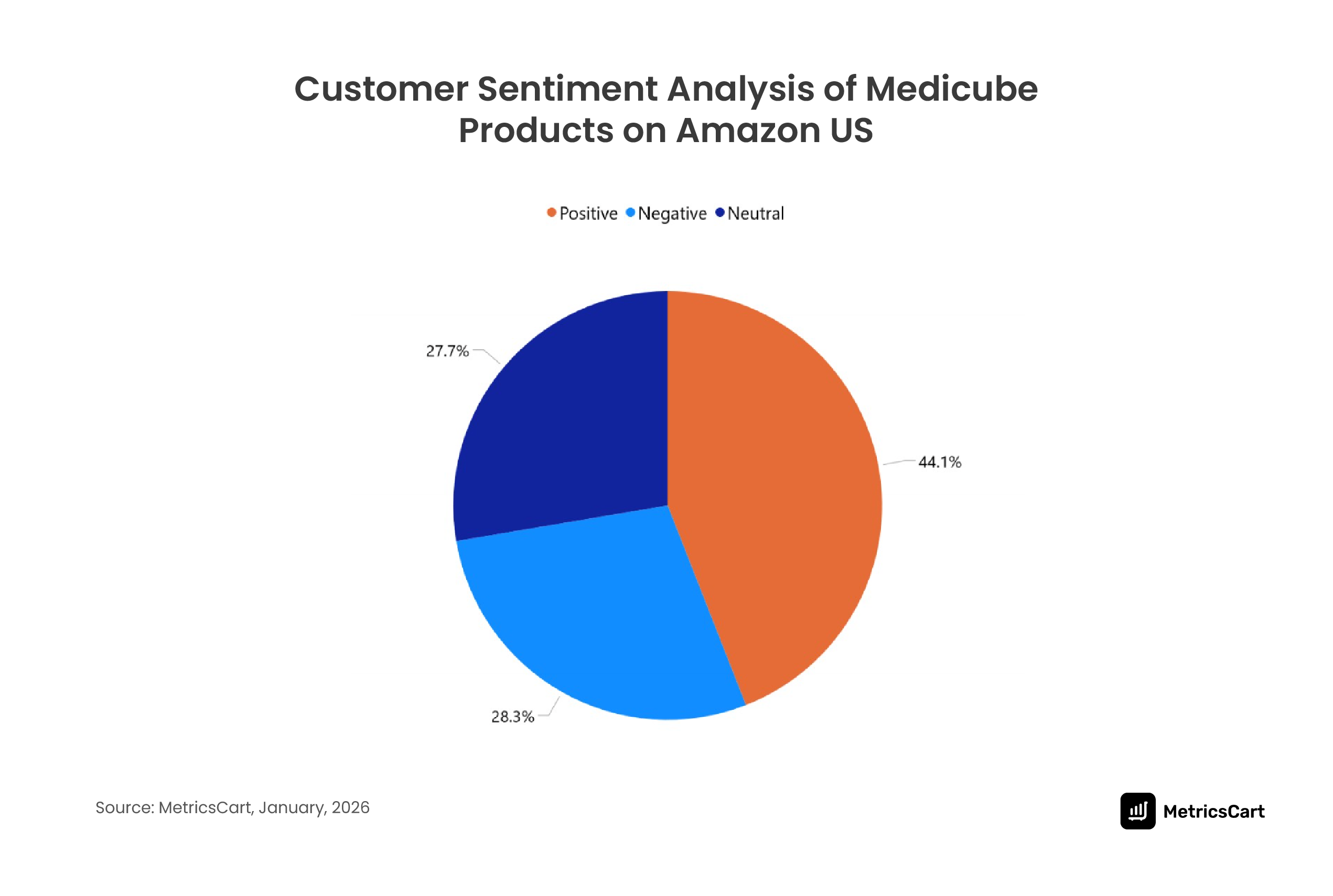
MetricsCart’s customer sentiment analysis feature for Medicube reveals that 44% of reviews reflect a positive sentiment, while the other 56% indicate negative and neutral sentiment.
Medicube’s TikTok-driven virality, its device-forward positioning, and its clinical-grade marketing language all set customer expectations high. When a meaningful chunk of buyers lands in neutral territory, it indicates brand perception and customer satisfaction gaps.
Medicube prioritizes sales Velocity and search Dominance over perfect sentiment, using high-volume ‘Toner Pad’ sales to mask the polarized reviews of complex beauty devices.
For Medicube’s marketing strategy on Amazon, this has concrete implications. Product listings, A+ content, and post-purchase emails need to set expectations thoughtfully. As long as sentiment remains split, the brand is relying on velocity and volume to stay ahead of its review curve.
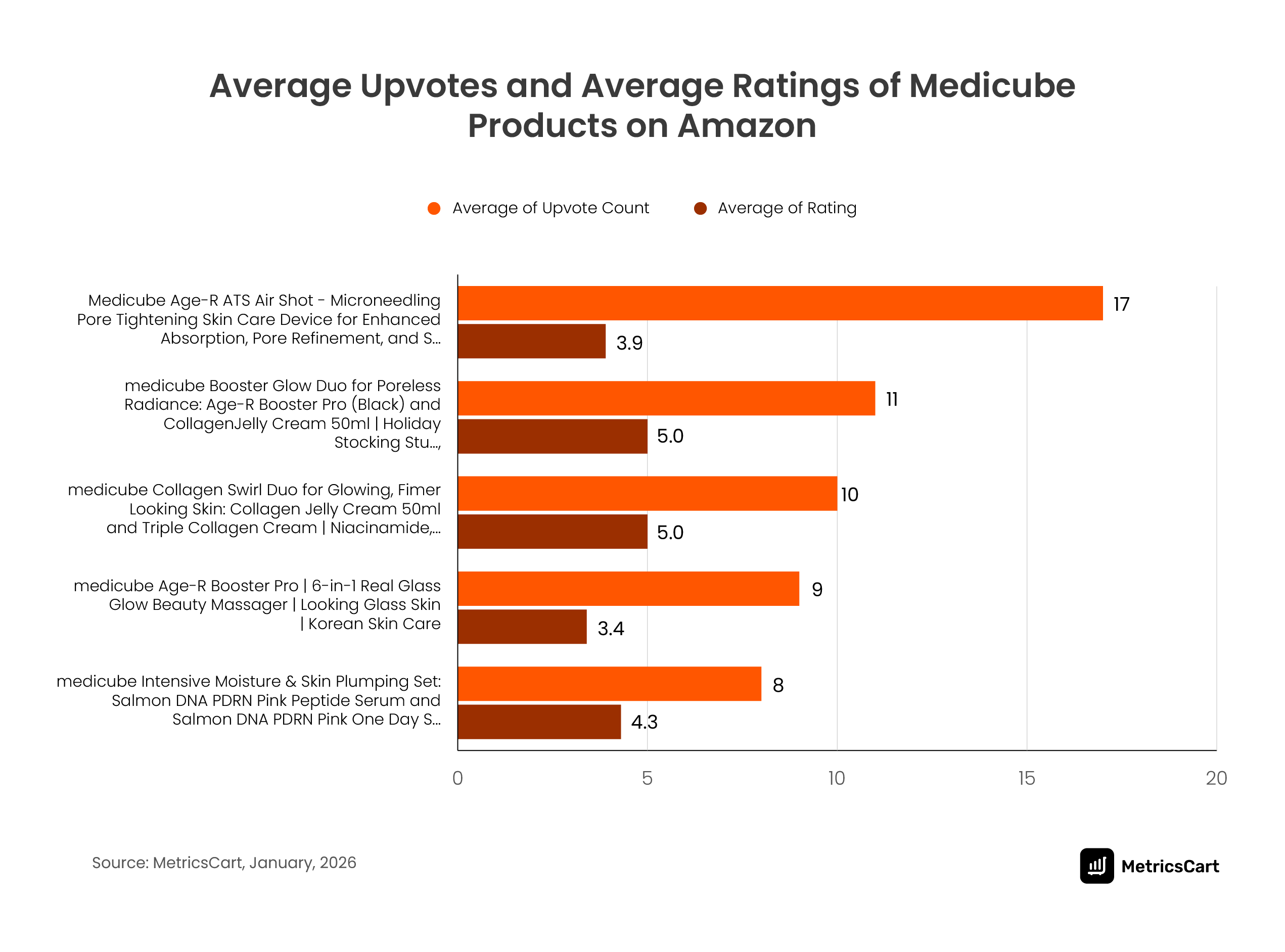
Devices attract the most attention but carry the most polarised satisfaction scores (3.4 to 4.4). Skincare bundles earn steadier, higher ratings (4.5 to 5.0).
A brand strategy built around devices as the entry point will naturally invite more varied reviews, because device expectations are higher and the experience is more subjective.
Managing the tension between the product that gets the clicks and the products that earn the trust is arguably the central challenge in Medicube’s business strategy as it scales.
Medicube’s Hero Products are Devices
Medicube products with the most customer upvotes are skincare devices, skincare bundles, face masks, and treatment sets.
The Age-R ATS Air Shot has the highest average upvotes of any Medicube product, yet carries an average rating of just 3.9. Compare that to the Booster Glow Duo and Collagen Swirl Duo. These bundles average 11 and 10 upvotes, respectively, and both hold a perfect 5.0 average rating.
Beauty devices generate high interaction even when ratings are uneven (3.4 to 4.4 across the device range). Skincare bundles and masks earn consistently higher praise (4.5 to 5.0), with steady upvotes averaging around 8.
For Medicube, devices are the front door. It generates curiosity, sparks engagement, and draws shoppers into the brand. Devices and bundles curate a customer journey from discovery to purchase in a way that maximizes average order value and boosts repeat purchases.
When a customer buys a Medicube device, Amazon’s “frequently bought together” engine immediately surfaces the booster gel and after-care cream, because the brand has been optimizing its content to train that recommendation loop.
What Medicube’s Brand Strategy Reveals About K-Beauty’s Bigger Playbook
The most important thing to understand about Medicube’s Amazon dominance is that Medicube did not build it on Amazon.
The broader K-beauty marketing strategy that has reshaped the Amazon beauty category follows a specific sequence:
- Build demand on social media, primarily TikTok
- Generate organic search volume and purchase intent
- Capture conversions on Amazon, with comparatively low on-platform advertising spend
During Amazon Prime Day 2025, Medicube took the number one beauty brand position by leaning into organic TikTok momentum and content-driven product pages, while competitors like Sol de Janeiro invested more heavily in on-platform advertising.
During Black Friday 2025, Medicube held 16.4% of Amazon beauty sales, outpacing CeraVe in second place by more than 11 share points. Navigo Marketing’s Cyber Week analysis confirmed the broader pattern: top brands, including Medicube, achieved massive sales volumes on relatively low on-platform ad spend, with off-Amazon creator networks driving disproportionate traffic.
Medicube was the first K-beauty brand to host a TikTok Shop Super Brand Day in the US in March 2025. As of that time, the brand had over 33,000 active creator affiliates on the platform.
Founder Kim Byung-Hoon appears in brand content under the nickname “CEOppa” (a play on CEO and the Korean term of endearment “Oppa”), giving the brand a personality-driven, founder-led presence that resonates strongly with the social commerce audience.
This is a founder-led social commerce strategy leveraging parasocial relationships to reduce Customer Acquisition Cost (CAC). That style of content is a hallmark of K-beauty marketing strategy and something US beauty brands have been slow to replicate.
Coming back to MetricsCart’s findings, Medicube’s business model works because it integrates product architecture (devices paired with consumables), pricing architecture (trial kits alongside premium bundles), and demand architecture (social media virality funneling into Amazon conversions) into a single reinforcing system.
However, the current sentiment split is a red flag that Medicube needs to address as the scale the US market.
How Medicube’s brand strategy evolves to address that gap will likely shape whether the brand holds its Amazon position or creates an opening for the next wave of K-beauty challengers.
Ready to See How Your Brand Stacks Up?
If you are a beauty brand competing on the same shelf as Medicube, or in any category where these dynamics shape market share, continuous monitoring is what separates reactive decisions from long-term strategic ones.
MetricsCart tracks pricing, promotions, ratings and reviews, content compliance, share of search and availability across Amazon, Walmart, and over 150 retail platforms, all from a single dashboard.
Contact us to see your brand’s digital shelf performance in real time!
See How Your Brand Stacks Up Against K-Beauty’s Fastest Riser on Amazon.