Highlights
- A Minimum Advertised Price policy controls the price a retailer can advertise, not the price they can charge at checkout. That distinction is the foundation of its legal standing.
- A MAP policy remains legal only when a single brand sets it independently, without input from competitors or coordination with other manufacturers.
- Enforcing MAP based on what retailers actually charge, rather than what they advertise, is what converts a lawful policy into resale price maintenance.
- How a MAP policy is enforced matters more than what it says. Inconsistent or selective enforcement is where most legal exposure begins.
- MAP violations are hardest to catch during peak sales periods, when pricing changes fast, and manual checks fall behind.
The Fine Line in MAP Enforcement
In June 2025, Bowtech and several competing archery manufacturers were hit with a class-action lawsuit in a US federal court. The accusation was not complicated. They had used a shared trade group to coordinate their MAP policies, and that one decision turned a common brand practice into alleged price-fixing.
None of those brands likely set out to break the law. But how they ran their MAP program together is what got them into trouble.
Once a MAP policy is written and sent out, most teams move on. The legal work feels done. But the real risk shows up later, in how violations are handled, who gets a warning, and how consistent those calls are across sellers.
Nearly 40% of consumers switch retailers to find a better price, according to McKinsey’s 2024 global consumer survey. That pressure does not ease up. Sellers look for gaps, especially when sales targets are close and margins are thin. The more actively a brand enforces its practices, the more its practices get looked at.
A minimum advertised price policy is not illegal on its own. What matters is how it runs day to day. This article covers the enforcement patterns, decisions, and structures that turn a clean policy into a legal risk, and what brands can do to stay on the right side of that line.
If you are already asking whether your current enforcement holds up, MAP Monitoring from MetricsCart is worth a look before you find out the hard way.
How MAP Policies Work, And Where the Legal Risk Begins
A minimum advertised price policy sets a floor on the price retailers can display in ads, listings, and promotions. It has nothing to do with what they charge at checkout or what they offer through private discounts. It only governs what they show publicly, and that single distinction is the entire legal foundation on which MAP stands.
A retailer can sell your product at any price they want. They can drop the price at checkout, run loyalty discounts, or offer member-only deals without violating MAP. What breaks MAP is showing a price below your floor anywhere a customer can see it before they buy, whether that’s on a product listing page, in a promotional email, or in a Google Shopping ad.
This is also what separates MAP from price-fixing. MAP doesn’t control what retailers charge or how they run their business. It controls what they advertise.
Why is MAP legal in the first place?
The legal backing comes from United States v. Colgate & Co. (1919), in which the Supreme Court ruled that a manufacturer can independently decide whom it sells to and on what terms. You can set a pricing policy, communicate it to your retail partners, and stop supplying retailers who don’t follow it. None of that constitutes an antitrust violation, as long as you’re acting on your own.
The keyword there is alone. The moment your MAP policy involves coordination with competing brands, shared distributors, or even at the suggestion of a retailer, you’ve stepped outside Colgate’s protection, and the legal picture changes.
Legal Risks of MAP: FTC and DOJ Compliance.
The Federal Trade Commission (FTC) and the Department of Justice (DOJ) are the two agencies responsible for enforcing antitrust law in the US. The FTC and DOJ do not automatically treat MAP policies as unlawful, but they do examine how those policies are implemented.
What they focus on is enforcement behavior, specifically whether a MAP policy in practice is doing something MAP isn’t supposed to do.
A policy that functions as a minimum selling price rather than a minimum advertised price is no longer a MAP policy. It becomes resale price maintenance, which is subject to a higher legal standard and carries materially greater risk.
Most brands don’t end up there intentionally. It usually happens through inconsistent enforcement, letting retailers set the floor, or simply treating the advertised price and the transaction price as the same thing. And that’s exactly where legal exposure builds, quietly, before anyone realizes it’s a problem.
Understanding where the line is helps. But knowing what pushes you past it is what actually keeps your program clean.
If you want to build that foundation before diving into the risk patterns below, our MAP Masterclass walks you through the essentials in plain terms.
When a MAP Policy Can Create Antitrust Risk
Most MAP violations don’t start with one big mistake. They build slowly from small enforcement decisions that seem perfectly reasonable at the time. Here are the five patterns that most commonly create legal risk for brands.
Coordinating MAP Levels With Competing Manufacturers
If your brand and a competing brand end up with aligned MAP levels, even informally, you’re facing a dangerous situation. It doesn’t matter how it happened, whether through a shared distributor, a trade association meeting, or a casual conversation. The moment MAP floors are aligned across competing manufacturers, it stops looking like an independent business decision and starts looking like price coordination.
This risk is especially high in markets where a handful of major brands dominate, and the same distributors manage relationships with multiple manufacturers simultaneously.
Enforcing MAP as an Actual Selling Price
MAP only covers what retailers advertise, not what they charge. If your team starts flagging retailers for selling below MAP rather than advertising below MAP, you’ve crossed into a different legal category entirely.
Here’s a common scenario. A retailer lists your product at the MAP price, but then applies a discount at checkout. If your brand reaches out to that retailer and threatens to cut them off because of the final sale price, you’ve gone beyond what MAP allows. What the retailer charges at checkout is their decision. What they display publicly is yours.
Selective or Retaliatory Enforcement
Enforcing MAP against some retailers but not others is one of the clearest signs of a policy being misused. If your largest accounts regularly advertise below MAP and nothing happens, but a smaller retailer gets terminated for the same behavior, that pattern is hard to defend in front of a regulator.
Retaliation is just as risky. If a retailer raises a concern about your pricing structure and then receives a termination notice shortly after for a violation that was previously ignored, that sequence of events raises serious questions about whether the enforcement was really about MAP at all.
Routing Enforcement Through Distributors or Trade Groups
Some brands lean on distributors to handle MAP enforcement, especially when they’re managing a large network of retail accounts. The problem is that if that same distributor is also working with your competitors, their enforcement activity can still appear to be coordination across brands, even if none of the manufacturers intended it that way.
The same concern applies to trade groups. If MAP levels or enforcement approaches come up in group settings, even in passing, that conversation can be treated as the kind of agreement antitrust law is designed to prevent.
Retailer-Initiated MAP Agreements
This one catches a lot of brands off guard. If a major retail partner comes to you and suggests where your MAP floor should be set, and you go along with it, your policy no longer looks like an independent brand decision. It appears to be an arrangement designed to protect that retailer from price competition with other sellers.
That’s a meaningful shift. A MAP policy that exists to serve a retailer’s pricing interests rather than the brand’s own channel strategy is much harder to defend, and much more likely to attract scrutiny.

READ MORE | 10 Common MAP Policy Loopholes that Would Cost Your Brand
Is MAP Pricing Considered Price Fixing?
No, and the difference is clear once you understand what price fixing actually means.
Price fixing occurs when competing brands agree to set prices at a certain level. That kind of agreement is illegal under US antitrust law, with no exceptions and no room for justification.
MAP pricing is not that. A brand setting its own MAP policy is simply deciding the terms under which it supplies its retail partners. There is no agreement among the competitors involved, which is the key reason MAP and price-fixing are treated very differently under the law.
That change is when other parties get pulled into the process. The moment competitors’ behavior shapes MAP levels, whether through a common distributor or in any group setting, the policy’s independent nature breaks down. And once that happens, the legal protection MAP normally carries starts to fall away.
MAP Policy vs. Resale Price Maintenance: Key Legal Differences
These two pricing tools are frequently confused, and they’re not the same thing. Here’s a clear breakdown.
| Factor | Minimum Advertised Price | Resale Price Maintenance |
| What it controls | Advertised price only | Actual price paid at checkout |
| Legal standing | Generally lawful when set independently | Legal, but faces higher scrutiny |
| Where a violation starts | Any publicly visible price below MAP | Retailer sells below the brand’s set price |
| Antitrust risk | Low, when consistently applied | Moderate to high |
| Retailer freedom | Can sell at any price, just not advertise below MAP | Actual selling price is constrained |
| Where brands go wrong | Policing sale prices instead of advertised prices | Labeling RPM as MAP to avoid scrutiny |
Understanding which category your policy falls into is what determines your legal exposure. A MAP policy that quietly functions as an RPM arrangement carries significantly more risk, even if it was never intended to.
How can Brands Enforce MAP Effectively while Avoiding Anti-Trust Exposure?
Legal risk from MAP enforcement is rarely about the policy itself. It’s about how the policy is applied, documented, and communicated. Practicing a few things consistently can separate low-risk programs from vulnerable ones.
Set your MAP policy on your own
Your MAP policy should be written, set, and communicated by your brand alone. No input from competing manufacturers, no adoption of levels proposed by retailers, no coordination through shared distributors. This independence is not just a best practice; it is the legal foundation that keeps your policy protected under the Colgate doctrine.
Hold every seller to the same standard.
Selective enforcement is one of the clearest signals of improper intent. If your MAP floor is $49.99, it applies to every authorized seller, including your largest retail partner. MetricsCart makes this straightforward by monitoring every seller in your network the same way, so no account gets a pass based on size or relationship.
Monitoring Your MAP Policy Across Retailers
MetricsCart tracks every advertised price across your retailer and marketplace network in real time. The moment a seller drops below your MAP floor, your team gets an alert with the exact listing, the price shown, and a timestamp. From there, automated emails are sent to the violating seller using predefined escalation templates, so your response is immediate and documented every single time.
Document violations before taking action
MAP enforcement software sends automated email notices to violators using pre-defined templates that escalate from reminders to final warnings. You can attach evidence, set timelines, and initiate follow-up steps like platform takedowns or supply restrictions. MetricsCart alerts your team the moment a violation is detected and handles seller communication automatically, so that every action is on record.
Keep retailer conversations straightforward.
Do not negotiate MAP levels with retailers. Do not accept retailer suggestions about where MAP should be set. If a retailer pushes back on your MAP floor, respond by explaining the policy, not by adjusting it in response to their request. Keeping a record of these conversations is just as important as the conversations themselves.
Review your MAP policy with counsel periodically.
Channel structures evolve. Distributor relationships change. A policy that was well-structured two years ago may now carry risks it did not before. As part of that review, it is also worth auditing your monitoring setup to ensure your enforcement data is complete and ready to withstand scrutiny.
READ MORE | Do you still have the Best MAP Monitoring provider? Why It’s Time to Re-Evaluate?
How MetricsCart Helps Brands Enforce MAP Without Legal Risk
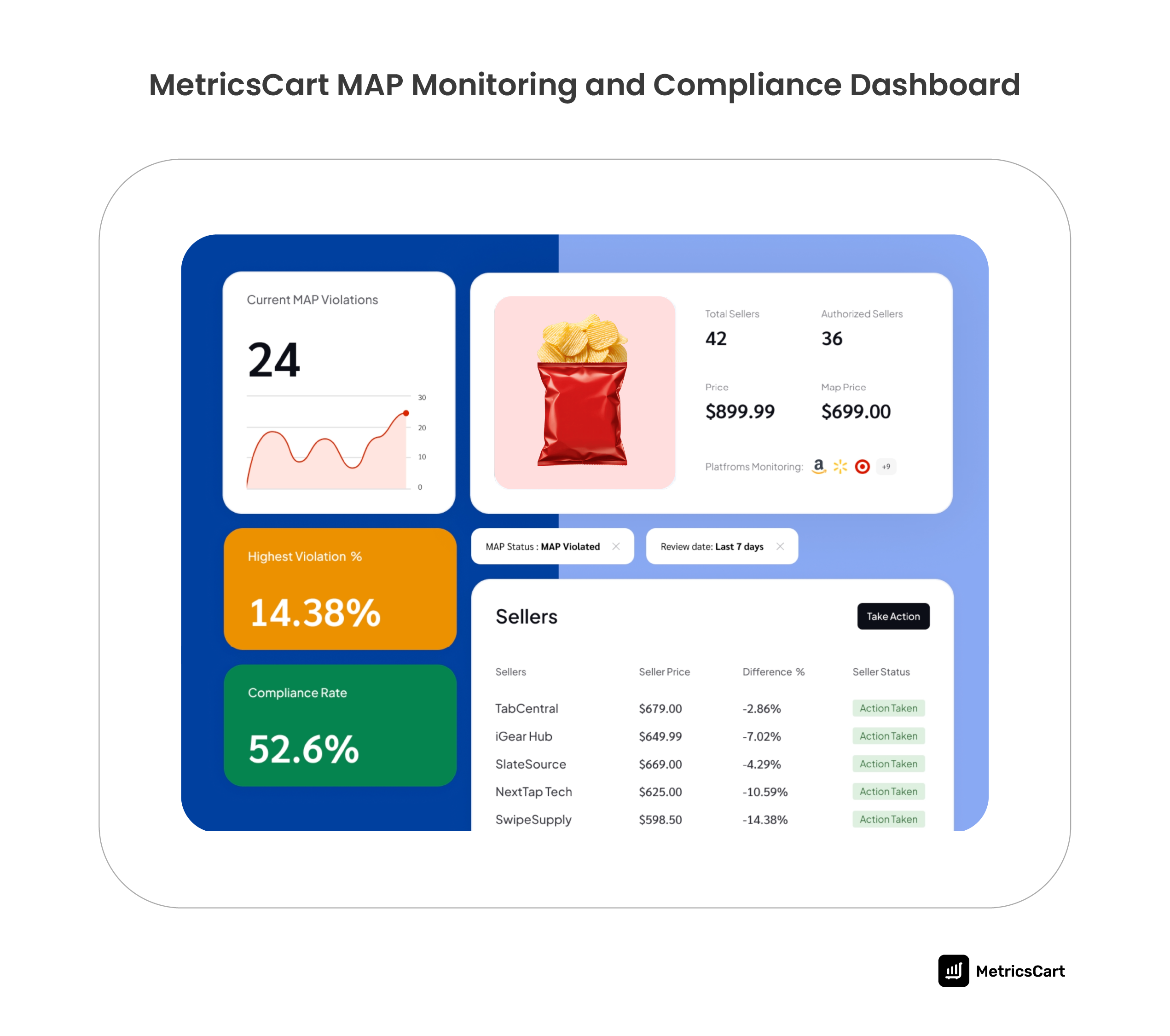
Here’s the reality. A MAP policy is only as strong as your ability to enforce it. If you’re relying on manual checks or spot monitoring, violations will slip through, and your enforcement will always be one step behind.
MetricsCart tracks advertised prices across retailer websites and marketplace listings around the clock. The moment a seller advertises below your MAP floor, you get flagged with the exact listing, the price shown, and a timestamp. Everything you need to act is right there.
What this also solves is the consistency problem. Because every seller in your network is monitored the same way, no one gets a pass. Your largest retail account is held to the same standard as your smallest one. That equal treatment is what makes MAP enforcement legally defensible.
Stay ahead of MAP enforcement before it becomes a legal risk.
FAQs
Yes. MAP policies are legal in the United States as long as the brand sets them independently and applies them only to advertised prices. A brand can choose to stop supplying retailers that don’t comply, as long as it makes that decision on its own terms.
A MAP violation happens when a retailer publicly displays a price below your MAP floor. This includes product listing pages, promotional emails, and paid ads. A lower price that only appears at checkout does not count as a violation.
Not when it is set and enforced correctly. MAP becomes a legal risk when brands coordinate pricing with competitors, enforce it as a minimum selling price, or apply it inconsistently across their seller network.
MAP controls the price a retailer can show publicly. Resale price maintenance controls what price a retailer actually charges the customer. With MAP, retailers are free to sell at any price they choose, as long as they advertise at or above the floor price.
Take a screenshot of the listing, record the date, and keep a log of all communications with the retailer. Consistent documentation is what protects your enforcement program if it is ever questioned.