
Highlights
- Standard online review monitoring only tracks star ratings and volume. It misses the attribute-level signals that drive product, packaging, and pricing decisions.
- Aspect-Based Sentiment Analysis (ABSA) breaks reviews into individual product attributes, routing the right insights to the right teams.
- Food and beverage reviews differ significantly. Food feedback centers on taste, texture, and ingredient perception. Beverage reviews focus on flavor intensity, functional efficacy, and packaging integrity.
- The right review monitoring platform surfaces competitive gaps, not just your own brand’s weaknesses.
- MetricsCart’s Ratings and Reviews Analysis platform delivers SKU-level, marketplace-level sentiment breakdowns with theme analysis, NPS tracking, and competitor benchmarking in one place.
Introduction
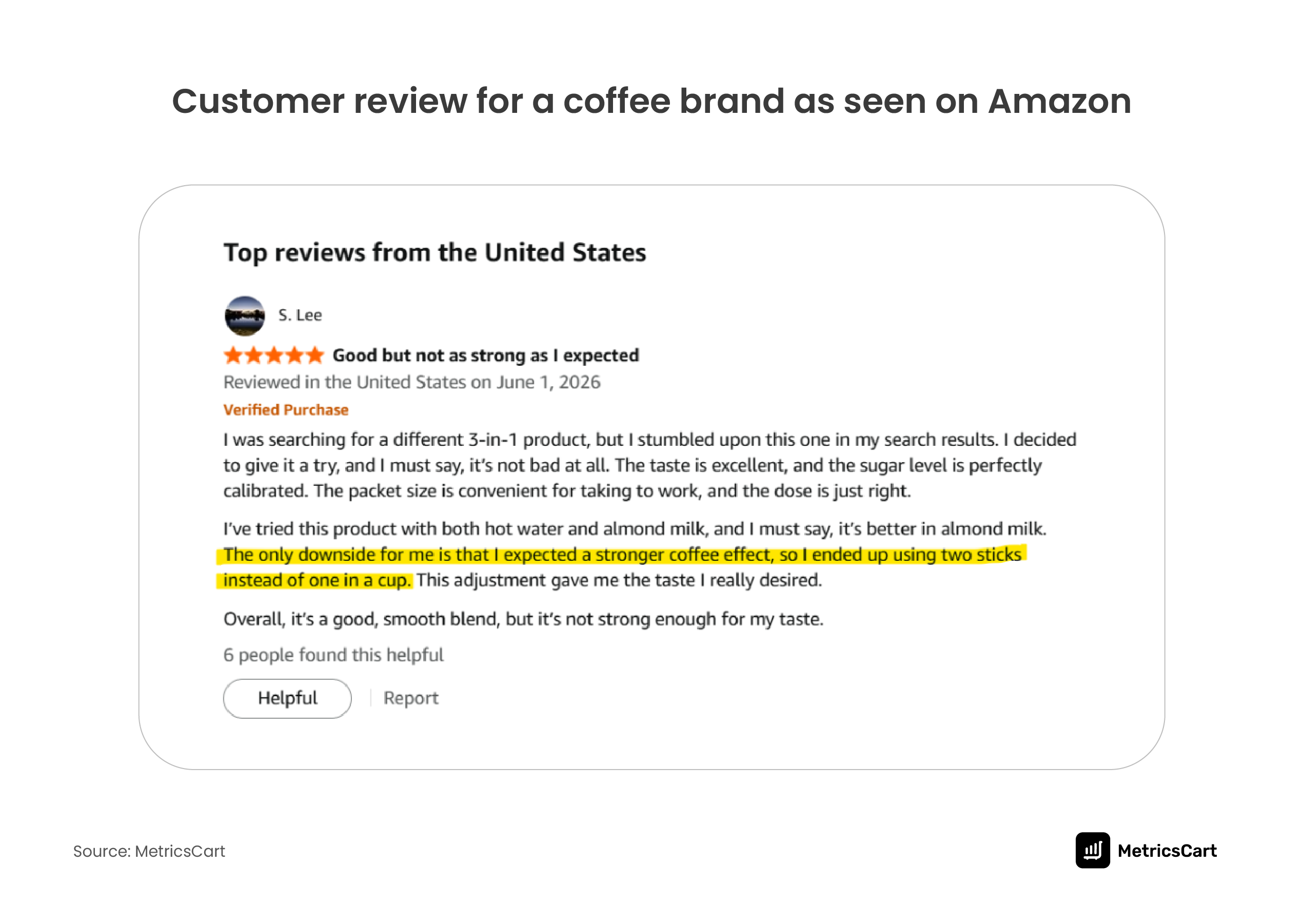
Above is a customer review as seen on Amazon for a coffee brand. The customer gave the product a 5-star rating, praised the taste, packaging, and the overall experience. The kind of review any brand would be happy to receive, read and may even feature as testimonial.
But look a little closer. The customer also mentions that the coffee wasn’t as strong as they expected. That right there is a product intelligence signal.
It tells the brand that while customers like the product, there may be demand for a stronger formulation. It’s the kind of insight the R&D team can use to decide whether to refine the existing product, develop a stronger variant, or launch a new product line for a different consumer preference.
And uncovering opportunities like these, hidden across thousands of customer reviews, is exactly why review monitoring for food and beverage brands is so important.
What Is Review Monitoring for Food and Beverage Brands?
Review monitoring is the process of collecting, tracking, and analyzing customer reviews for a brand or product across e-commerce marketplaces, retailer websites, quick commerce platforms, social channels, and review sites.
Unlike many other categories, food and beverage review monitoring often reveal detailed feedback on taste, texture, freshness, packaging, ingredients, portion size, value for money, and even dietary preferences, making them an invaluable source of consumer and product intelligence.
When done right, reviews become a direct line to the voice of the customer, helping brands make better decisions across product development, marketing, category management, and digital commerce.
READ MORE | Review Monitoring on Digital Shelf: Why it Matters?
Why Standard Review Monitoring Isn’t Enough for Food and Beverage Brands
Standard review monitoring typically looks like this:
- Checking aggregate star ratings on Amazon and other platforms weekly
- Reading flagged one and two-star reviews manually
- Tracking total review volume as a proxy for brand health
- Occasionally pulling a keyword search for specific product names
This is what could be called “A/B level” review monitoring. It is surface-level, reactive, and unable to distinguish between different types of problems or opportunities at scale. They tell you how many reviews came in, what the average rating is, and whether sentiment is trending positive or negative. For a general consumer goods brand, that might be enough.
For food and beverage, it isn’t.
F&B products are judged on dimensions that generic sentiment tools flatten into a single score. A beverage with a 4.2 rating might be hiding a consistent complaint about aftertaste that only shows up in the third sentence of a five-star review. A snack brand’s new flavor launch might be pulling down the parent product’s rating without anyone catching it, because no one is tracking at the SKU level.
The category also moves faster than most. Reformulations, seasonal variants, packaging changes, and regional distribution shifts all create review patterns that require attribute-level reading, not just positive or negative bucketing.
There is also the portfolio problem. A mid-sized F&B brand might have dozens of active SKUs across multiple retailers. Standard monitoring tools surface what is loud, not what is structurally important. A low-review SKU with a persistent texture complaint gets buried under the noise from a high-velocity product.
What F&B brands actually need is monitoring that reads reviews the way a category manager would: by product attribute, by SKU, by retailer, and by time period, so the signal is specific enough to act on.
The Role of Aspect-Based Sentiment Analysis (ABSA)
The advancement that separates modern review intelligence as given by tools like MetricsCart’s Rating and Review analysis platform from traditional monitoring is Aspect-Based Sentiment Analysis (ABSA).
Rather than classifying a review as positive or negative in aggregate, ABSA identifies specific product attributes mentioned in each review and scores the sentiment associated with each attribute independently.
For a food brand, this means, a single review that says “love the taste but the bag is impossible to reseal and the price went up again” gets broken into three distinct signals: positive taste sentiment, negative packaging sentiment, and negative value sentiment.
Multiply this across thousands of reviews and you get attribute-level intelligence that can be routed directly to the right function:
- Taste complaints go to R&D and product development
- Packaging feedback goes to packaging and supply chain teams
- Value perception signals go to pricing and marketing
- Delivery and condition complaints go to logistics and fulfillment
Without ABSA, a 3.8-star product looks uniformly mediocre. With it, you know exactly which dimension of the product is underperforming, and which team should act.
READ MORE | Power Up Your Business With Thematic Review Analysis: A Brand Guide
Food Reviews vs. Beverage Reviews: How the Insights Differ
Food and beverage might sit in the same industry vertical, but the nature of customer feedback, the themes that emerge, and the operational implications are meaningfully different.
Food Products: What Reviews Reveal
For food products, taste and texture dominate the conversation. But the nuances within those themes matter enormously.
Taste and Flavor
Shoppers are specific. They do not just say “it tastes good.” They say “the chocolate flavor is too artificial” or “the cinnamon flavor is overpowering compared to the last version.” For brands, this level of detail is reformulation intelligence. If 200 reviews in 90 days mention that a flavored oatmeal has become “sweeter than before,” that is a product development signal.
Common flavor-related themes in food reviews:
- Authenticity of flavor (does it taste like the thing it claims to be?)
- Sweetness balance
- Saltiness or seasoning intensity
- Off-notes or chemical aftertaste
- Consistency across batches
Texture and Mouthfeel
For categories like cereals, snack bars, crackers, or baked goods, texture complaints are often the leading indicator of declining repeat purchase. Terms like “soggy,” “stale,” “too hard,” or “falls apart” show up well before return rates move.
| Food Category | Common Texture Themes | Typical Complaint Signal |
| Cereals | Crunch, sogginess | “Goes soft too fast in milk” |
| Snack bars | Chewiness, hardness | “Too hard to bite into” / “Crumbles in the bag” |
| Crackers | Snap, fragility | “Arrived broken” / “Too thick” |
| Frozen meals | Post-microwave texture | “Rubber-like after heating” |
| Baked goods | Moistness, density | “Dry” / “Dense compared to before” |
Nutritional and Ingredient Perception
For health-positioned food brands, the ingredient list is often reviewed as carefully as the product itself. Reviews will surface concerns about specific ingredients (seed oils, artificial sweeteners, gums and emulsifiers) that may not be prominent in your NPS surveys but show up consistently in customer language.
This is particularly relevant for cereal brands, protein products, snack bars, and any brand positioning around “clean label” or “better for you.”
Format and Packaging
Portion size, resealability, and convenience are major themes in food reviews. A trail mix that reviews well on taste but poorly on the bag’s seal mechanism will see steady complaints that are easy to miss if you are only tracking star ratings.
READ MORE | How to Perform Review Sentiment Analysis: A Step-by-Step Guide
Beverage Reviews: A Different Set of Signals
Beverage reviews carry a different texture. The feedback tends to move faster, the sensory vocabulary is different, and functional and health claims face heavy scrutiny.
Taste and Flavor Intensity
Beverages get reviewed on a more polarized taste spectrum. Carbonated drinks, for example, generate feedback around sweetness level, carbonation intensity, and whether the flavor “lasts” through the drink.
Common themes by beverage subcategory:
| Beverage Type | Primary Review Themes | Key Differentiators |
| Carbonated soft drinks | Sweetness, fizziness, flavor authenticity | “Too sweet,” “not enough carbonation” |
| Energy drinks | Taste vs. function tradeoff, aftertaste | “Works well but tastes medicinal” |
| RTD Coffee | Sweetness, coffee strength, dairy alternatives | “Too milky,” “not enough espresso flavor” |
| Plant-based milks | Creaminess, taste in hot drinks, separation | “Separates in coffee,” “chalky aftertaste” |
| Functional beverages | Efficacy perception, ingredient taste | “Can taste the collagen” / “No noticeable effect” |
| Bottled water / sparkling | Mineral taste, carbonation level | “Flat within minutes of opening” |
Functional Claims and Efficacy
This is unique to beverages more than most food subcategories. When a brand sells a “focus-enhancing” drink or a “gut health” kombucha, customers review the claim as much as the product.
Negative reviews in this area often indicate a gap between marketing promise and product experience, which is both a messaging and formulation issue.
Packaging for Beverages
Leakage, cap quality, can denting in transit, and fill level complaints are disproportionately common in beverage reviews.
A drink that arrives with a damaged seal or a bottle that leaks in a customer’s bag will generate a one-star review regardless of how good the product tastes.
Without separating packaging sentiment from product sentiment, your brand’s star rating absorbs a problem that belongs to your logistics or packaging supplier.
Top 3 Food and Beverage Review Monitoring Tools
Here are the top 3 review monitoring tools food and beverage brands can use for customer review monitoring, brand reputation management, competitive benchmarking, and product intelligence.
While each platform helps brands analyze customer feedback, they differ in their depth of analysis, reporting capabilities, and focus areas.
MetricsCart Ratings & Reviews Analysis
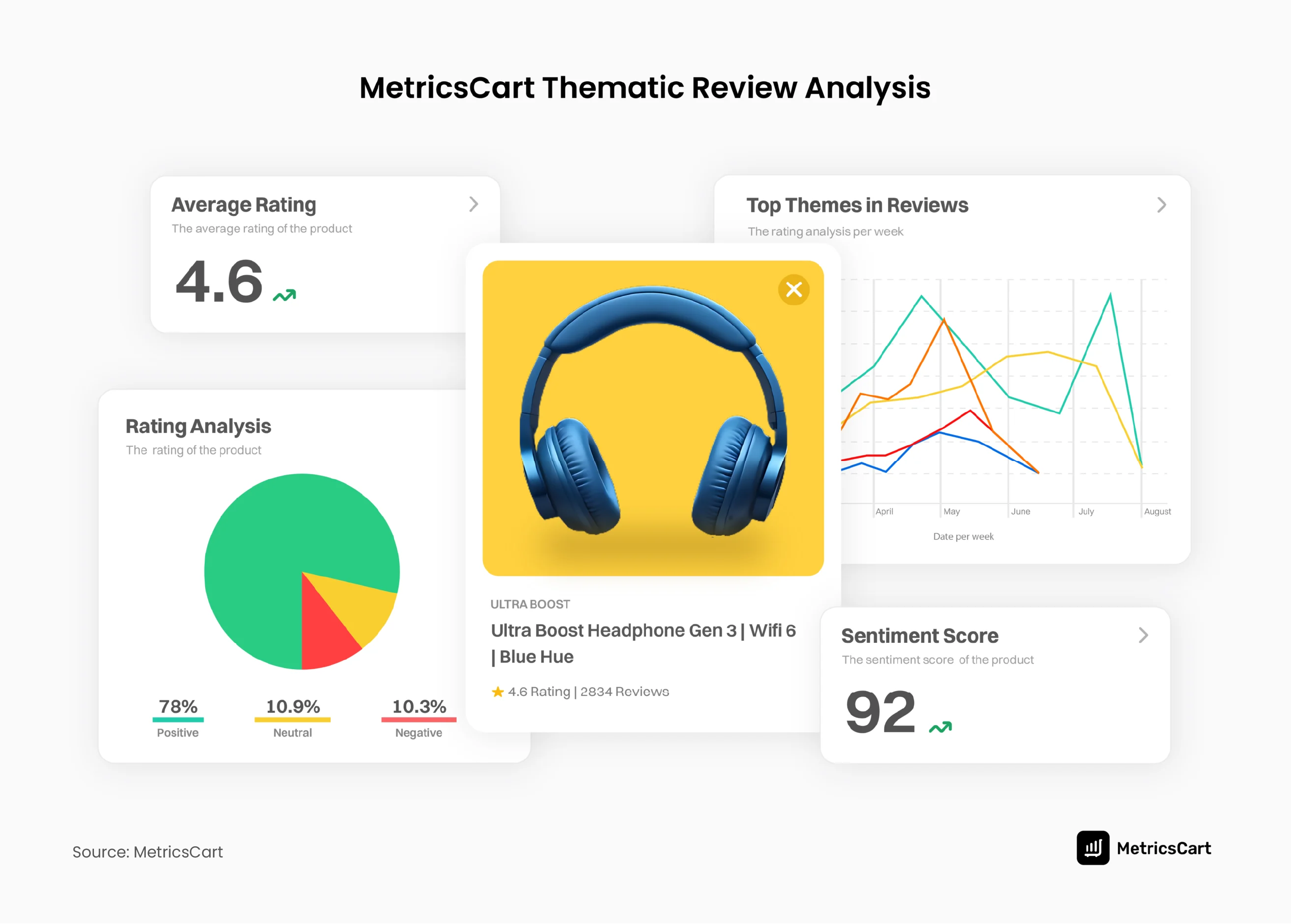
MetricsCart offers one of the best review monitoring tools built specifically for CPG brands operating on the digital shelf. Beyond simply doing star rating aggregation and surface-level review analysis, MetricsCart Rating and Review analysis offers:
- Theme-Based Analysis: Surfaces recurring positive and negative themes at the sub-attribute level.
- Advanced Sentiment Analysis: Automatically categorizes feedback by emotion and attribute, enabling teams to track changes in customer perception week over week, by SKU, by marketplace.
- Competitor Benchmarking: Lets brands compare their review themes and sentiment scores against competitors, directly surfacing what gaps exist in the market and what customer expectations competitors are failing to meet.
- NPS Tracking: Monitors Net Promoter Score fluctuations daily, tying loyalty signals to specific product or experience changes.
- Multi-Marketplace Coverage: Covers 150+ global marketplaces including Amazon, Walmart, Target, Instacart, Tesco, Woolworths, and global marketplaces. Custom
MetricsCart clients include global CPG brands like PepsiCo and the platform has demonstrated measurable outcomes.
A snack brand used its competitor review benchmarking to identify rising demand for a truffle parmesan flavor variant and an unmet need around cheese flavor depth in competitor products. It’s the intelligence that directly shaped their product launch and drove stronger early performance.
For F&B brands that need attribute-level insight at scale across multiple retailers, MetricsCart is the most purpose-fit option in this category.

2. Revuze
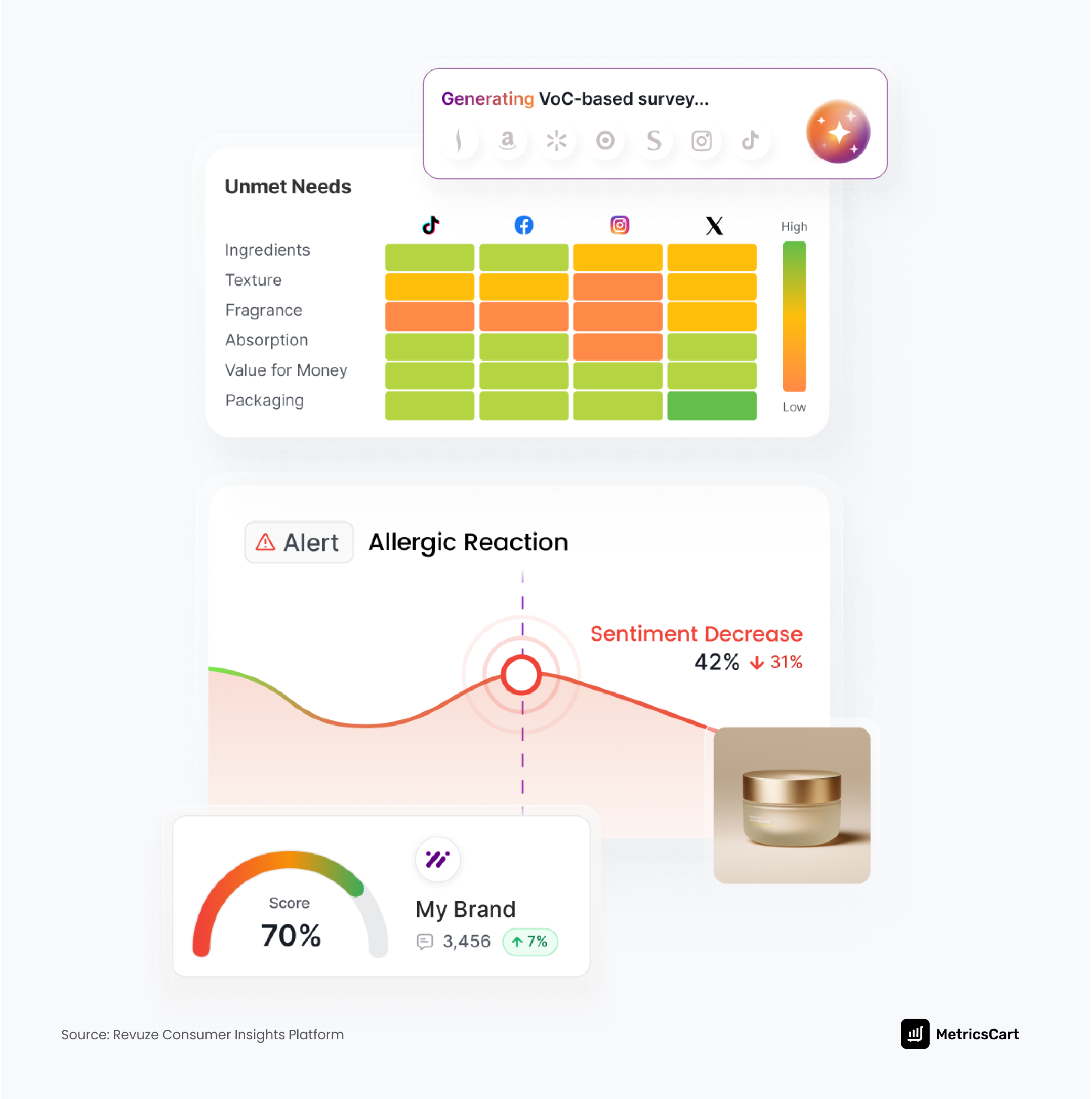
Revuze is a consumer insights platform that helps brands analyze customer reviews and other feedback at scale. It is widely used by CPG companies for market research, product development, and voice of customer analysis.
Key features of Revuze include:
- AI-powered review analysis
- Aspect-based sentiment analysis
- Voice of Customer (VoC) analytics
- Category and competitor benchmarking
- Product attribute segmentation
- Consumer trend detection
- Dashboards for market research and insights
- Supports product innovation and R&D
3. Yogi
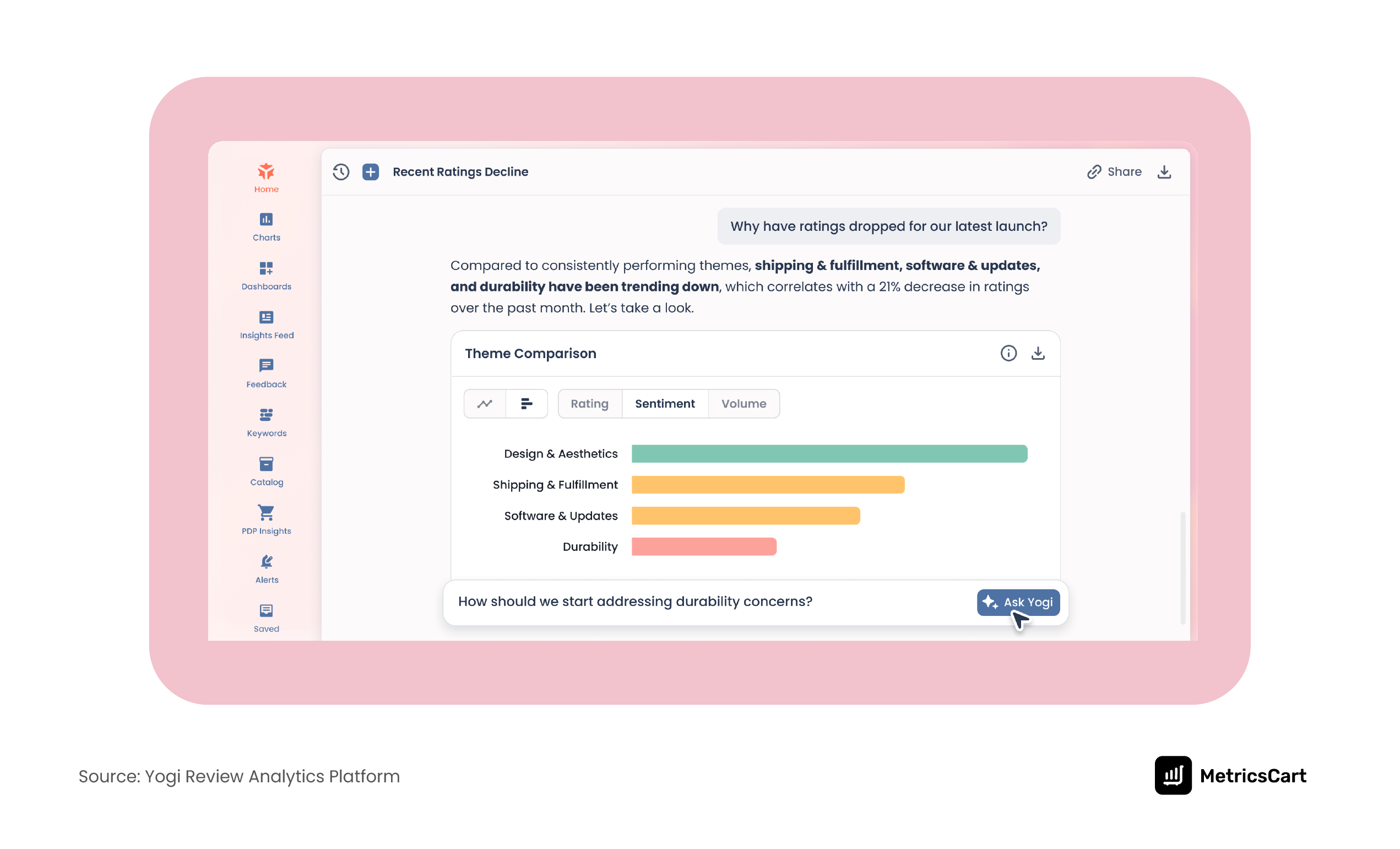
Yogi is another review analytics platform that aggregates customer feedback from multiple sources and organizes it into actionable themes. It is designed for brands looking to understand customer sentiment, identify recurring issues, and improve products using review intelligence.
Key features of Yogi include:
- AI-powered review aggregation
- Automatic theme and topic detection
- Customer sentiment analysis
- Voice of Customer insights
- Cross-platform review monitoring
- Recurring issue identification
- Trend tracking across reviews
- Workflow integrations for product and CX teams
READ MORE | Choosing the Right Online Review Management Software: A Brand Perspective
Turning Review Intelligence into Competitive Advantage
Customer reviews are more than feedback. They are a continuous source of product, market, and competitive intelligence. And review monitoring is not just about protecting brand reputation. It is about understanding your customers better than your competitors do, and using that knowledge to build better products, stronger listings, and more informed business decisions.
To get the most value from review monitoring it’s important to analyze reviews at the attribute level. Go beyond overall ratings to understand what customers think about taste, texture, packaging, ingredients, value, and more.
Also, along with your own, keep an eye on the reviews that come in for your competitors as well. It will help understand unmet customer needs, product gaps, and positioning opportunities that can shape your product and marketing strategy.
Platforms like MetricsCart Ratings and Review analysis make it all scalable and effortless. They automate review collection, aspect-based sentiment analysis, competitor benchmarking, and trend detection, helping food and beverage brands turn customer feedback into faster, data-driven decisions.
Discover the product intelligence hidden in every customer review!
FAQs
When customers describe taste experiences in reviews, patterns emerge at scale. ABSA tools can identify recurring terms (like “artificial aftertaste” or “not as flavorful as before”) and quantify their frequency, giving brands early signals about reformulation issues or flavor perception gaps.
Phrases like “reordering immediately,” “my new go-to,” and “have already bought three times” are strong loyalty signals. Conversely, “went back to my old brand,” “last purchase,” and “not worth the price anymore” signal churn risk.
Standard sentiment analysis classifies a review as positive or negative overall. ABSA identifies individual product attributes mentioned in the review (taste, packaging, price, texture) and scores sentiment separately for each one, enabling attribute-level insight rather than a blended average.
By monitoring the frequency of specific flavor-related terms over time, with week-over-week trend tracking by SKU. An increase in terms like “too sweet,” “chemical taste,” or “not like before” can surface batch or formulation issues before they cause measurable rating damage.
Yes. MetricsCart is as good as any pure-play review monitoring platform, offering a dedicated Ratings & Reviews Analysis solution with capabilities like aspect-based sentiment analysis (ABSA), review monitoring, competitor benchmarking, trend detection, and product intelligence. In addition, MetricsCart also integrates these insights with broader digital shelf analytics, including pricing, content compliance, assortment, share of search, and competitor intelligence, giving brands a more complete view of marketplace performance.