Highlights
- Walmart MAP (Minimum Advertised Price) monitoring helps brands track product listings on Walmart to ensure sellers aren’t advertising below approved minimum pricing. It automates compliance monitoring, flags unauthorized sellers, and protects your Buy Box, brand value, and profit margins.
- Amazon’s repricing systems continuously scan Walmart pricing, meaning a single MAP violation on Walmart can trigger price drops across Amazon within hours.
- Legacy MAP tools miss Walmart violations due to delayed scanning, incomplete SKU matching, poor seller identification, and Walmart’s anti-bot defenses.
- Effective Walmart MAP enforcement requires real-time cross-platform monitoring, child-SKU tracking, automated alerts with screenshot evidence, and repeat seller analysis.
- Brands that ignore Walmart in their MAP program risk silent price erosion, weakened trust with retailers, wasted ad spend, and unchecked unauthorized sellers.
If your Amazon pricing suddenly shifts and nothing inside Amazon seems to explain it, the trigger may not be Amazon at all. More often than brands realize, the pricing disruption starts on Walmart.
Amazon and Walmart together account for nearly half of US e-commerce sales. With 9.2% of the US e-commerce market share, over 200,000 active third-party sellers, and roughly 420 million product listings, pricing activity on Walmart now ripples across the entire digital shelf.
Moreover, Walmart’s pricing behavior increasingly affects Amazon’s algorithms, reseller pricing decisions, and your brand’s pricing integrity across the entire digital shelf.
The problem is that most brands do not realize Walmart is the source. Many assume their existing MAP monitoring tools already cover it effectively. In reality, Walmart remains one of the biggest blind spots in marketplace price enforcement, and by the time brands notice the impact, the pricing damage has already spread across channels.
This guide unpacks how Walmart MAP monitoring works, why most MAP pricing monitoring tools fall short on Walmart, and what brands need to do to ensure their Amazon MAP monitoring program does not have a Walmart-shaped gap.
Why does Walmart Belong in Every Brand’s MAP Pricing Monitoring Strategy?
Walmart’s pricing system works differently from Amazon’s, and those differences are exactly why MAP violations behave differently here.
Walmart runs on an Everyday Low Price (EDLP) model, a pricing strategy built around maintaining consistently low shelf prices rather than cycling between high prices and promotional discounts.
The platform expects prices to stay consistently low, not just competitively low. On top of that, Walmart layers in Rollback promotions, temporary price cuts that can last a few days to several months and snap back without warning.
In Q4 of fiscal year 2026 alone, Walmart ran roughly 6,200 Rollbacks, up 23% from the previous year. For brands trying to maintain a MAP floor, such price movement makes it harder to distinguish real violations from legitimate promotional activity.
The Buy Box works differently, too. Amazon rotates its Buy Box among qualified sellers based on price, fulfillment speed, and seller metrics. Walmart does not rotate. It awards the Buy Box to the single lowest landed price, which is the item cost plus shipping. Every seller on the listing is racing to be the cheapest, and automated repricing tools adjust offers multiple times a day to get there.
For brands, this means three things.
- First, MAP violations at Walmart occur more quickly. A seller can drop below MAP, win the Buy Box, clear inventory, and disappear before a daily scan ever picks it up.
- Second, MAP violations are harder to detect. Walmart’s bundle, multipack, and variant structures are different from Amazon’s; a seller can list a custom bundle that brings the per-unit price below MAP without ever changing the listed price of the individual product.
- Third, Walmart actively monitors competitor pricing across platforms. If your product is listed at a lower price elsewhere, including on Amazon, Walmart may suppress your listing or reduce its visibility until the price aligns. That cross-platform pricing pressure works in both directions.
Then there is the question brands ask most often: What if we do not sell on Walmart at all? The need for monitoring does not go away. Products reach Walmart through unauthorized sellers, grey market channels, wholesale leakage, and liquidation buyers.
These listings appear without the brand’s knowledge, often at prices well below MAP. Without active monitoring and a clear MAP pricing policy, they go undetected, quietly driving down prices on Amazon and across every other channel where the brand sells.
How Does Amazon React to Lower Prices Listed on Walmart?
Amazon does not formally match Walmart’s prices. But its automated pricing systems and third-party repricers continuously scan Walmart listings and, when they detect a lower price, adjust downward. As a result, a MAP violation on Walmart can trigger price drops on Amazon within hours.
If unauthorized sellers are undercutting MAP on Walmart and Amazon, sellers and repricers can quickly mirror those cuts.
Here is how a single Walmart MAP violation cascades into Amazon:
- An unauthorized seller lists your product below MAP on Walmart.
- Amazon’s pricing systems and third-party repricers detect the lower price.
- Amazon sellers adjust downward to stay competitive.
- Authorized sellers lose Buy Box position or margin on Amazon.
- Ad spend on Amazon now drives traffic to an unauthorized seller.
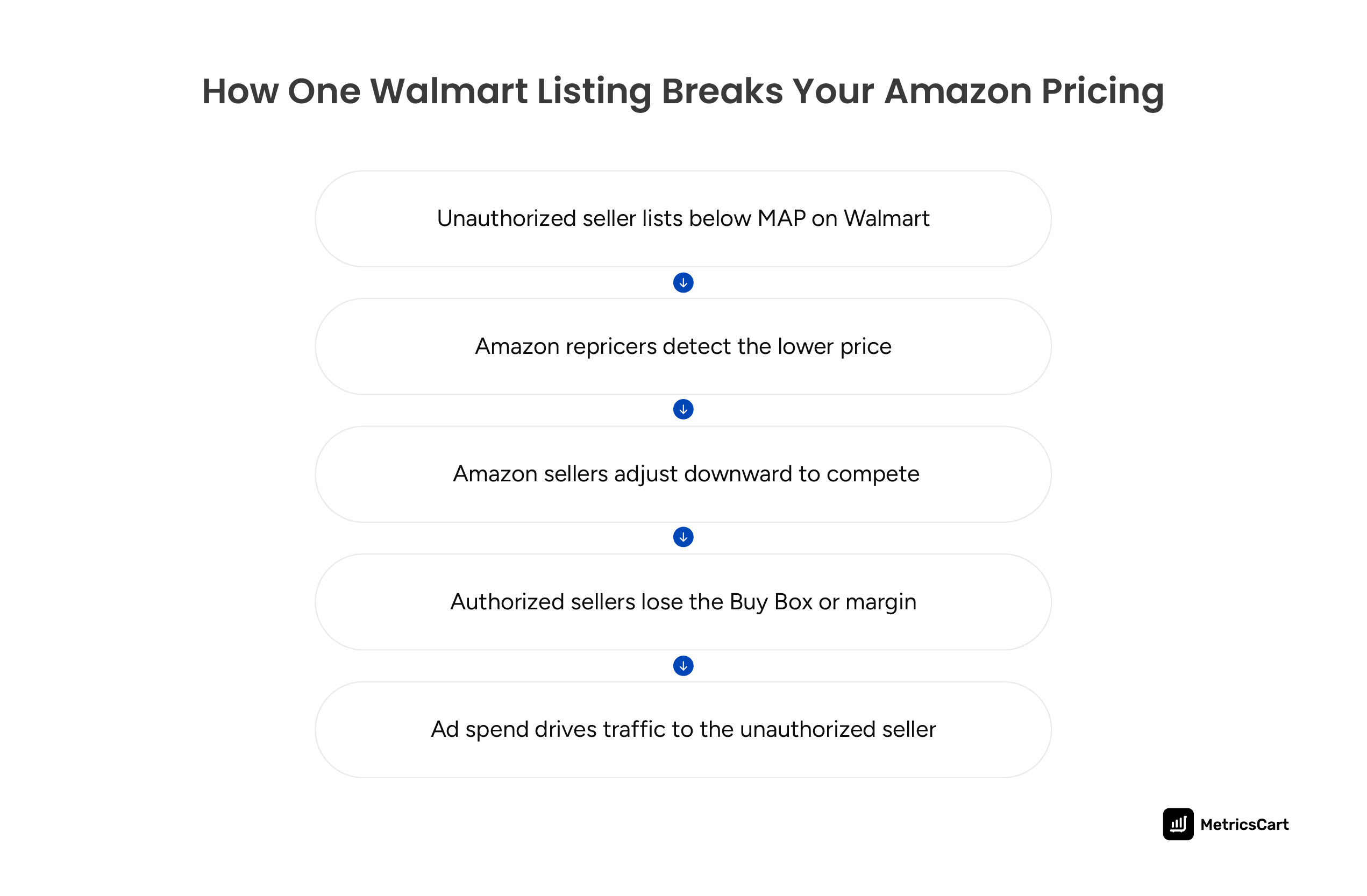
This indirect connection means Walmart pricing feeds into how products perform on Amazon and across other retail channels. That is why Walmart MAP monitoring directly affects Amazon’s pricing stability.
Common Types of MAP Violations at Walmart
MAP violations on Walmart do not look the same as they do on Amazon. The platform creates patterns that are easy to miss if your monitoring is built around Amazon’s logic.
Third-Party Seller Undercutting
Unauthorized sellers list your product below MAP to move inventory fast. They have no relationship with your brand and no incentive to protect your pricing floor. On Walmart, where the Buy Box typically goes to the single lowest landed price, these sellers can win visibility almost instantly and start dragging your pricing down before your team even spots the listing.
Buy Box Price Competition
Multiple sellers competing for Walmart’s Featured Offer can push advertised prices below MAP, not because anyone sets out to violate MAP, but because automated repricing tools keep shaving pennies off to win the box. The price gradually drifts below your MAP floor, and no single seller appears to be the obvious offender.
Bundle and Multipack Workarounds
A seller creates a custom bundle or multipack that brings the per-unit price below MAP without ever changing the listed price of the individual product. On paper, the listing looks clean. In practice, your pricing floor just got undercut through the side door. These are among the most commonly missed violations at Walmart because they do not trigger standard price-threshold alerts.
Multi-Account Sellers
Some sellers operate under multiple Walmart accounts. When one account gets flagged or penalized, it continues to violate by using another one. Without MAP monitoring that connects seller behavior across accounts, these repeat offenders cycle through enforcement actions and keep going.
Clearance and Liquidation Pricing
Products acquired through liquidation channels enter Walmart’s marketplace at well below wholesale cost. That means sellers can list below MAP and still turn a profit, making these violations persistent rather than temporary. The listing stays up, the price stays low, and the damage compounds until someone intervenes or the inventory runs dry.
Recognizing these patterns is the first step toward building an enforcement program that actually works at Walmart.
Why do Most MAP Monitoring and Enforcement Tools Miss Walmart Violations?
Many older MAP monitoring tools, which focus on Amazon or broad web scraping, lack the depth needed to capture Walmart’s pricing ecosystem. Walmart’s pricing patterns, including EDLP, promotions, rollbacks, and frequent adjustments, are different from typical Amazon marketplace behavior.
Tools that aren’t built to parse these patterns can misidentify listings, miss violations on bundles or multipacks, or fail to detect unauthorized seller behavior at scale.
Moreover, they have limitations such as:
- Delayed or infrequent price tracking. Walmart repricers adjust in minutes. Tools that scan daily or weekly miss violations entirely. By the time the next scan runs, the damage has already crossed platforms.
- Incomplete SKU matching. Bundles, multipacks, and product variations are structured differently on Walmart than on Amazon. Tools that cannot match at the child-SKU level miss violations or generate false alerts.
- Poor seller identification. Walmart’s open marketplace makes it harder to separate authorized sellers from unauthorized ones. Tools without robust seller detection allow violators to operate unnoticed.
- Blocked by Walmart’s anti-bot defenses. Walmart has deployed advanced anti-scraping technology that prevents legacy monitoring tools from reliably accessing pricing data. Many providers still list Walmart coverage on their website, but quietly deliver incomplete or missing violation reports because their extraction methods cannot keep up with Walmart’s evolving defenses.
Some providers have quietly reduced or eliminated coverage for Walmart entirely. Others keep Walmart listed in their marketing materials but deliver inconsistent data. They report fewer violations, not because the marketplace is healthier, but because their extraction capabilities have degraded.
These gaps delay the detection of MAP violations and allow unauthorized pricing to seep into other channels before enforcement teams can act.
READ MORE | Confused about selecting the right MAP monitoring software? Check out the best map compliance monitoring software you should consider for e-commerce.”
How to Check Whether Your MAP Provider Actually Covers Walmart?
- Request a sample MAP violation report that includes screenshots, seller names, and timestamps.
- Ask about scan frequency, child-SKU matching, bundle detection, and individual seller identification on Walmart.
- Compare violation counts across platforms. Zero Walmart violations alongside active Amazon violations usually mean degraded extraction, not a clean marketplace.
- Ask what extraction methodology they use. Open-source scraping tools cannot keep up with Walmart’s anti-bot defenses.
- Run a manual spot check. Search your products on Walmart.com and compare against your provider’s dashboard.
If your current setup is falling short, building a stronger foundation starts with understanding how MAP monitoring works, what it captures, how violations are tracked, and where most tools fall short.
The MAP Monitoring Masterclass course walks through all of this, with real examples from brands managing enforcement across multiple platforms. Watch the full playlist here: https://youtube.com/playlist?list=PLyioClS_gEc41gr0QEhYWkNCXA9P2sYy9&si=NPkEq0OsPzklafN3
What Effective Walmart MAP Monitoring Looks Like in Practice
An effective solution must continuously monitor Walmart and stay in sync with Amazon and other channels. MetricsCart’s MAP pricing monitoring software tracks prices and seller behavior in real time across 150+ e-commerce platforms globally. It helps brands and sellers flag violations quickly so you can act before they cascade across the digital shelf.
Accurate Seller Identification and Violation Capture
MetricsCart goes beyond generic price tracking. It automatically captures screenshots, timestamps, and seller details whenever there’s a MAP violation, including:
- Unauthorized seller detections
- Price drops below the MAP policy on Walmart and Amazon
- SKU‑level insights for complex catalogs
This makes MAP enforcement easier and supports solid reseller conversations or policy escalations.
READ MORE | See how MetricsCart helped Prevent MAP Violations. Check out Kitchen Electronics Brand Cut MAP Violations by 65% with MetricsCart
Automated Alerts and Customizable Reporting
Brand teams need clarity, not confusion. MetricsCart’s Walmart MAP price monitoring solution provides automated alerts with customizable thresholds, so your team sees only the most relevant signals and not noise. Detailed violation reports let you spot repeat offenders, seasonal trends, and pricing vulnerabilities.
Unified Digital Shelf Visibility
The best MAP monitoring isn’t siloed. MetricsCart combines Walmart price monitoring with broader digital shelf analytics, including search visibility, review signals, pricing trends, and content compliance, all on one platform. That gives you context for MAP enforcement decisions and helps you plan pricing and channel strategies with full confidence.
Hidden Discount and Promotion Monitoring
Not every MAP violation looks like a straightforward price cut. Some sellers use coupon stacking, cart-level discounts, or promotional codes that bring the effective advertised price below MAP without changing the listed price on the product page. Effective Walmart MAP monitoring needs to detect these hidden price reductions that standard tracking tools miss entirely.
Historical Tracking and Repeat Seller Analysis
Catching a violation once is not enough. Brands need to see patterns over time. Which sellers violate repeatedly? Which products are targeted most often? When do violations spike, around holidays, product launches, or competitor activity? Historical tracking turns individual violation alerts into a strategic enforcement picture, helping brands prioritize action where it will have the most impact.

Don’t Let Walmart Be Your Blind Spot
Walmart’s influence on e-commerce pricing is clear. Prices that slip below MAP on Walmart can quickly echo across platforms, impacting Amazon pricing, automated repricing engines, and your brand’s market perception. Without Walmart MAP monitoring, you risk silent price erosion, weaker marketplace control, and strained relationships with retailers.
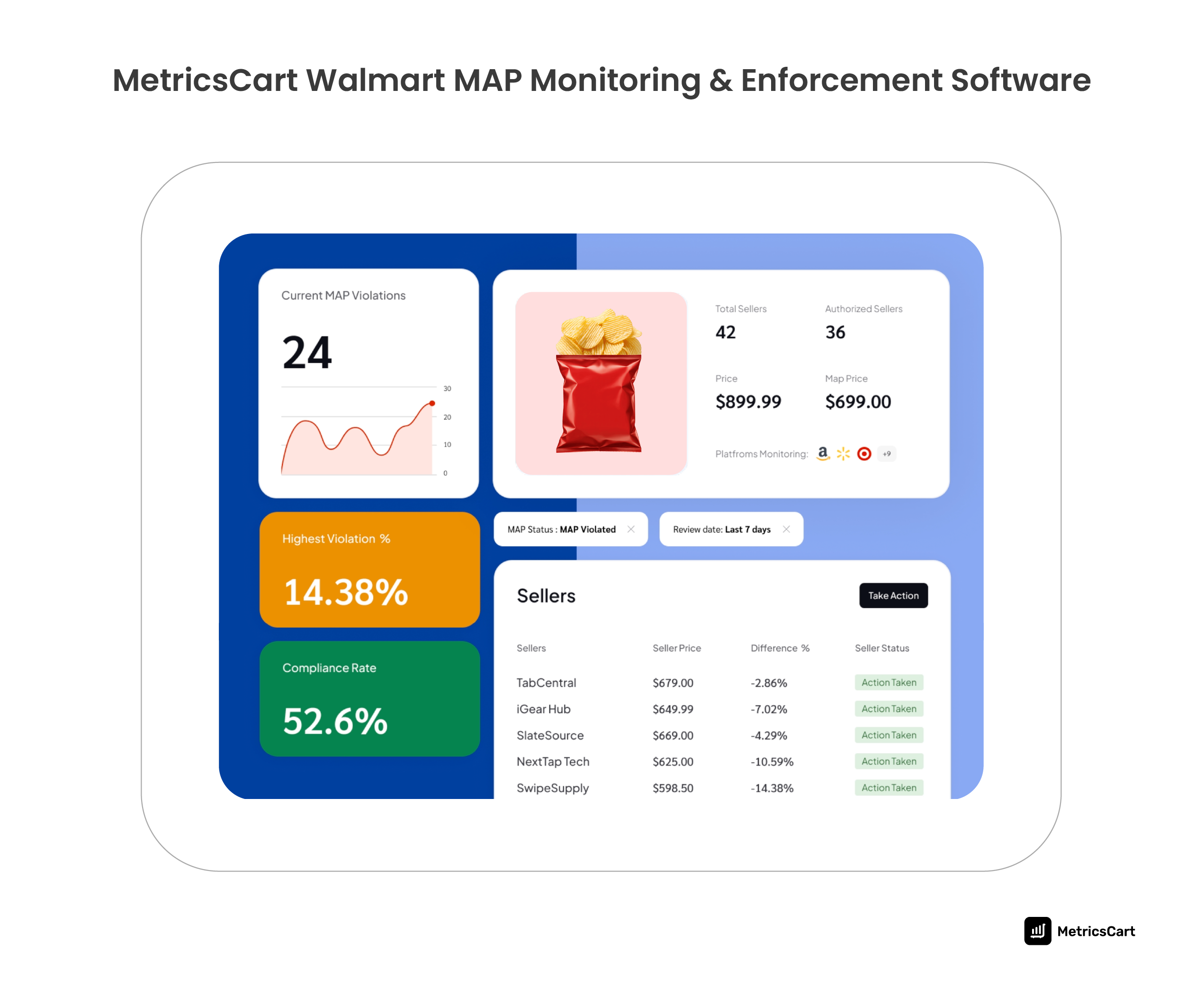
A dedicated marketplace intelligence solution like MetricsCart fills this gap with real‑time visibility, automated enforcement support, and unified insights across major online channels.
Combined with digital shelf analytics covering pricing trends, search visibility, review signals, and content compliance, MetricsCart gives brand teams the full picture, not just where violations are happening, but why they keep happening and who is behind them.
Your MAP policy already exists. The question is whether you can see it being broken in real time, on every platform, before the damage spreads.
Detect, Track, and Act on MAP Violations Faster with MetricsCart.
FAQs
Yes, because Walmart’s pricing directly affects Amazon. Amazon’s pricing algorithms frequently track Walmart’s prices, so a lower price at Walmart can automatically trigger a price drop on Amazon, affecting margins and brand positioning. Even without a direct selling relationship on Walmart, your products can appear there through unauthorized sellers or gray market channels, and those listings influence pricing across every platform where you do sell.
Through automated repricing. Amazon continuously monitors competitor sites, including Walmart, as part of its dynamic pricing system. If Walmart lists an item at a lower price, whether due to Everyday Low Pricing (EDLP), unauthorized sellers, or markdowns, Amazon’s algorithms and third-party repricers can match that price almost instantly, eroding profitability for brands.
Price erosion spreads silently. When Walmart listings undercut MAP, other marketplaces like Amazon react. Brands then face reduced margins, inconsistent pricing visibility, unauthorized seller activity, retailer distrust, and weakened relationships with authorized retail partners. The longer Walmart goes unmonitored, the harder it becomes to trace where the pricing damage started.
Because Walmart’s defenses are harder to get through. Walmart has implemented advanced anti-bot and anti-scraping technologies that block unauthorized data collection. Many legacy MAP monitoring platforms rely on outdated scraping tools or open-source extractors that cannot adapt quickly to these defenses, leading to incomplete or missing Walmart data. Some providers have quietly reduced Walmart coverage while still listing it in their marketing materials.
Yes, and more. MetricsCart delivers everything a dedicated MAP monitoring platform does, including continuous violation detection, seller tracking, and enforcement workflows. It also combines MAP monitoring with deeper pricing, seller, and digital shelf intelligence, so teams can identify violations and understand who is driving them, how they spread, and what impact they have on margins. It functions as a complete, end-to-end solution for MAP compliance and online pricing visibility.