Highlights
- The Wearables and Smart Tech category on Walmart runs on a dual-tier pricing structure with a $1,460 ceiling and a $2 floor.
- Garmin owns the premium tier outright, holding all 11 of the top-priced positions on the shelf and averaging $550 across 75 SKUs.
- Samsung owns customer engagement with 469K reviews and 12,360 upvotes, roughly eight times the next brand.
- Walmart.com is the largest single seller with 112 products at a $128 average, while specialty third-party sellers like 6AVE Electronics, FrontRow Tech, and Beach Camera carry most of the premium assortment.
- Smartwatches account for 374 of the 678 bestseller products, keeping smart glasses, smart rings, and smart bracelets on the margins.
Is Walmart Where the Wearables and Smart Tech Category Is Winning?
Ask any shopper looking for a smartwatch or fitness tracker where they would buy one, and Walmart is not usually the first name that comes up. The wearable technology market has spent the past decade being defined by Apple Store launches, Amazon deals, Best Buy demos, and DTC storefronts.
The global category has grown into a serious business. Wissen Research projects the wearable technology market to grow from $92 billion in 2025 to $185 billion by 2030 at a 15% CAGR, driven by demand for health monitoring, sensor advancements, and AI integration. That momentum is showing up in mass retail.
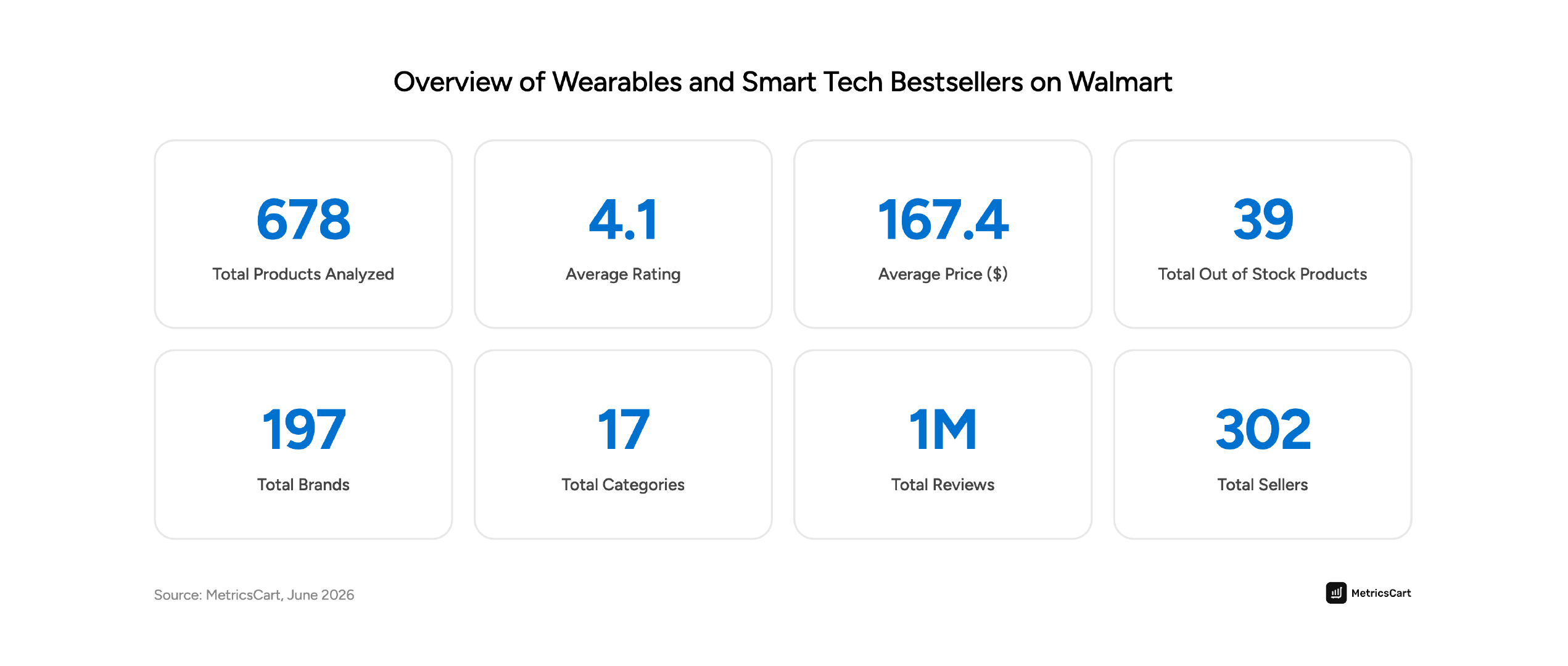
Walmart carries a bestseller shelf that spans $2 fitness bands and $1,460 Garmin tactical smartwatches, sold through a marketplace of 302 distinct sellers. The composition tells you exactly how wearables mass retail works in 2026 and why we are talking wearables and Walmart.
This report is all about which brands are winning share, which are winning attention, and where the pricing structure is shaping the category as a whole. Let’s get into it.
About The Report
MetricsCart tracked 678 Wearables and Smart Tech Bestsellers on Walmart between June 8 and June 22, 2026, covering 197 brands, 17 sub-categories, and 302 sellers, together carrying more than one million customer reviews.
The analysis covers pricing distribution, brand and seller mix, sub-category composition, daily price and product-count movements, review depth, upvote engagement, and structured review themes and sentiment. The findings explain how a mature-but-still-expanding Wearables and Smart Tech category looks at the shelf level on one of the largest US mass retailers, and what patterns separate the brands winning share from the rest.
The Pricing Architecture: A $2 Entry Point and a $1,460 Ceiling on the Same Shelf
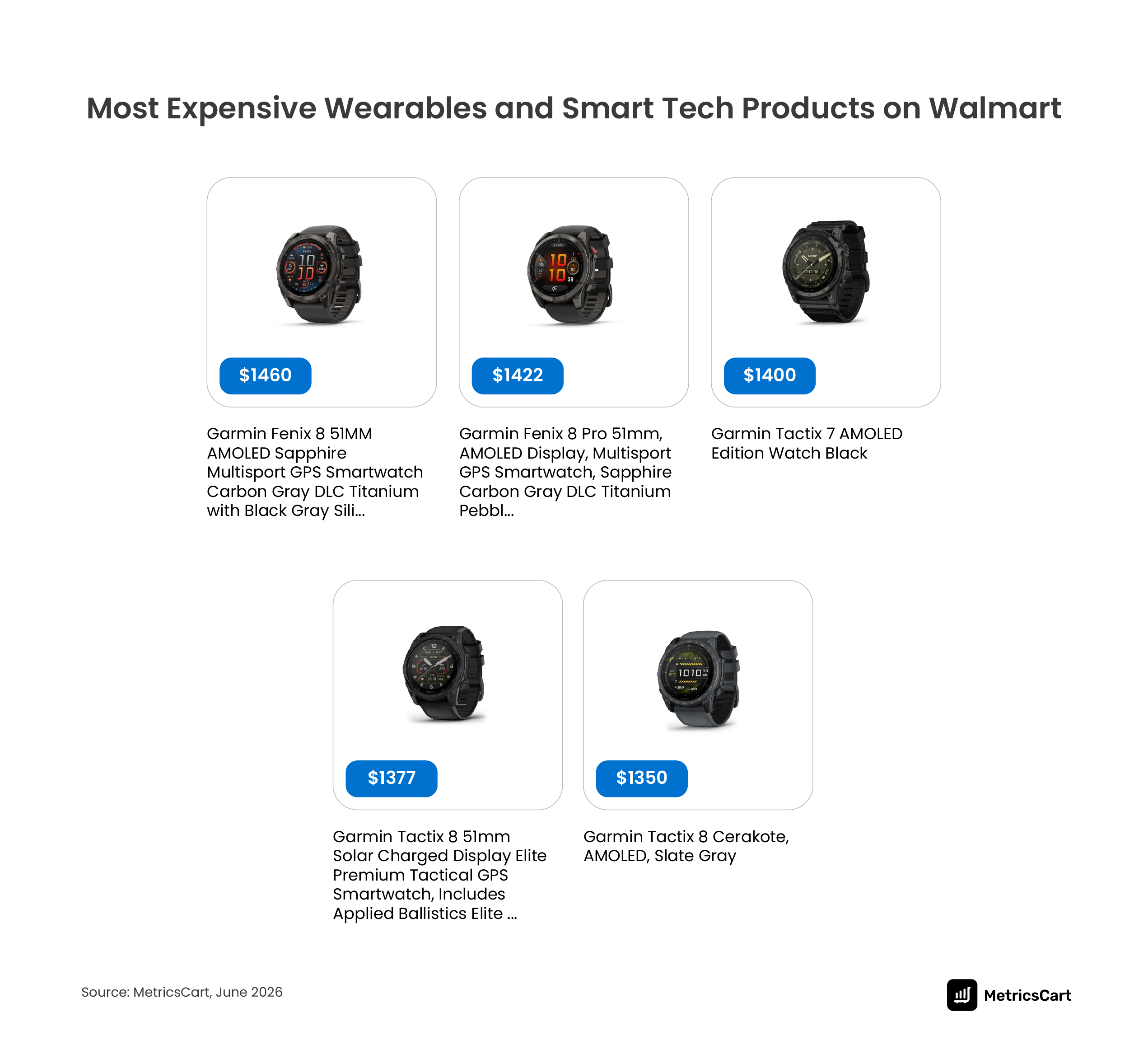
The pricing spread on the Wearables and Smart Tech on Walmart bestseller shelf is the widest structural feature of the category. MetricsCart found the top-priced product at $1,460 and the most affordable at $2, with a category average of $167.40.
What the Top-Priced Products Tell Us: Garmin’s Lock on the $1,000+ Tier
Every one of the 11 most expensive products on the shelf belongs to Garmin. The list runs from the Garmin Fenix 8 51MM AMOLED at $1,460 down to the Garmin tactix 8 47mm AMOLED Sapphire Edition at $1,050, covering the Fenix 8 Pro, Tactix 7, Tactix 8, Descent Mk3i dive computer, and quatix 8 Pro nautical smartwatch.
No other brand appears in the premium band. Apple Watch, despite Apple’s $485 brand-level average price, does not reach into the $1,000-plus tier on Walmart. Samsung’s Galaxy Watch Ultra sits well below it. Garmin has effectively claimed the premium outdoor, tactical, dive, and multisport segments on the Walmart digital shelf, with no direct competition from either of the two other largest brand names in the wearable technology market.
The Affordable End: $2-$7 Smartwatches with Bluetooth Calling and Notifications
At the other end of the shelf, MetricsCart research shows a cluster of smartwatches and fitness bands priced between $2 and $7.
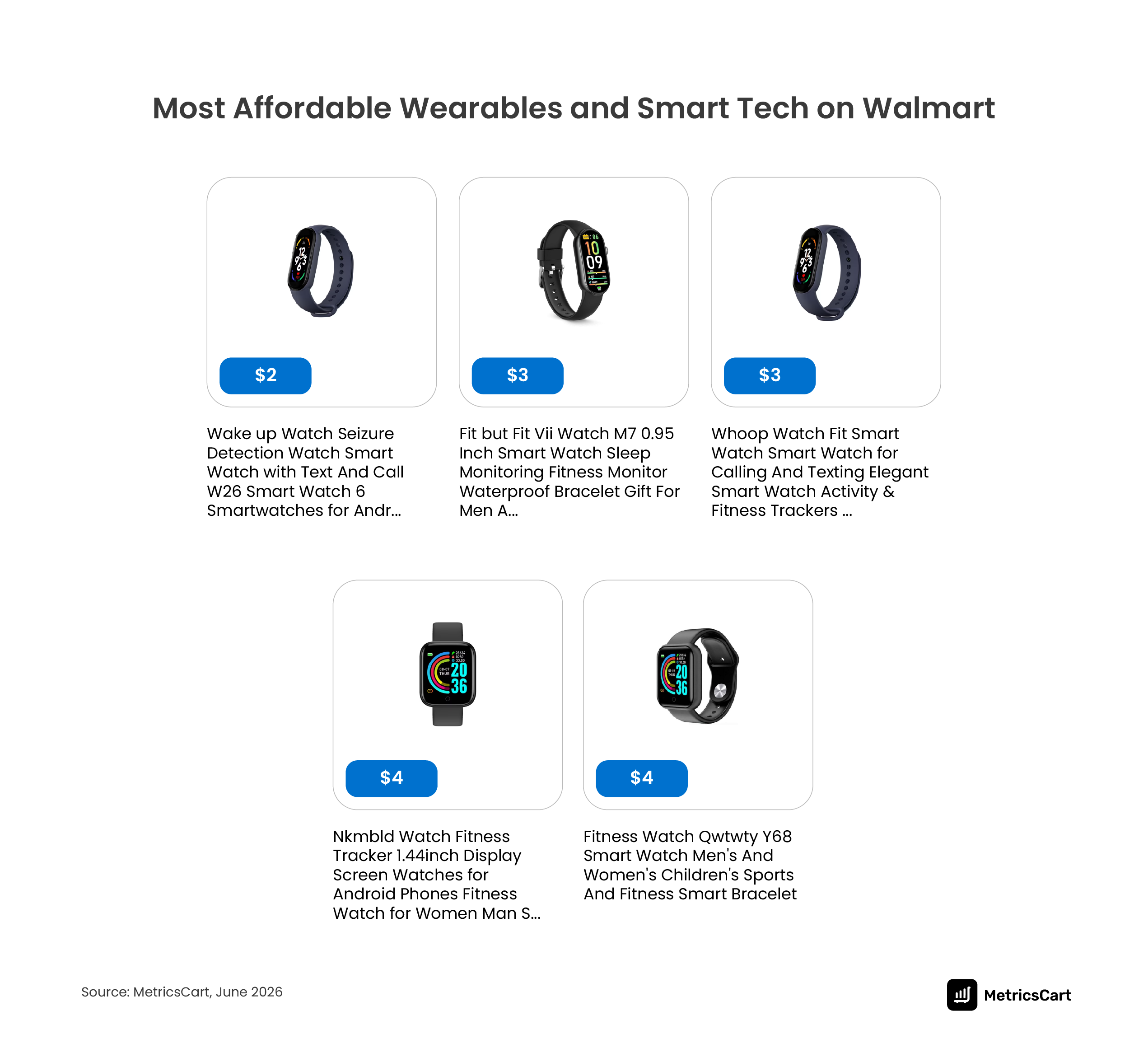
Products in this band include the Wake up Watch Seizure Detection Smart Watch at $2, several Fit Vii and Whoop-branded fitness trackers at $3, and generic 1.7-inch and 1.6-inch smartwatches at $6-$7. Most advertise Bluetooth calling, notifications, call answering, sleep monitoring, and basic activity tracking.
This tier is not a niche edge case. It represents a distinct consumer motion driven by feature-check purchasing at extreme price sensitivity, and it is one of the reasons the Wearables and Smart Tech category on Walmart looks different from the same category on Amazon or Best Buy.
Why the $167 Category Average Describes Almost No Real Buyer
The $167 average price is arithmetically correct and analytically misleading. A shopper spending $167 on this shelf is buying neither a Garmin Fenix nor a $3 fitness tracker. They are buying a mid-tier Samsung Galaxy Watch, a Fitbit Charge, or an Amazfit GTR series device. Category managers reading a shelf average without understanding the underlying bimodal distribution will underprice their premium listings and overprice their value ones.
MetricsCart’s SKU-level pricing analytics surface this distribution shape so pricing teams can benchmark against the tier they actually compete in.
READ MORE | How To Choose The Best Pricing Intelligence Tool: 2026 Checklist
Assortment Concentration: How Three Brands Anchor 155 of the 678 Bestseller SKUs
Assortment share on the Wearables and Smart Tech Bestsellers shelf is meaningfully concentrated at the top. Garmin, Samsung, and Apple together hold 155 of the 678 tracked SKUs, or roughly 23% of the shelf. The remaining 77% is spread across 194 other brands, most of which contribute fewer than 20 products each.
Garmin vs Samsung vs Apple: Three Brands, Three Different Strategies
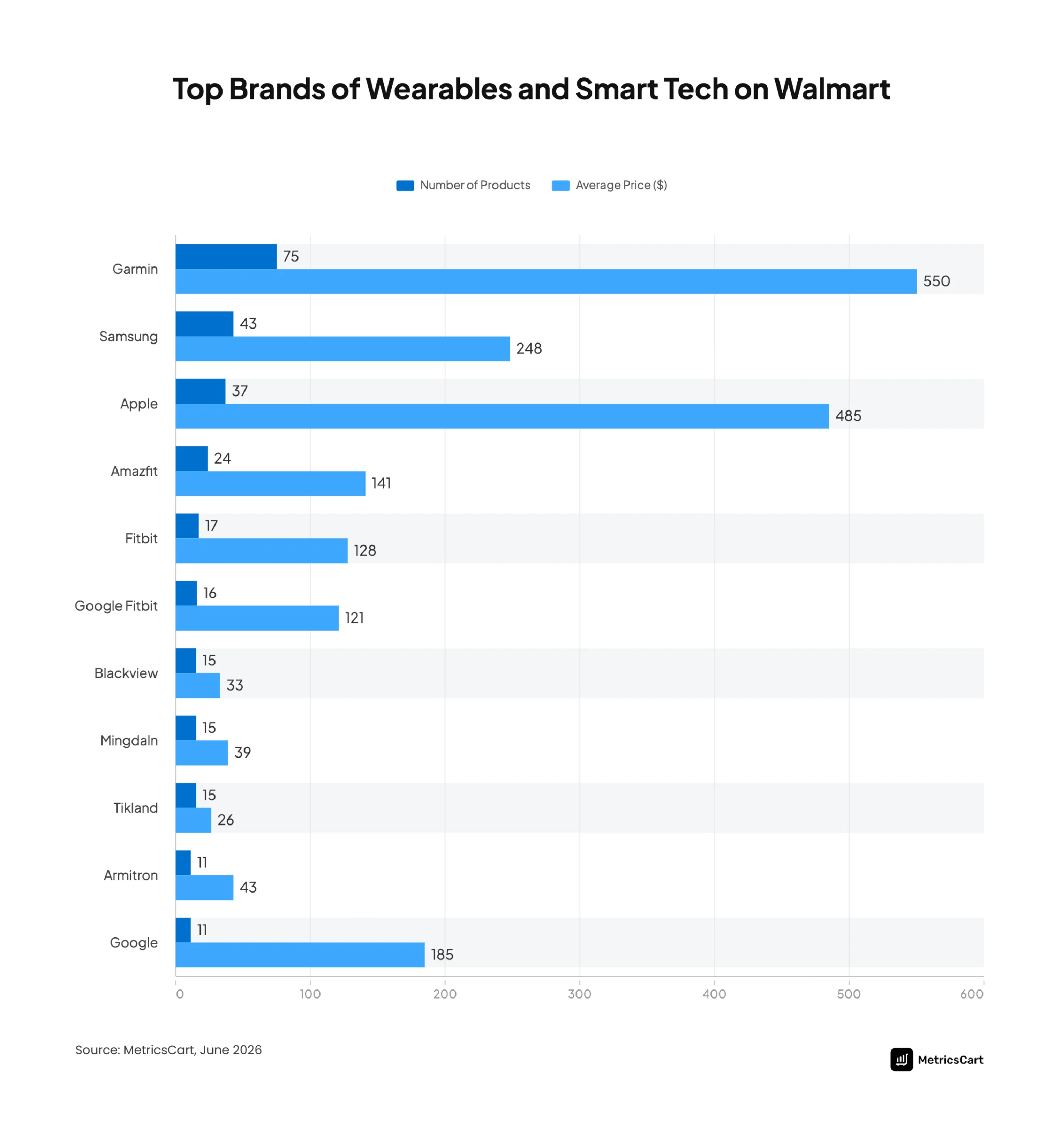
Each of the three leading brands plays the shelf differently. Garmin carries the most SKUs at 75 and the highest average price at $550. The play is depth and premium anchoring, spread across running, multisport, dive, tactical, and outdoor sub-categories.
Samsung carries 43 SKUs at $248 average. The play is mid-premium wrist-wear with a heavy tilt toward the Galaxy Watch line as the flagship product family.
Apple carries 37 SKUs at $485 average, sitting between Samsung on volume and Garmin on price. The play is fewer SKUs at premium price points anchored by the Apple Watch product family.
Below the top three, Amazfit (24 SKUs at $141) and Fitbit (17 SKUs at $128) hold the mid-market. Blackview and Mingdaln (15 SKUs each at $33 and $39 respectively) hold the affordable challenger positions.
The Fitbit and Google Fitbit Split After the 2021 Acquisition
MetricsCart tracks Fitbit and Google Fitbit as separate brand entities on the Walmart shelf, following the naming convention Walmart itself applies to listings. Fitbit operated as an independent company before Google’s 2021 acquisition, and the Walmart catalog still carries products under both labels.
Google Fitbit accumulates 70K reviews at a 4.1 average, while Fitbit sits at 12K reviews at a 3.7 average. The Fitbit-branded listings appear to skew older, which is consistent with the lower rating and lower review velocity. This split matters for anyone benchmarking Fitbit’s true share of the Wearables and Smart Tech category, since summing the two brands recovers 33 combined SKUs and roughly 82K reviews.
Emerging Form Factors: Smart Glasses, Smart Rings, and Smart Bracelets on the Margins
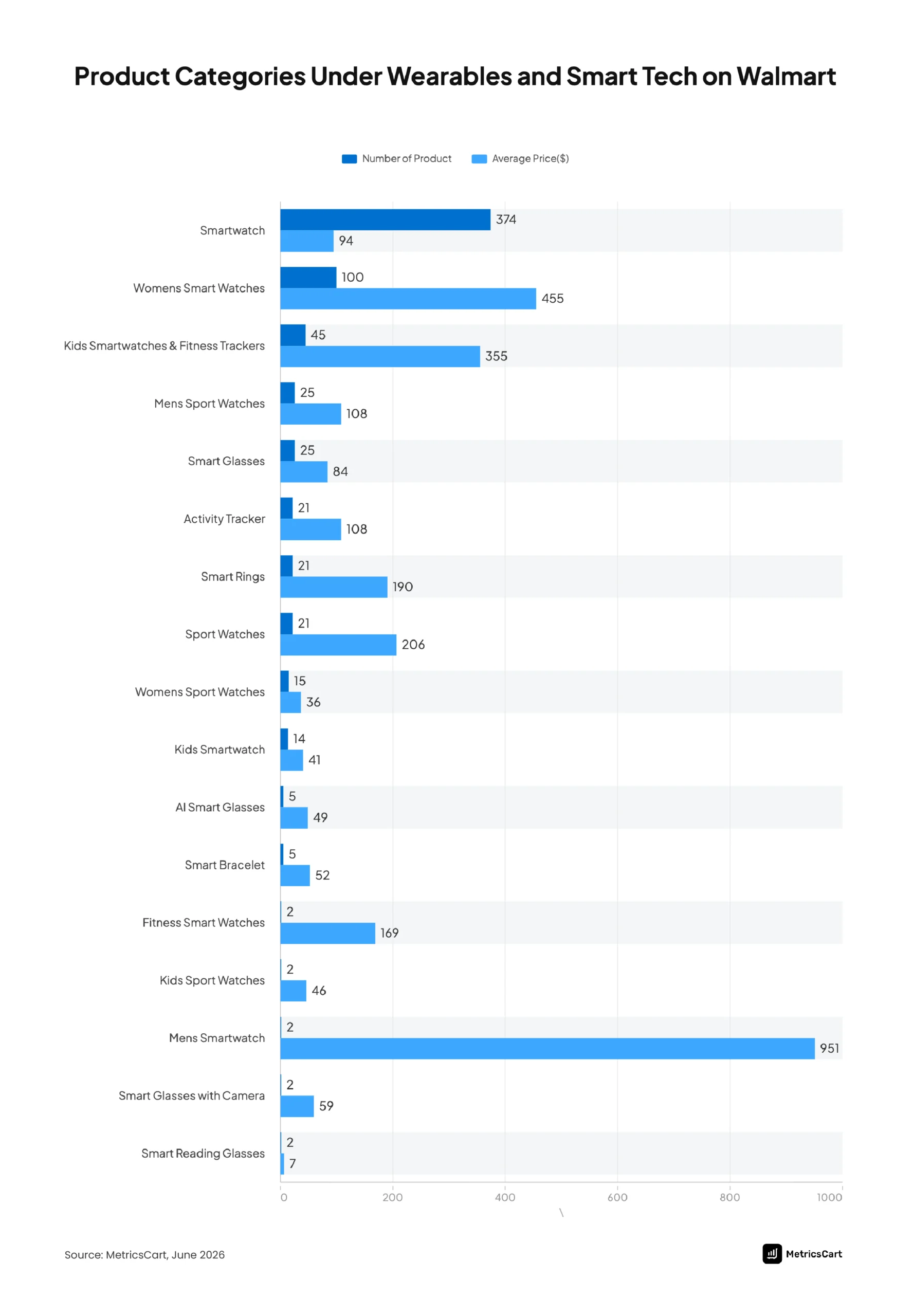
Non-wrist wearables remain marginal on Walmart’s bestseller list. MetricsCart found 25 Smart Glasses SKUs at an $84 average, 21 Smart Rings at $190, five AI Smart Glasses at $49, five Smart Bracelet SKUs at $52, two Smart Glasses with Camera at $59, and two Smart Reading Glasses at $7. Combined, these emerging form factors account for around 60 SKUs, or under 9% of the shelf.
That is worth noting against wider industry momentum. Beauty tech companies at CES 2026 showcased AI-enabled smart mirrors, LED skincare masks, and connected personal-care devices, and smart-ring makers like Ultrahuman are building visible review volume on Walmart (14K reviews at 4.3 average). The shelf is still overwhelmingly wrist-wear, and any brand pushing new form factors into mass retail should expect a long ramp before category share catches up with industry attention.
READ MORE | Video Game Market Trends on Target: How to Get Your Brand Play-Ready
The Engagement Gap: Why Samsung’s Reviews and Upvotes Outweigh Garmin’s SKU Lead
In the Wearables and Smart Tech category, MetricsCart research shows Samsung leading engagement decisively even though Garmin leads assortment.
Samsung Galaxy Watch Owns 6 of the 10 Most-Reviewed Products
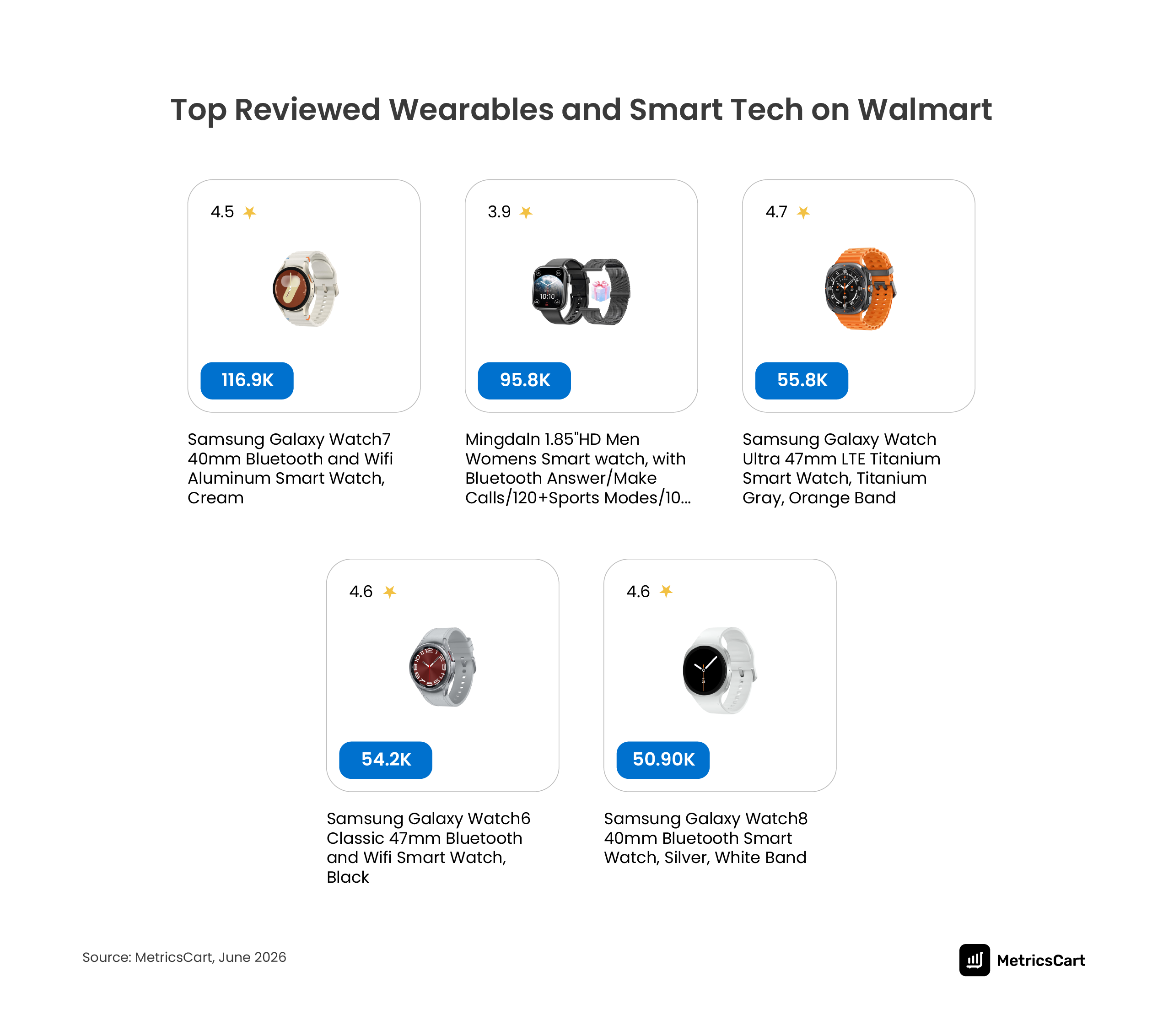
The top 10 most-reviewed products on the Wearables and Smart Tech Bestsellers shelf include six Samsung Galaxy Watches: the Galaxy Watch7 40mm (116.9K reviews, 4.5 rating), Watch Ultra 47mm LTE Titanium (55.8K, 4.7), Watch6 Classic 47mm (54.2K, 4.6), Watch8 40mm (50.0K, 4.6), Watch4 Classic 46mm (30.9K, 4.5), and Watch4 40mm (27.3K, 4.2).
Only two Garmin products (Venu 3 at 23.8K reviews, vívoactive 5 at 23.5K) appear in the top 10. The Mingdaln 1.85-inch smartwatch sits in the number two review position with 95.8K reviews at a 3.9 rating, which is the highest review count for any non-Samsung, non-Apple product in the set. The Mingdaln case is a useful reminder that high review volume in an affordable segment can coexist with a rating that would be a red flag at the premium end.
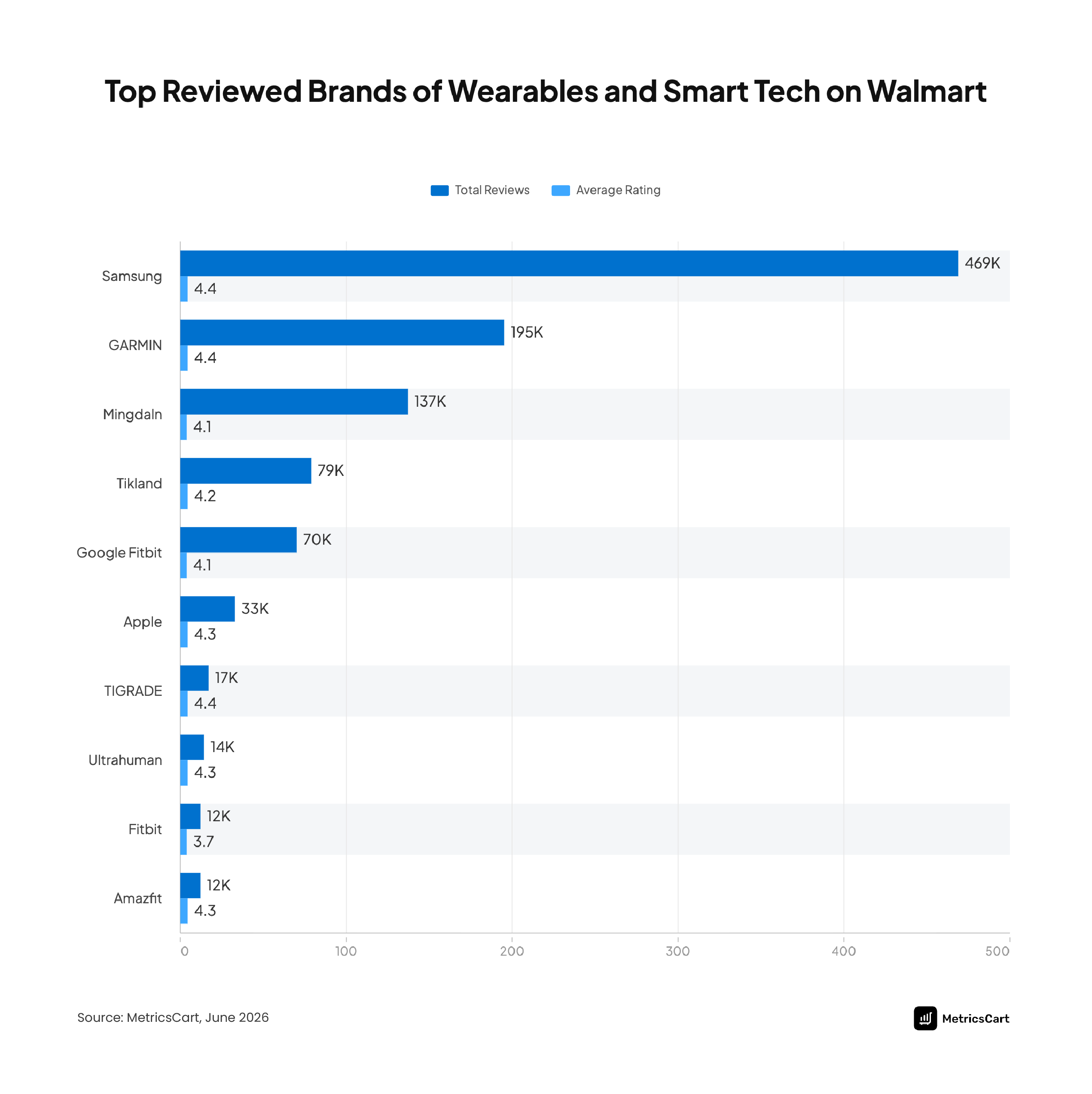
Samsung’s brand-level review total of 469K, at a 4.4 average, is more than double Garmin’s 195K (also 4.4 average). Samsung is winning the smartwatch space at the shelf level through review depth on a small number of flagship SKUs, rather than through wide assortment.
The 8x Upvote Gap Between Samsung and the Next Brand
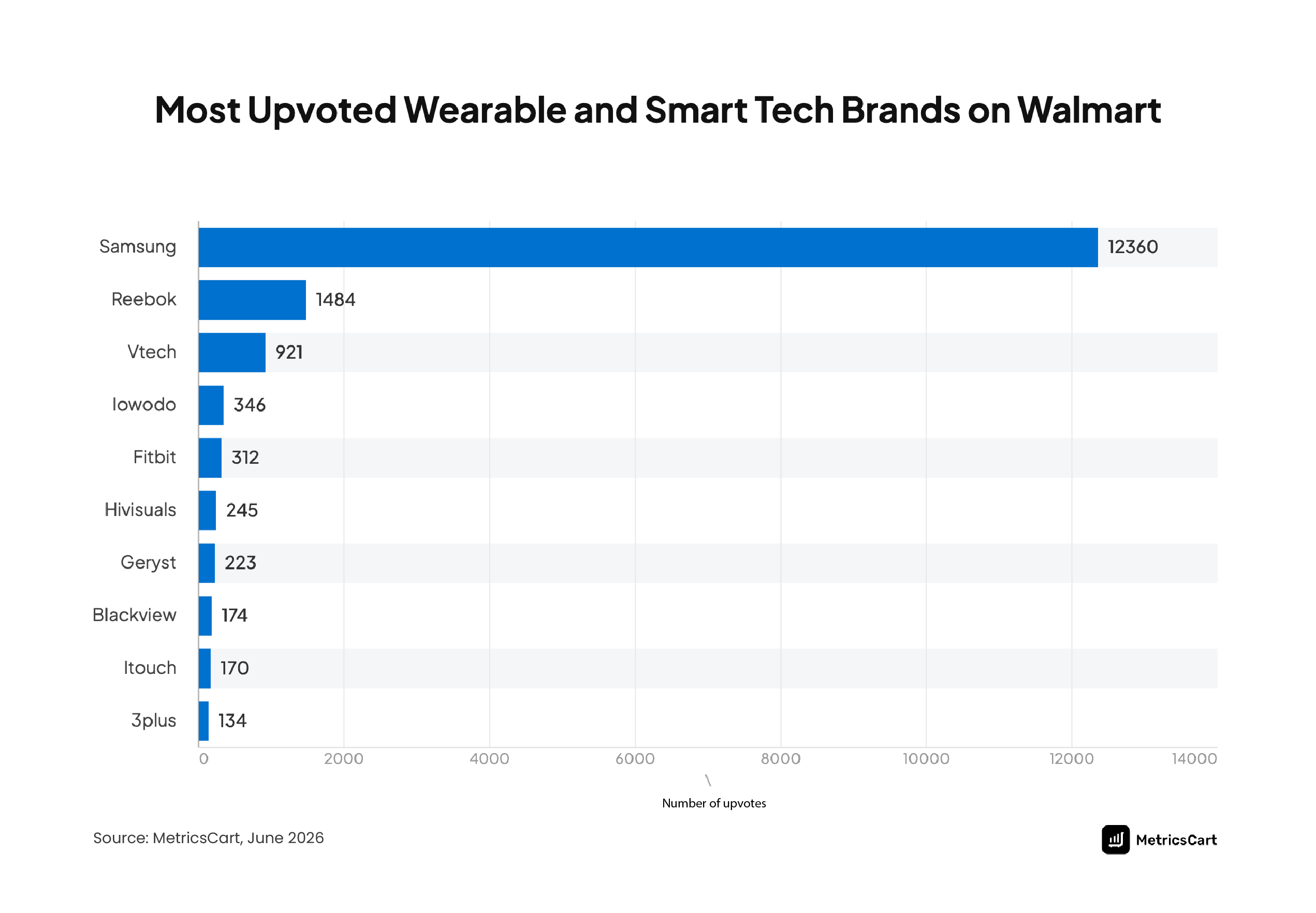
Samsung wearables received 12,360 upvotes in the tracked window, roughly eight times the next brand, Reebok, at 1,484. Vtech follows at 921, then a drop to Iowodo at 346, Fitbit at 312, Hivisuals at 245, Geryst at 223, Blackview at 174, Itouch at 170, and 3plus at 134. Outside the top three brands, upvote counts fall off sharply.
For challenger brands trying to build presence on Walmart’s marketplace, this signals that customer engagement is heavily concentrated with a few incumbents, and building upvote and review velocity requires either paid amplification, launch-cycle review acquisition programs, or breakout product launches.
Why Fitbit Standalone Sits Below a 4.0 Rating
Fitbit-branded listings on Walmart carry a 3.7 average rating across 12K reviews, the only sub-4.0 rating among the top reviewed brands. Google Fitbit listings, by contrast, carry a 4.1 rating across 70K reviews. The pattern is consistent with older Fitbit-branded inventory (pre-2021 Google acquisition) still being sold through Walmart, aging out of user favor while newer Google Fitbit-branded devices accumulate more positive engagement. For competitive analysts benchmarking Fitbit’s shelf position, the Google Fitbit figures are the more accurate representation of current product performance.
READ MORE | Weekly Review Tracking for CPG Brands: Why It Matters
Category Composition: What Consumers Are Actually Buying on Walmart
The 17 sub-categories in the Wearables and Smart Tech on Walmart dataset are heavily skewed toward one product type.
Smartwatch Dominance: 374 of 678 Bestseller Products
The Smartwatch category alone accounts for 374 SKUs, or 55% of the shelf, at a $94 average price. Adding Women’s Smart Watches (100 SKUs at $455), Kids Smartwatches & Fitness Trackers (45 at $355), Men’s Sport Watches (25 at $108), and Kids Smartwatch (14 at $41) brings smartwatch-and-fitness-tracker form factors to over 550 SKUs, or roughly 82% of the shelf. Wrist-wear dominance in the Walmart bestseller data aligns with what Wissen Research identifies as the leading product segment globally, with smartwatches and fitness bands driving demand through ECG, SpO2, and sleep-tracking features.
Men’s Smartwatches at $951 Average is the Highest-Priced Sub-Category
MetricsCart found the Men’s Smartwatch sub-category (2 SKUs) at a $951 average price, the highest of any sub-category on the shelf. This is a small but heavily premium slice, likely populated by Garmin’s tactical and multisport listings tagged for the male demographic. Women’s Smart Watches at $455 average across 100 SKUs is the more meaningful premium segment by volume, and points to a distinct pricing motion in gender-tagged wearables that mass retailers often flatten in their category taxonomy.
Smart Reading Glasses at $7 is the Affordable Edge of the Category
At the other end, Smart Reading Glasses show up at a $7 average across just 2 SKUs. AI Smart Glasses ($49 average, 5 SKUs), Smart Glasses with Camera ($59 average, 2 SKUs), and standard Smart Glasses ($84 average, 25 SKUs) fill out the eye-wear segment. The affordable end of smart glasses on Walmart is closer to a novelty tier than to the AI-integrated devices getting industry attention, and the assortment size confirms that this form factor has not yet moved into mass retail momentum.
READ MORE | Smartphones on Amazon vs Walmart: What It Takes to Win More Screens and Sales in 2026
Consumer Voice: What Reviews Say Wearables Buyers Care About
Structured review analysis surfaces which product attributes shoppers are actually evaluating, and which ones are driving satisfaction or complaint. The Wearables and Smart Tech on Walmart review base is large enough (over one million reviews) to produce a clear signal on both counts.
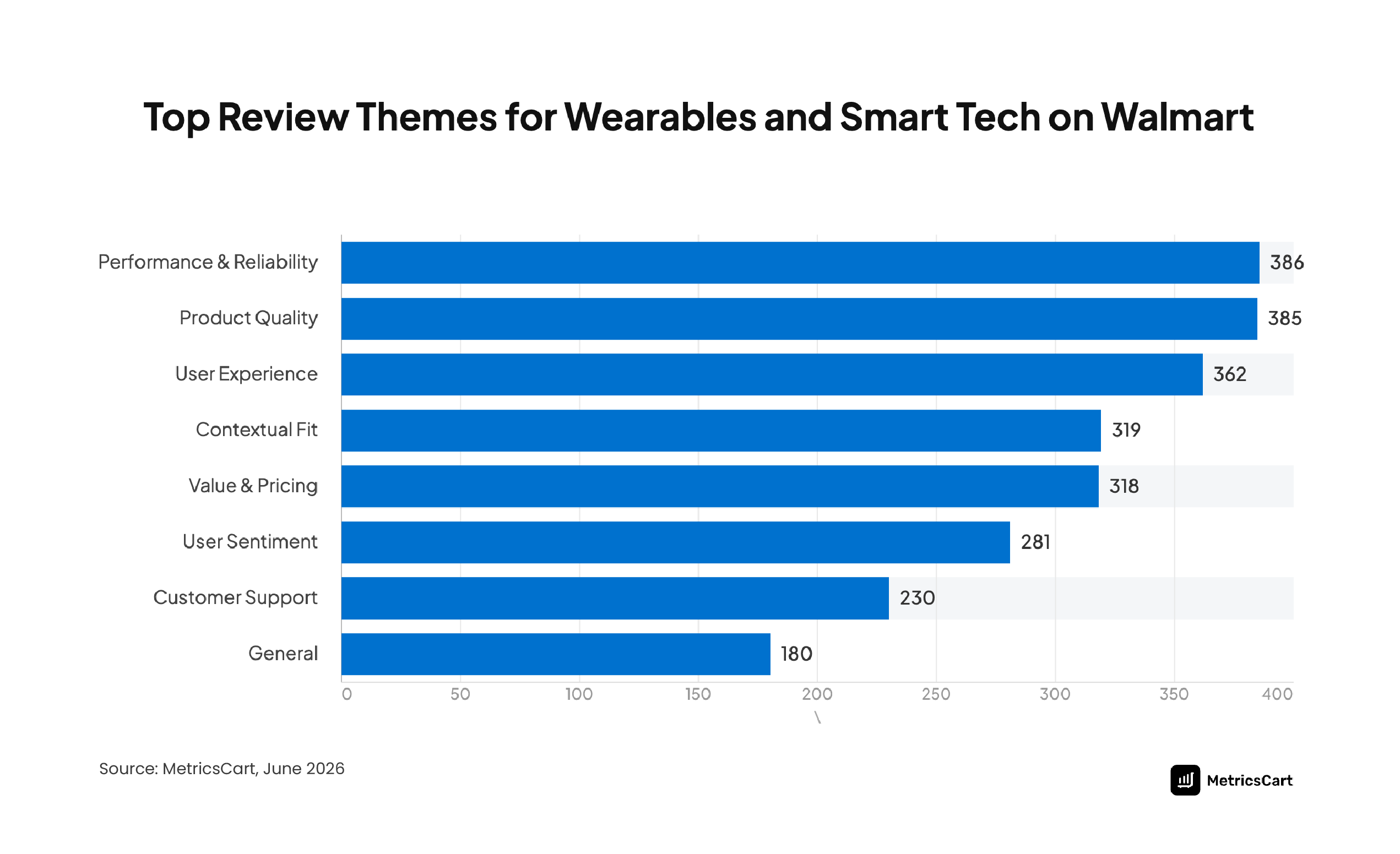
At the theme level, the distribution is tight. Performance & Reliability (386 mentions), Product Quality (385), User Experience (362), Contextual Fit (319), and Value & Pricing (318). No single theme dominates, which is typical of a mature category where multiple attributes matter to buyers. Sub-theme detail is where the actionable signal sits.
Sensor Accuracy as the Leading Discussion Sub-theme
MetricsCart found sensor accuracy leading the sub-theme conversation with 367 mentions, ahead of Aesthetics (336), Battery life (324), Customization of functions (274), and Setup process (266). Sensor accuracy leading is consistent with the functional promise of the whole Wearables and Smart Tech category. Buyers are evaluating heart-rate readings, step counts, sleep tracking, and SpO2 measurements against their expectations, and the accuracy of those readings is the axis on which product credibility rests.
Battery Life: Both the Top Discussion Topic and the Top Complaint Driver
Battery life appears as the third-largest discussion sub-theme (324 mentions), and MetricsCart’s sentiment scoring identifies battery life as a primary complaint driver inside the 11.2% of reviews scored as negative. The dual pattern is important. Shoppers discuss battery life positively when it exceeds expectations and negatively when it disappoints, meaning it functions as a differentiator on both ends of the satisfaction spectrum. Brands designing next-generation devices should treat multi-day battery performance as a core feature claim rather than a secondary spec.
The 66.9% Positive Sentiment Baseline and How the Category Is Being Judged
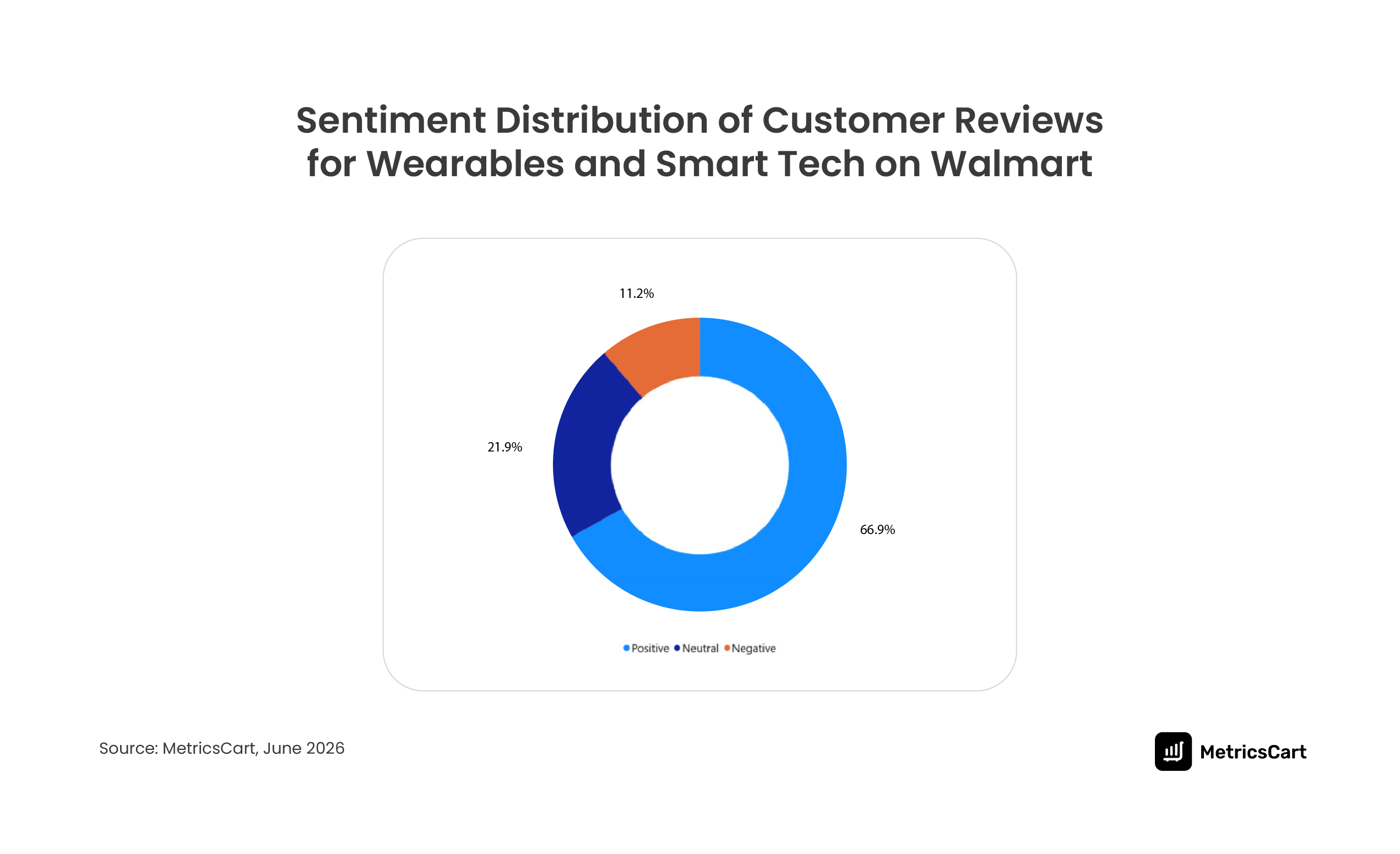
The overall sentiment distribution is 66.9% positive, 21.9% neutral, and 11.2% negative. Two-thirds positive is a healthy baseline for a mature consumer electronics category, and the 21.9% neutral share is likely composed of reviews focused on setup, unboxing, or functional description without strong evaluative language. The 11.2% negative bucket concentrates around battery life and connectivity issues (Bluetooth pairing, app sync, phone compatibility), which are recurring pain points across almost every brand in the tracked set.
MetricsCart’s aspect-based sentiment analysis breaks out this signal at the brand and SKU level so category and product teams can see exactly which attributes drive their own review deltas.
READ MORE | Consumer Sentiment Analysis for CPG Brands: 2026 Growth Guide
What Walmart’s Wearables Shelf Signals for the Broader Wearable Technology Market
The Walmart shelf sits inside a wider wearable technology market context, and two 2026 developments are worth tracking as they filter into how brands compete on the digital shelf over the next 18 months.
How the FDA’s January 2026 Wellness Reclassification Reshapes Category Marketing
In January 2026, the FDA updated its guidance to allow more consumer wearables to fall under a general wellness category, skipping the agency’s full review process for non-invasive products that estimate blood pressure, blood oxygen, blood glucose, and heart rate variability. The change was announced by FDA Commissioner Marty Makary at CES 2026 and applies to smartwatches, smart rings, patches, and other sensor-based devices, so long as the device does not claim to treat or prevent a specific disease.
The practical implication for the Wearables and Smart Tech on Walmart shelf is that brands can bring more health-adjacent features to market with less regulatory friction, and marketing language around health sensing is likely to broaden. Category managers should expect more listings in 2026-2027 to feature health-monitoring claims, and should watch closely for the line between “wellness” positioning and prohibited disease-treatment language. The July 2025 FDA warning letter to WHOOP over its Blood Pressure Insights feature is a reminder that the wellness-versus-medical boundary is actively policed.
AI-Enabled Health Tracking as the Next Competitive Battleground
The Wissen Research analysis identifies AI-enabled health tracking as a key differentiator among leading brands, and the industry deal flow supports it. In March 2026, Samsung partnered with Verily Life Sciences to integrate AI-enabled health analytics into the Galaxy Watch platform. Meta partnered with Caltech on sensing research, and Qualcomm extended its multi-year Xiaomi partnership on premium wearables.
The Walmart shelf will likely reflect this within 12-24 months. Samsung’s already-strong review moat on Galaxy Watch positions it to convert AI feature launches into further engagement. Garmin will need to decide whether its premium positioning holds without a comparable AI-partnership narrative, or whether it responds through its own AI feature roadmap. Challenger brands like Amazfit, Blackview, and Mingdaln will find AI-feature parity harder to claim credibly at the sub-$150 price points where they compete.
The Wearables and Smart Tech category on Walmart is a real-time barometer for how these industry shifts land in mass retail. Tracking the shelf weekly, brand teams and category managers can see which AI-feature claims translate into review velocity, which price tiers absorb premium AI positioning, and which challengers actually break through.
READ MORE | E-commerce Product Monitoring: The Ultimate Explainer for 2026
Track Your Digital Shelf the Way We Tracked Walmart’s Wearables and Smart Tech Category
If you are a wearables or consumer electronics brand competing on the same shelf as Garmin, Samsung, and Apple, or in any category where these dynamics shape market share, continuous monitoring is what separates reactive decisions from long-term strategic ones.
MetricsCart tracks pricing, promotions, ratings and reviews, sponsored placements, share of search, seller mix, and availability across Amazon, Walmart, and over 150 retail platforms.
Contact us to see your brand’s digital shelf performance in real time.
See How Your Brand Stacks Up Against the Bestsellers on Walmart’s Wearables Shelf.
Disclaimer: MetricsCart is the exclusive owner of the data used in these Digital Shelf Insights reports. Any third-party usage must include proper credit to the source.