Highlights
- Aldi’s marketing strategy functions as an integrated system in which operational efficiency, private-label dominance, and cultural relevance reinforce one another.
- Over 90% of Aldi’s assortment is private label, prices average 30% below national brands, and its 2025 namesake rebrand consolidated roughly 90 store brands into 26.
- One in three US households shopped at Aldi in 2025. The retailer attracted 17 million new customers that year and saw store visit growth of 8% year-over-year, outpacing Walmart, Kroger, Costco, and Albertsons.
- Aldi plans to operate nearly 2,800 US stores by the end of 2026, with 180+ new openings this year alone, backed by a $9 billion investment through 2028.
- A revamped social media strategy delivered double-digit engagement growth on Instagram and TikTok in the first half of 2025, while “Aldi Aisle of Shame Community” built a 3.6-million-member Facebook group.
In under a decade, a German discount chain with cardboard displays, no loyalty program, and a quarter-deposit shopping cart has become the fastest-growing grocer in the United States.
The limited assortment reduces operational cost. The no-frills store design signals honest value. The private labels control margins and pricing. Each operational decision doubles as a marketing decision.
As a result, Aldi’s store traffic rose by more than 50% from 2019 to 2024. In 2025, the company attracted 17 million new customers. It is now the third-largest US grocer by store count, trailing only Walmart and Kroger and gaining ground faster than either.
This article provides a comprehensive breakdown of how Aldi’s business strategy works: pricing mechanics, private-label architecture, consumer behavior patterns across income groups, the social media pivot, and the aggressive US expansion.
We’ll also explore what it all means for CPG brands trying to figure out whether Aldi is an opportunity, a threat, or both, and how MetricsCart’s digital shelf analytics can help navigate the retailer’s business model.
What Makes Aldi’s Marketing Strategy Different from Traditional Grocers?
Most grocery retailers compete on breadth. Walk into a Kroger or an Albertsons, and you’ll find 30,000+ SKUs, sprawling aisles, and dozens of variants within single product categories.
Aldi operates on the opposite principle.
The “Less Is More” Philosophy Behind Aldi’s Business Strategy
Aldi’s stores carry roughly 1,800 products. According to CNBC, the average store footprint is about 10,000 square feet, a fraction of Walmart’s supercenter average of 178,000 square feet. Products sit in their shipping cartons, often on wooden pallets. Customers deposit a quarter to use a shopping cart and bag their own groceries.
This operational simplicity translates directly into lower costs, which leads to lower prices, which translates into consumer trust and more foot traffic. That sequence defines the core of Aldi’s business strategy.
Scott Patton, Aldi US chief commercial officer, has been direct about the trade-offs. The smaller stores and curated assortment save shoppers time and reduce decision fatigue. “You might have to shop at another store and that’s actually OK with us,” Patton told CNBC. “What we want our customers to do is shop Aldi first.”
Items carry multiple barcodes to speed up checkout. Staff levels are minimal. The quarter-for-a-cart system eliminates the need for employees to manage cart corrals. Each of these decisions shaves cost, and those savings compound into the price advantage that defines the brand.
How Aldi Positions Itself Against Walmart, Costco, and Kroger
You can understand Aldi’s competitive strategy through what it avoids.
Traditional supermarket chains like Kroger and Albertsons occupy what analysts call the “squeezed middle,” forced to compete on price with Walmart while simultaneously trying to build loyalty like Costco. Aldi sidesteps this by occupying a distinct lane: small stores, curated assortment, private-label quality at the lowest prices of any national grocer.
The market data reflects this positioning. According to CNBC, Aldi’s store visits grew 8% year-over-year in 2025, outpacing Costco’s 5.9% growth, Albertsons’ 1.6%, Kroger’s 0.8%, and Walmart’s 0.5%. The overall grocery sector grew visits by 3.1%.
Aldi holds 2.8% of the US grocery market share. The absolute number is still small, but the trajectory is generating competitive pressure across the industry.
Albertsons CEO Susan Morris acknowledged on an earnings call that even higher-income shoppers are becoming more price-conscious. Kroger’s leadership has stressed “strengthening our competitive position” without naming specific discounters.
Brands benchmarking against Aldi’s pricing need real-time competitor data, not quarterly reports. MetricsCart’s price monitoring software helps CPG teams track pricing shifts across retailers and flag gaps as they emerge.
Inside Aldi’s Low Price Strategy: How They Actually Make the Math Work
Aldi’s low prices are well known. The mechanics behind sustaining those prices while maintaining product quality are less widely understood.
Everyday Low Price (EDLP) and How Aldi Cuts Costs Without Cutting Quality
Aldi operates on an Everyday Low Price model, meaning prices are consistently low rather than driven by weekly promotional cycles.
Promotional pricing is expensive: it requires marketing spend, in-store signage changes, supply chain coordination, and often erodes margin over time. EDLP eliminates most of that overhead.
The 2026 Dunnhumby Retailer Preference Index ranked Aldi #1 in terms of base price, confirming the pricing advantage as an empirically measured reality.
The EDLP model depends on tight cost control across operations. Aldi achieves this through several mechanisms:
- Limited assortment. Fewer products mean less shelf space, less warehouse complexity, lower logistics costs, and stronger negotiating leverage with suppliers.
- Efficient store design. Products displayed in shipping cartons rather than individually stocked shelves. No bakery, no deli counter, no floral department. Layouts optimized for throughput.
- Labor efficiency. Multi-barcode items speed up scanning. The cart deposit system is self-managing. Cross-trained employees handle stocking and checkout.
- Minimal marketing overhead on products. With over 90% private-label assortment, Aldi does not pay for national brand advertising. The savings go directly to the shelf price.
READ MORE | How to Track Grocery Prices on E-Commerce Platforms: A Guide for Brands
The Private-Label Pricing Advantage
Private-label products offer an average 30% price discount compared to national brands across food, beverage, and non-food categories. In some categories, the gap is wider: carbonated soft drinks show an average price difference of 42%.
The margin advantage is equally significant. National CPG brands typically operate on gross margins around 26%. Private-label products can deliver 30% to 40% margins for the retailer. That structural advantage funds the expansion, store redesigns, and digital transformation.
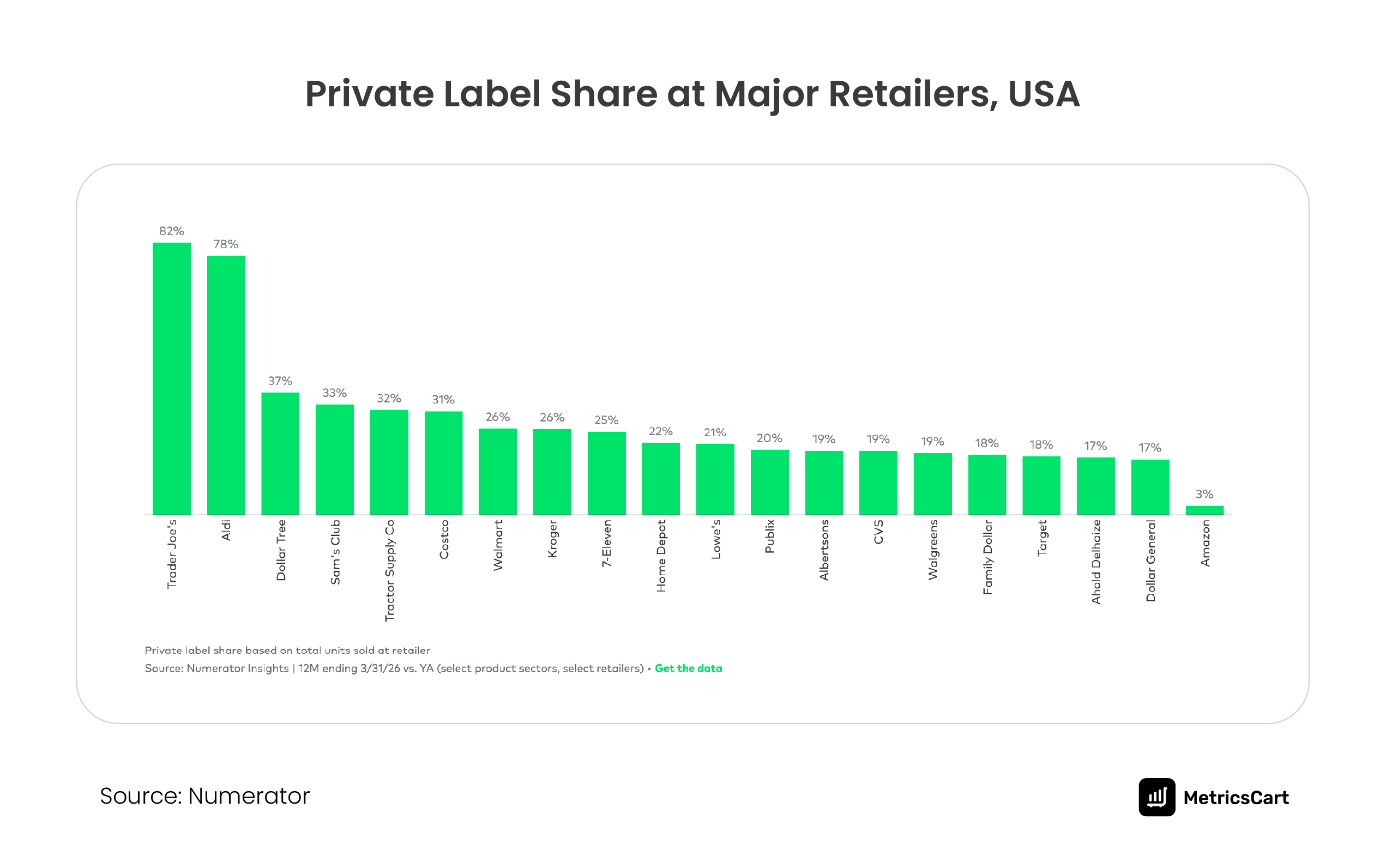
Aldi claims that 90% of its products are private label. Aldi’s private labels also perform well in quality assessments. The company has received over 1,200 product awards and recognitions since 2017. Every Aldi-exclusive product is free from certified synthetic colors, making strides in the clean-label movement.
READ MORE | Private Label Manufacturers US: 2026 List of Top Companies
Aldi’s Private Label Strategy and the Biggest Rebrand in Company History
If pricing is the engine of Aldi’s business strategy, private labels are the chassis. In September 2025, Aldi undertook the most significant branding overhaul in its history.
Inside Aldi’s 2025 Namesake Brand Launch
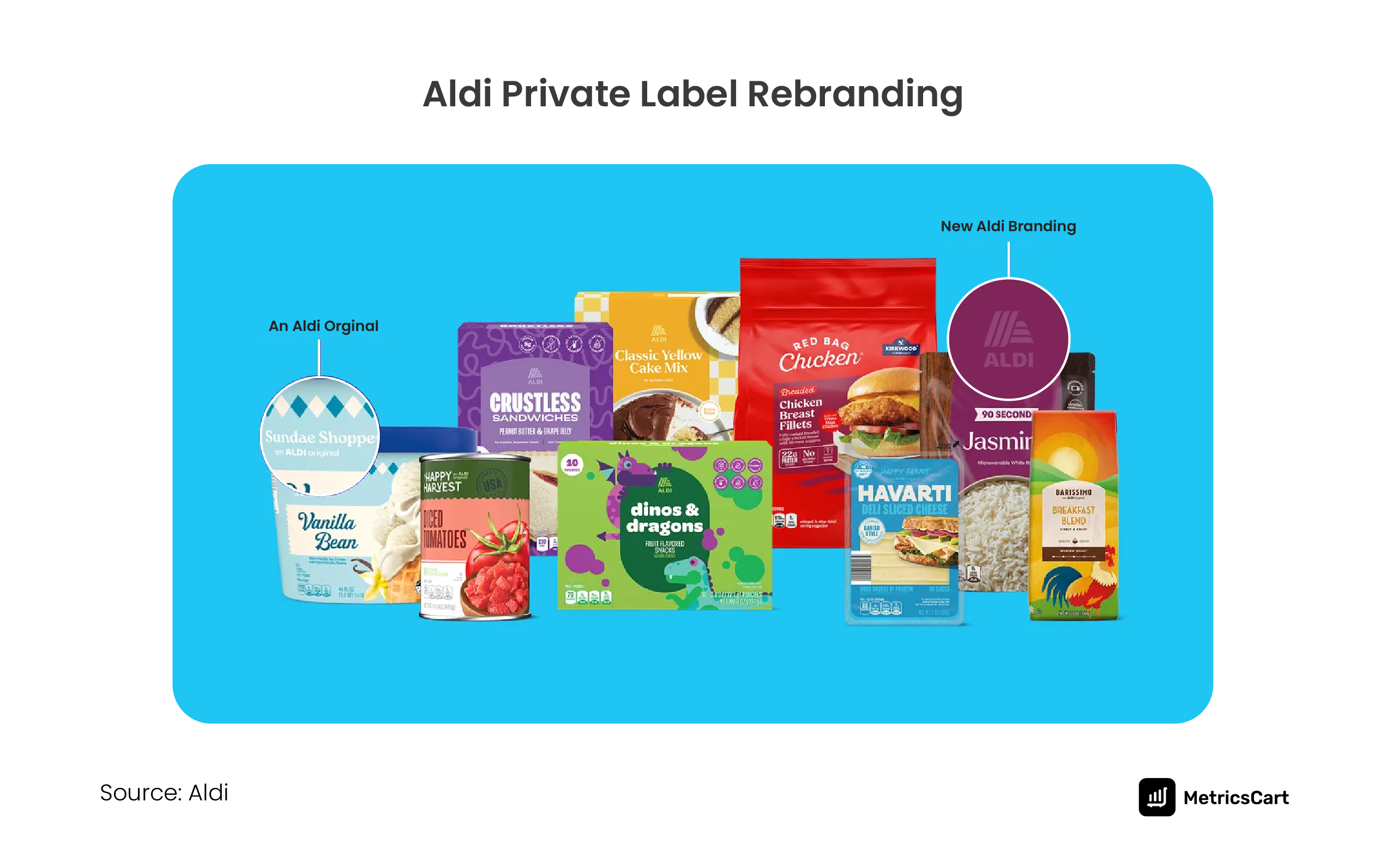
For nearly 50 years, Aldi operated with roughly 90 individual private-label brand names: Baker’s Corner for baking supplies, Dakota’s Pride for canned goods, Kirkton House for home products. Long-time shoppers knew these brands well. New shoppers often had no idea they were Aldi-exclusive.
The rebrand consolidated the portfolio from roughly 90 brands down to 26, introducing a new unified “Aldi” umbrella brand for commodity-type products like flour, beans, and baking soda. Not only does this boost search visibility for Aldi, but it also creates a unified brand architecture.
Brands with strong consumer followings, including Specially Selected, Simply Nature, and Clancy’s, were retained but received new packaging featuring an “an ALDI Original” endorsement.
Aldi also adopted shopper-given nicknames for some products. Kirkwood Breaded Chicken Fillets, known universally among Aldi shoppers as “Red Bag Chicken,” officially became Red Bag Chicken. The change signals that Aldi is building its brand architecture from community input.
Kristy Reitz, Aldi’s director of brand and design, explained the logic: they asked customers where brand names mattered and where they did not. For fresh or commodity-based items, brand names were not a purchase driver. The Aldi name, however, was. Now it appears on everything.
The strategic parallel to Costco’s Kirkland brand is deliberate. Aldi is trying to generate the same organic brand conversation that Kirkland has achieved, where Reddit threads serve as a form of word-of-mouth endorsement.
What the Mondelez Lawsuit Tells Us About Aldi’s Competitive Strategy
The rebrand took place following a significant legal dispute. In 2025, Mondelez sued Aldi over product packaging, alleging that the discounter’s private-label items copied the look and feel of brands like Oreos, Chips Ahoy, and Wheat Thins. Aldi maintained that the rebrand had been in development for three years and was independent of the litigation.
The lawsuit reflects the competitive anxiety that Aldi’s private-label quality is generating among national brands. When store-brand products are close enough to category leaders that legal teams get involved, the competitive terrain has shifted.
Broader data confirms this shift. According to a BRG consulting report, 67% of Gen-Z shoppers believe private-label products are just as good as national brands. Over half of global consumers now report increasingly purchasing store brands. Private label is actively reshaping how shoppers define value across the grocery sector.

Who Shops at Aldi? Consumer Behavior Across Income Groups
A common misconception about Aldi is that it primarily serves low-income shoppers. The Aldi consumer behavior data tells a more nuanced story.
The Income Breakdown: How Low, Middle, and High-Income Shoppers Use Aldi
Aldi’s core positioning targets middle-income consumers who want quality groceries without overpaying for brand names. But the customer base has diversified significantly.
Aldi’s CEO, Atty McGrath, stated that one in three US households shopped at Aldi in 2025. That level of household penetration requires appeal well beyond budget-constrained shoppers. Higher-income consumers are trading down, not out of necessity, but out of economic pragmatism.]
Inflation brought shoppers from all income levels to Aldi, and many have stayed after discovering the product quality matched or exceeded what they had been buying at traditional grocers.
What Aldi Shoppers Buy Most
Grocery products account for 80% of Aldi’s total sales. Within that category, the composition is shifting.
Fresh foods, meal solutions, and natural/organic items are driving growth. Aldi has steadily expanded its fresh offerings, including produce, meats, and dairy, moving well beyond the shelf-stable staples that defined its early years in the US. The expansion of its chilled distribution center in Haines City, Florida, is specifically designed to support this perishable growth.
There is an imminent rise of protein-focused products and better-for-you alternatives, categories where Aldi’s private labels like Summit Popz (a functional soda competing with brands like Olipop and Poppi) are actively gaining share.
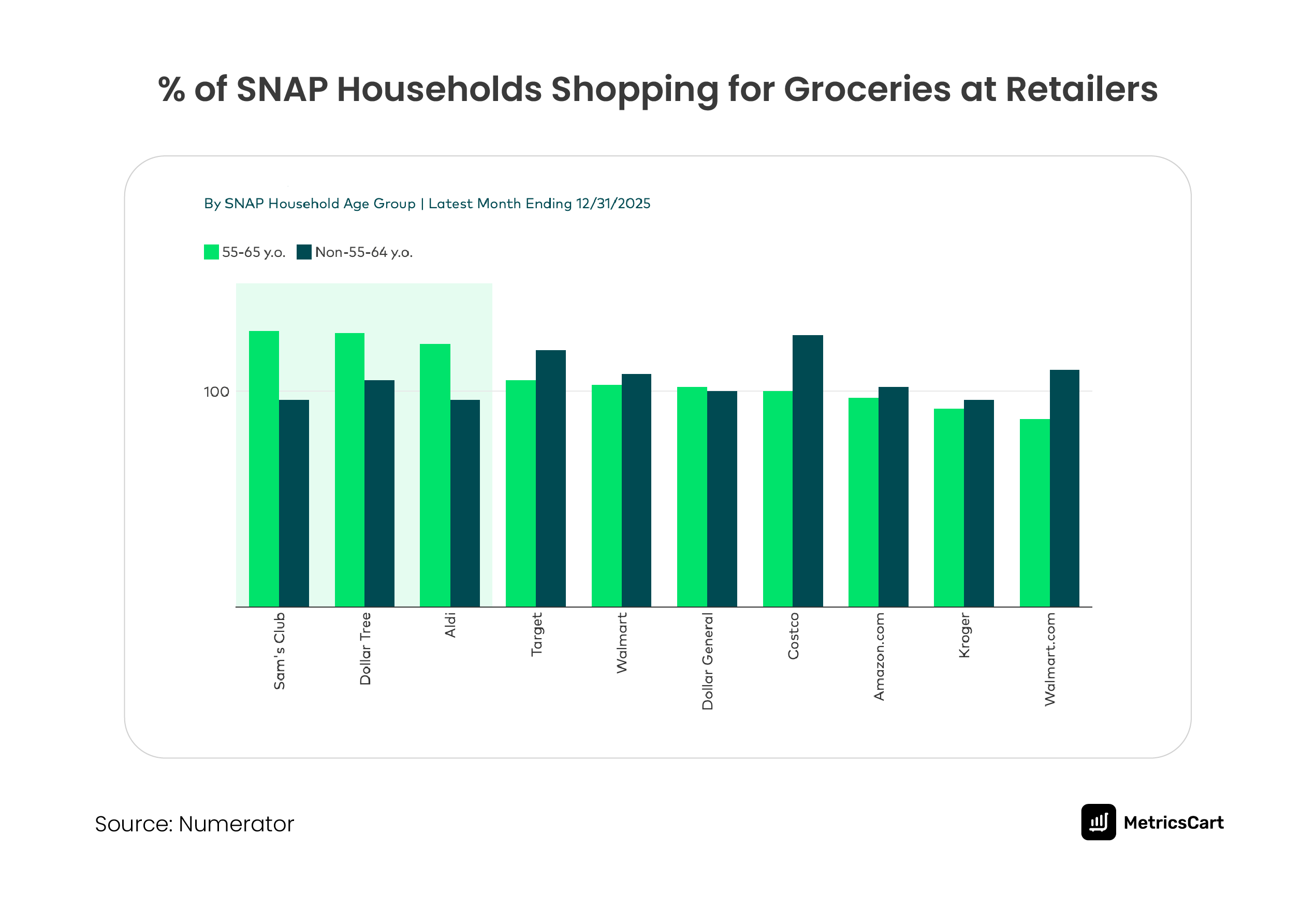
SNAP (Supplemental Nutrition Assistance Program) households are also shifting spending toward Aldi. Numerator data from early 2026 showed spending moving toward value-oriented retailers, including Aldi, Sam’s Club, and Dollar Tree, with the pullback more pronounced in online channels.
The Demographic Shift: Why Young Workers and Couples Are Choosing Aldi
This tracks with broader retail behavior. Young workers and couples are increasingly avoiding hypermarkets because of the time investment required.
Aldi’s model of simplicity, speed, and curated assortment maps onto a generation that values efficiency and has significantly less brand loyalty than previous generations.
Aldi is also making strides to win over health-conscious consumers by expanding its healthier food options in the product lineup.
Understanding what drives purchase decisions across these shifting demographics requires granular product-level data. MetricsCart’s ratings and reviews analysis helps brands identify recurring themes in customer feedback, including how shoppers compare national brands to Aldi’s private-label alternatives.
Aldi’s US Store Expansion: 2,800 Stores and Counting
The Aldi marketing strategy operates at the brand level. The store network is the infrastructure that delivers it. And Aldi is building that infrastructure at a pace that is difficult for competitors to match.
In January 2026, Aldi announced plans to open more than 180 stores across 31 states by year’s end, pushing its total US store count to nearly 2,800. This follows the retailer’s biggest expansion year ever in 2025, when it opened nearly 200 locations.
One of the most strategically significant moves in Aldi’s expansion was its 2024 acquisition of Southeastern Grocers, the parent company of Winn-Dixie and Harveys Supermarket.
Rather than building from scratch in the Southeast, Aldi converted existing locations. Roughly 90 stores have already been transformed into the Aldi format, with 200+ total conversions planned by the end of 2027.
The State of Aldi’s E-Commerce Growth
For years, Aldi’s digital presence lagged behind its physical retail strategy. Consumer expectations have shifted, and Aldi’s business strategy has moved to close the gap.
The Instacart Partnership: How Aldi Rebuilt Its Entire Online Experience
In March 2026, Aldi relaunched its entire US website and mobile app on Instacart’s Storefront Pro enterprise commerce platform. The partnership made Instacart Aldi’s exclusive e-commerce fulfillment partner, extending a relationship that began in 2019.
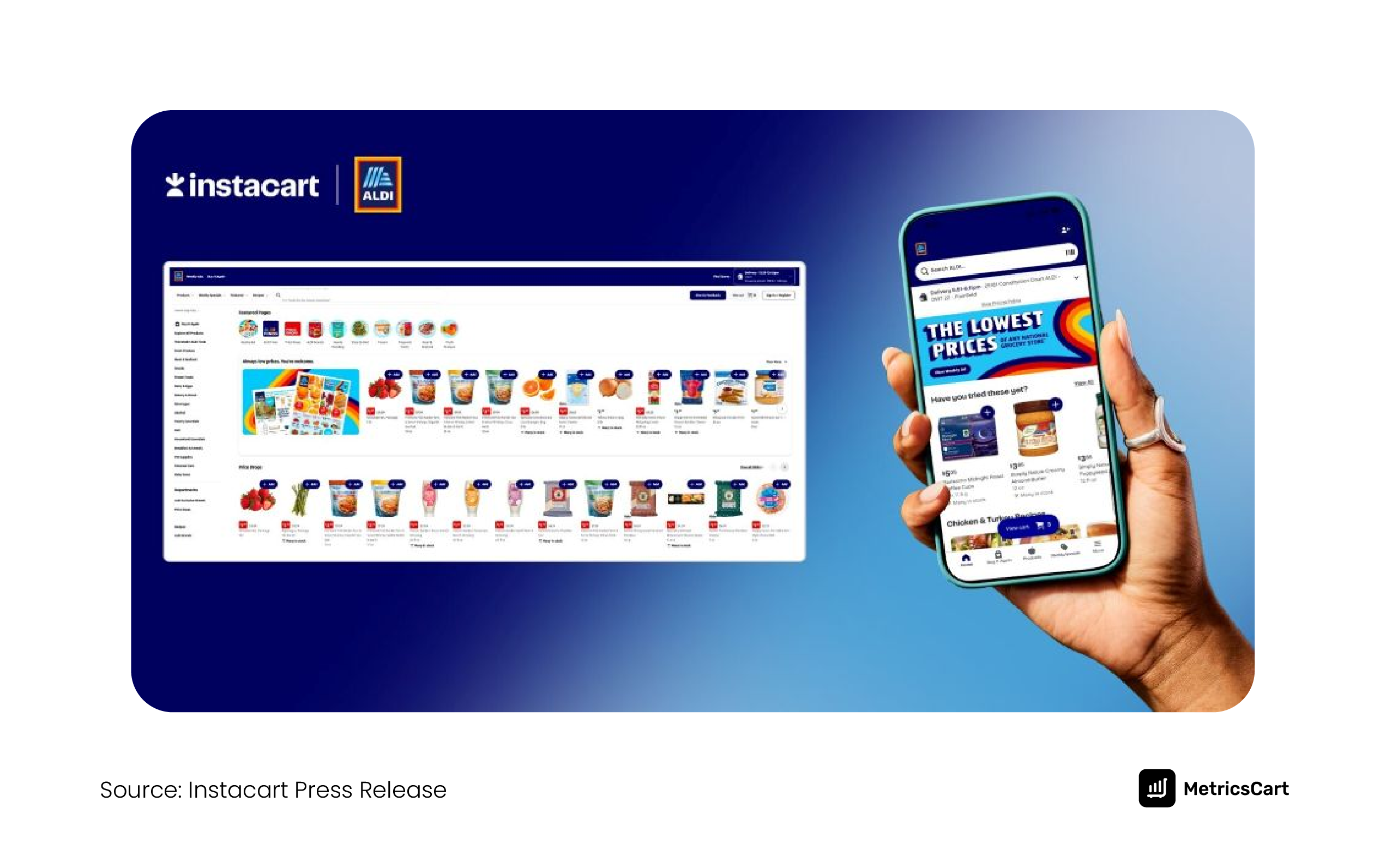
The new experience offers AI-powered product discovery, personalized recommendations for easy reordering, expanded nutritional information, shoppable recipes, and built-in meal planning tools. The design aims to replicate the simplicity of in-store shopping in a digital environment.
READ MORE | Future of Grocery E-Commerce: Top Technology Trends of 2026
Curbside Pickup, Home Delivery, and the Omnichannel Flywheel
Aldi’s omnichannel approach now includes curbside pickup, with orders hand-picked by trained Aldi team members, along with home delivery through Instacart, DoorDash, and Uber Eats.
The online grocery market exceeded $12 billion in 2025, and Aldi’s website redesign is its bid to capture a meaningful share of that spend.
The digital experience also feeds back into physical stores: shoppable recipes and meal planning tools encourage customers to plan their in-store trips online, creating an omnichannel loop where each channel reinforces the other.
For a company that built its business on physical retail efficiency, the digital investment reflects that Aldi’s low price strategy requires meeting customers where they increasingly choose to shop.
As grocery e-commerce expands, product visibility on platforms directly affects sales. MetricsCart’s share of search tracking helps brands monitor where their products rank in search results across online grocery retailers and identify keyword gaps before competitors fill them.
READ MORE | Buy Online and Pickup In-Store (BOPIS): Co-Opetition Strategies for Maximizing Revenue
Aldi’s Social Media Marketing Strategy: Turning a Grocery Store into a Cultural Brand
Most grocery retailers use social media as an extension of their weekly circular: product shots, seasonal recipes, promotional announcements. Aldi’s marketing strategy took a different approach in 2025.
Katherine Sodeika, Aldi’s US Marketing Director, described the shift to Marketing Dive: the company moved away from showcasing Aldi as a store and toward building Aldi as a persona with less brand-centric content and more culture-centric content.
The approach delivered double-digit growth in engagement on Instagram and TikTok in the first half of 2025. Aldi posts across five platforms (Facebook, Instagram, TikTok, X, and LinkedIn) with Facebook and Instagram as the primary channels.
Why Aldi Finds Is a Marketing Masterclass
Aldi Finds is a rotating section in every store stocked with limited-time bargain items outside the grocery category: home decor, fitness equipment, clothing, and garden tools.
The community named it the “Aisle of Shame” because shoppers frequently arrive for groceries and leave with unplanned purchases from this section.
The marketing mechanics are straightforward. Weekly product drops create scarcity and urgency because items sell out and never return, which turns shopping into a treasure hunt.
This is treasure-hunt retail executed at scale. The unpredictability drives foot traffic. The social sharing drives awareness. The low prices drive conversion. Aldi does not spend on advertising in this section; the community generates the marketing organically.
What Aldi’s Growth Means for CPG Brands: Key Takeaways
Aldi’s expansion, private-label investment, and shifting consumer demographics carry specific implications for national brands. Here is what the data points to:
1. Shelf Space for National Brands Is Shrinking
Limited-assortment grocers like Aldi command a 76% private-label dollar share, according to Circana. For every dollar spent in an Aldi store, 76 cents goes to an Aldi-owned product. Aldi’s own innovations, such as Summit Popz, are entering categories that national brands previously dominated. The Mondelez lawsuit over packaging similarity signals how narrow the gap between private label and branded products has become.
2. Price Alone Will Not Differentiate Your Brand
Roughly 30% of national brand unit sales now come from promotional activity, about six percentage points higher than private-label competitors, per Circana. That promotional dependency compresses margins without building long-term preference. The viable paths for differentiation are focus (going deep in a specific product format or niche) and community (building emotional connection through founder stories, content, and brand culture that private labels cannot replicate).
3. Aldi Still Carries Select National Brands
Earning a spot requires alignment with Aldi’s priorities: quality, trend relevance, and pricing efficiency. Products that add something Aldi’s own brands cannot easily replicate, whether through a proprietary ingredient, a specific technology, or strong cultural relevance, have an opportunity. The Aldi Finds rotation also opens doors for non-grocery brands through seasonal and specialty items that do not require permanent shelf space.
4. AI-Driven Shopping Will Favor Value-Priced Products
An emerging dynamic worth monitoring is the rise of agentic commerce. AI-powered shopping assistants increasingly recommend products based on budget parameters. Value-priced options, exactly the kind Aldi stocks, are likely to receive disproportionate visibility in these systems. Brands that rely on name recognition without competitive pricing may find themselves deprioritized by algorithmic recommendations.
5. Digital Shelf Performance Now Determines Competitive Position
With Aldi’s ecommerce relaunch on Instacart’s Storefront Pro, the digital shelf is where pricing, availability, search visibility, and content quality converge. Brands that do not actively monitor their performance on these dimensions across grocery ecommerce platforms risk losing ground to private-label alternatives that are increasingly optimized for online discovery.
How MetricsCart Helps Brands Compete in Aldi’s Ecosystem
We outlined certain challenges while looking into Aldi’s marketing strategy. From private-label pressure to shifting consumer demographics to the growing importance of digital shelf performance, brands require a specific kind of visibility.
For CPG brands navigating Aldi’s growth, MetricsCart’s complete suite of digital shelf analytics tools is built to provide that visibility across 150+ retailers. From pricing intelligence and share-of-search tracking to customer feedback analysis and availability monitoring and more, MetricsCart helps brands keep up with the rise of private labels.
As Aldi’s private labels gain share and grocery ecommerce grows, the brands that maintain clear visibility into their digital shelf performance across channels are better positioned to respond. Explore how MetricsCart can help.
Ready To Take Your Brand Performance to the Next Level?
FAQs
The Aldi marketing strategy is built on cost leadership through operational efficiency, a 90%+ private-label assortment, a low-price strategy, and a deliberately limited store format of roughly 1,800 SKUs. The company combines this with culturally relevant social media content, an aggressive US expansion, and a revamped digital experience.
Aldi keeps prices low by minimizing operational overhead (small stores, limited staff, customer-returned carts), stocking primarily private-label goods (eliminating brand marketing costs), maintaining a small assortment (reducing logistics and storage expenses), and using the EDLP model to avoid the cost of promotional cycles.
Aldi’s US success stems from addressing a structural gap: American grocery shoppers increasingly prioritize value over brand loyalty, and Aldi’s model delivers quality products at lower prices with a faster, simpler shopping experience.
The Aldi business strategy rests on five pillars: (1) limited assortment of roughly 1,800 SKUs that reduces operational complexity; (2) 90%+ private-label products that control margins and pricing; (3) operational efficiency through no-frills store design and labor optimization; (4) aggressive physical expansion paired with strategic acquisitions; and (5) an increasingly sophisticated omnichannel strategy connecting in-store, curbside, and delivery through partnerships with Instacart, DoorDash, and Uber Eats.
The available evidence suggests it is. Aldi’s model becomes more advantageous during periods of economic pressure, exactly when consumers are most price-sensitive. The sustainability question may apply more urgently to competitors whose strategies depend on higher price points and promotional spending cycles.