Highlights
- Carrefour is the largest retailer in Europe and the second-largest in the world, operating more than 15,000 stores across 40+ countries, with €94.6 billion in revenue in 2024 and over 500,000 employees worldwide.
- The Carrefour marketing strategy functions as an integrated multi-format system. Hypermarkets, supermarkets, convenience formats (Express, City), and discount banners (Atacadão, Supeco) each serve a different shopper occasion and geography, with private label, loyalty, and digital infrastructure tying them together.
- Private labels already account for 37% of Carrefour’s food sales (up from 33% in 2022). Consumer behavior has shifted toward private label and entry-price ranges since 2022. Higher-income shoppers traded down during inflation, and many stayed down, lifting private-label penetration 6 to 10 percentage points in inflation-focused categories.
- Carrefour became the first major European grocery retailer to adopt Google’s Universal Commerce Protocol and to integrate its catalog into ChatGPT, signaling a serious bet on agentic commerce as the next discovery layer.
- Store expansion continues at pace: a record 456 new convenience stores opened in France in 2025, 50 new Carrefour Market supermarkets planned by 2030, and more than 70 Atacadão openings targeted in Brazil to reach 455 stores.
Look at the international food retail landscape, and you find a familiar split. There are the discounters who turned operational efficiency into a religion (Aldi, Lidl). There are the American giants who built scale through depth of range (Walmart, Kroger). And then there is Carrefour, which decided to compete on all of it at once.
The Carrefour marketing strategy in 2026 reads like a paradox. The 67-year-old hypermarket pioneer is simultaneously running aggressive discount formats, premium convenience concepts, organic private labels, AI-driven shopping agents, and a €3 billion digital transformation. It is gaining share in some markets and ceding it in others.
In this breakdown, we cover the Carrefour business strategy, the private-label engine that funds most of it, the shifting Carrefour consumer behavior across formats and income groups, the store expansion roadmap, the e-commerce growth trajectory, and the agentic AI bets that could change how shoppers find Carrefour products in the first place.
We close on what all of it means for CPG brands trying to win shelf space inside the Carrefour ecosystem, and how MetricsCart’s digital shelf analytics helps brands operate inside it.
What Makes Carrefour’s Marketing Strategy Different from Other Global Grocers?
The instinct with most retailers is to identify a single competitive lane and dig in. Aldi picked limited-assortment hard discount. Costco picked membership-warehouse. Whole Foods picked premium organic. Each of those companies competes on a defined axis.
Carrefour does not.
The Multi-Format Model Behind Carrefour’s Business Strategy
Carrefour rests on operating multiple formats under one corporate roof. At the end of 2024, the group disclosed a network of approximately 1,220 hypermarkets (under Carrefour and Atacadão banners), 4,301 Carrefour Market supermarkets, 8,899 local convenience stores (Express, City, Contact, So.Bio, and others), 627 cash-and-carry stores, and 197 soft-discount and Sam’s Club locations.
Each format serves a different shopper occasion. The hypermarket captures the weekly family stock-up. Carrefour Market handles mid-week top-ups. Carrefour Express and City catch the urban grab-and-go. Atacadão owns the bulk-buying B2B and price-sensitive household segments in Brazil. Drive (click-and-collect) takes care of pre-planned shops. Quick commerce through Uber Eats covers the 15-minute urgent need.
Map this against an Aldi or a Lidl, and the contrast is sharp. The hard discounters serve one occasion well. Carrefour tries to be present at every occasion. That comes with overhead, but also with breadth of relevance.
How Carrefour Positions Itself Against Aldi, Lidl, Leclerc, and Walmart
In France, the main rival is E.Leclerc, which has cultivated a price-leader reputation for two decades. Intermarché competes on producer partnerships and “made-in-France” sourcing. Lidl and Aldi continue to nibble at share, particularly in tier-2 cities. Carrefour competitive analysis reveals that hard discounters are forcing it into more aggressive pricing, compressing gross margins.
In Spain, Carrefour holds the number two position and is gaining ground. The company reported 13.5% profitability growth in 2025 on the back of food sales rising 2.3% and its best price positioning in the market since 2022. Mercadona remains the dominant force, and Mercadona is expanding into Portugal too, which intensifies regional competition.
In Brazil, Carrefour is the largest grocery operator, with Atacadão as the volume engine and Sam’s Club playing the membership-warehouse role. The local rivals here are GPA (Pão de Açúcar) and Assaí, both of whom run their own cash-and-carry formats.
Across all three core countries, the company is being squeezed from below by discounters and from above by manufacturer pricing demands.
Brands monitoring competitive pricing across Carrefour’s multi-country footprint can use MetricsCart’s pricing and promotion tracking to flag shifts before they erode share.
Inside Carrefour’s Pricing Strategy: Price Competitiveness at Scale
In European food retail, pricing has become a public political act, and Carrefour has put itself at the center of that shift.
The Price Offensive: France, Spain, and Brazil
The Carrefour 2030 plan reads as a price-led document. In France, the stated objective is consistent improvement in price competitiveness, narrowing the gap with E.Leclerc. The company reported that its NPS score rose three points in Q4 2025, which it attributed largely to price investment.
In Spain, Carrefour is maintaining what it now describes as its best price positioning since 2022. The strategy here is to defend the value proposition while expanding convenience density.
In Brazil, the Carrefour low price model is delivered primarily through Atacadão. The format is warehouse-style: products sold on pallets, in cartons, on metal racks. Approximately 9,000 SKUs (versus 30,000+ in a hypermarket). The model relies on volume rather than depth, with prices 10% to 15% lower than conventional supermarkets, achieved through everyday-low-price economics with no promotional cycle.
The most visible expression of Carrefour’s pricing posture is its willingness to fight manufacturers publicly. In 2024, the retailer refused to stock PepsiCo products, citing “unacceptable price increases.”
Carrefour has also gone so far as to label products on the shelf when manufacturers reduce pack sizes without lowering prices, a practice called shrinkflation.
Both moves drew national press coverage and positioned Carrefour as a consumer advocate, which is a different kind of asset from a discount on a shelf.
Discount Formats and the Atacadão/Supeco Expansion
The 2030 plan calls for 70 new Atacadão openings in Brazil to bring the network to 455 stores, with the model being extended to France (where the format launched in 2024) and Morocco. The format generates margin from scale and B2B traffic rather than per-unit profit.
The other discount banner, Supeco, originated in Spain and is now active in Italy, Poland, and Romania (although the broader European retreat may change that footprint). Carrefour is expanding Supeco from 120 stores to over 200, particularly in Spain.
Most full-line grocers have failed to build a credible discount brand. Tesco shut down Jack’s in 2022 after concluding it could not match the Aldi-Lidl cost structure. Carrefour has so far avoided that fate, mostly because Atacadão was built in Brazil with native warehouse economics.
Private-Label Pricing and the Margin Advantage
National brand gross margins typically sit around 26%. Private-label margins for the retailer can run 30 to 40%. In carbonated soft drinks, the price gap between national brands and private label can be as wide as 42%.
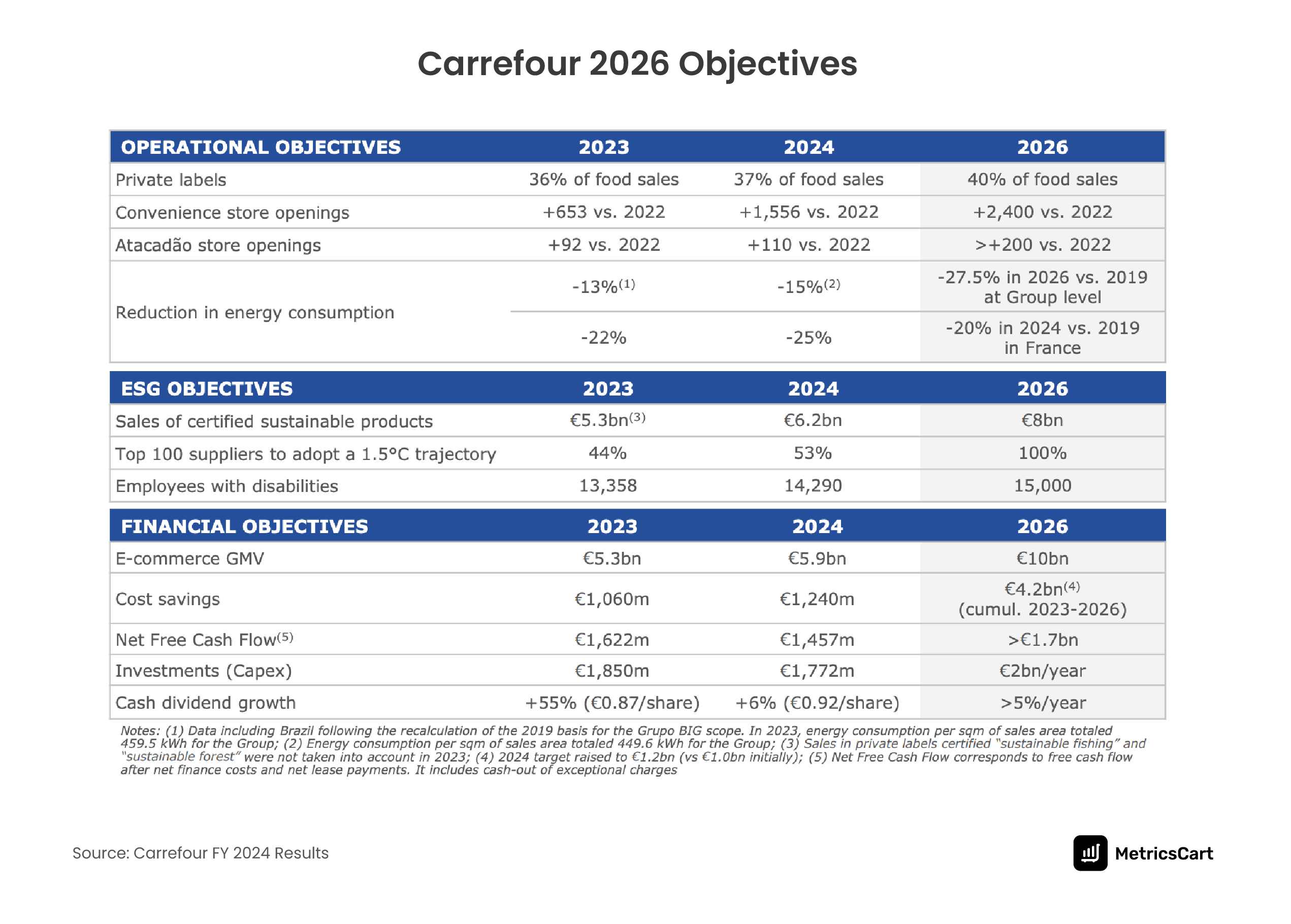
Carrefour’s own disclosures show private label at 36% of food sales in 2023, 37% in 2024, with a 40% target for 2026. That three-percentage-point jump represents billions in margin transfer from national brands to Carrefour-owned products. Every percentage point of share gained by private label is a percentage point of branded volume lost.
Carrefour’s Private-Label Strategy: Building Store Brands That Compete with National Brands
A recent industry analysis of the French private label market reported that private labels now account for roughly one-third of all grocery sales in France, and the share has held steady even as branded products launched discounts and loyalty incentives. The shift is no longer purely about price. It is about trust.
That is the context in which to read Carrefour’s private-label push.
The Three-Tier Private-Label Architecture
Carrefour’s private-label range works in three tiers, each managed as a standalone brand.
The entry tier is led by Carrefour Simpl, which absorbs price-sensitive demand. When inflation rises, Simpl picks up the trade-down. Packaging is plain, claims are minimal, and pricing is the headline feature.
The core mid-tier is Carrefour Classic, which represents the bulk of own-brand assortment. This is where the head-to-head competition with national brands happens. Carrefour invests heavily in packaging design, ingredient quality, and supplier consistency to ensure these products do not feel like budget alternatives.
The premium and specialty tier covers Carrefour Selection (high-quality and gourmet ranges), Carrefour Bio (organic), and various sub-ranges including plant-based and international cuisine. The Express 4.0 store that opened in Brussels in June 2026 carries more than 180 Carrefour Selection and Carrefour Bio products, alongside categories such as sports nutrition and alcohol-free wines.
Together, the three tiers cover every income segment and shopping occasion. The structure is similar to what Tesco operates with Finest, Tesco core, and Tesco Stockwell, but Carrefour’s range is broader, and the organic sub-brand is more developed.
Sustainability as a Private-Label Differentiator
Carrefour has placed sustainability claims at the center of its private-label proposition, which makes commercial sense as much as ethical sense. In 2026, the group announced it would remove 5,000 tons of plastic from its packaging, framing the move as both an environmental commitment and a cost reduction.
The broader sustainability framework is more demanding. The top 100 suppliers must adopt a 1.5°C emissions trajectory under what Carrefour calls Sustainable Linked Business Plans.
On the product side, Carrefour Bio has become the centerpiece of the organic strategy. The Carrefour Bio organic semi-skimmed milk is one of many SKUs developed through direct partnerships with organic producers. The group works with approximately 7,000 organic producers and 50,000 known producers overall, and has doubled the proportion of produce sourced within 50 km of stores.
The sustainability investment serves two purposes. It supports the brand’s premium positioning in Carrefour Bio and Selection, and it provides a credible answer when consumers ask why store brands should be trusted at the same level as national ones.
READ MORE | Understanding the Potential of Private Label Brands
Carrefour’s Competitive Analysis: What the PepsiCo and Shrinkflation Battles Reveal
The PepsiCo episode is worth examining as a strategic signal. When PepsiCo demanded price increases Carrefour considered unacceptable, the retailer simply removed PepsiCo’s products from shelves across multiple countries. Lay’s, Doritos, Pepsi, and 7Up disappeared. The dispute was eventually resolved, but the message was unmistakable: Carrefour was prepared to use its 80 million customers as leverage in pricing negotiations.
The shrinkflation campaign worked similarly. Carrefour put yellow stickers on products where pack size had been reduced without a corresponding price cut, calling out specific brand owners by name. Both moves play directly into the brand’s positioning. Carrefour wants to be trusted by shoppers more than it wants to be liked by manufacturers.
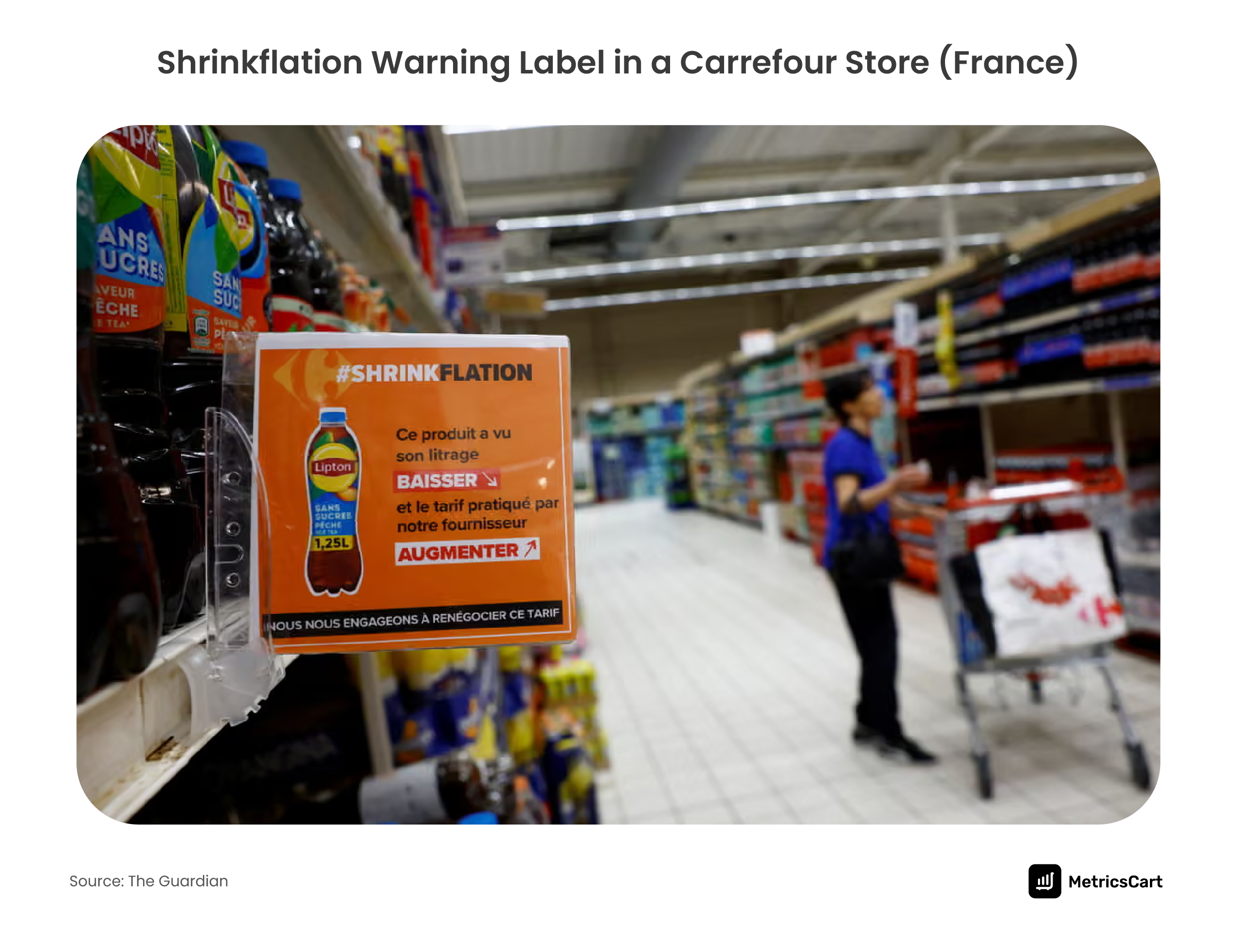
For CPG brands, the implication is straightforward. Negotiating with Carrefour now involves a media risk that did not exist five years ago.
READ MORE | Shrinkflation in CPG Brands: How to Do it Without Losing Loyalty
Who Shops at Carrefour? Consumer Behavior Across Formats and Income Groups
A Carrefour market analysis that stops at “the French middle class” misses most of what is interesting about the customer base. The reality is more layered.
The Carrefour Consumer Profile: Demographics and Income Breakdown
The core customer is aged 25 to 64, mixed gender, middle income, and family-oriented. Families with children remain the largest revenue source in hypermarkets, primarily through weekly stock-up trips with price-quality as the dominant decision criterion.
Carrefour consumer behavior reveals that urban millennials and Gen Z, broadly the 18 to 44 age band, favor the convenience formats (Express, City) for high-frequency, small-basket trips. They are also the heaviest users of click-and-collect and home delivery. According to industry data, loyalty-app users shop more frequently and lift average basket value, with click-and-collect accounting for 25 to 35% of weekly grocery orders in urban stores.
In Brazil, the customer base skews more strongly toward price-sensitive households and small businesses buying in bulk. Atacadão captures both, which is part of why the format scales so cleanly.
READ MORE | Buy Online and Pickup In-Store (BOPIS): Co-Opetition Strategies for Maximizing Revenue
What Carrefour Shoppers Buy Most: From Fresh Food to Functional Products
Fresh food is the priority category in the 2030 plan. Carrefour intends to transform its hypermarkets into “fresh-food and discount specialists” modeled on the Marché Frais by Carrefour concept. The strategic logic is to defend hypermarket traffic by elevating the categories where the format genuinely outperforms convenience and online.
Ready-to-eat and meal solutions are growing fastest in convenience formats. The Brussels Express 4.0 store includes a salad bar where office workers can build customized fresh meals, smoothie machines, and partnerships with local caterers offering Korean and Lebanese options.
International foods are another growth area. In urban stores with diverse demographics, Asian sections can be three times larger than in a typical Express. The store carries French, Spanish, Italian, Polish, and Mediterranean products to serve expatriate communities. Fresh-food strategy executed at the neighborhood level rather than chain-wide.
Organic and functional products continue to expand. Sports nutrition, alcohol-free wines, and plant-based ranges are now standard in the new convenience format. Carrefour Bio is positioned to compete head-on with branded organic specialists.
The Demographic Shift: How Inflation Changed Who Shops at Carrefour
Two years of European food inflation reshaped purchasing patterns. French households bought fewer products in 2024 than in 2023 but spent more in aggregate. Private label benefited the most, accounting for nearly 40% of the FMCG market.
CEO Alexandre Bompard has noted that customers have shifted toward private labels and entry-price items, with more dependence on promotions.
Carrefour has shown private-label penetration rising 6 to 10 percentage points in inflation-focused ranges. Higher-income shoppers, who would historically have stayed loyal to national brands, traded down and in many cases stayed there once inflation eased.
This shift is not unique to Carrefour. Aldi captured 17 million new US customers in 2025, driven by the same dynamic. Carrefour’s three-tier private-label structure allowed it to retain those shoppers across both budget (Simpl) and premium (Selection, Bio) tiers as their income recovered.
Understanding what drives purchase decisions across these shifting demographics requires granular product-level data. MetricsCart’s ratings and reviews analysis helps brands identify recurring themes in customer feedback and compare national brand sentiment against private label alternatives.
Carrefour’s Store Expansion: 7,500 Stores in Europe and Growing
The headline number from the Carrefour 2030 strategic plan is 7,500 stores across the France/Spain zone, including Travel Retail formats in train stations and airports.
In France, the plan calls for 50 new Carrefour Market supermarkets by 2030, either through fresh openings or external banner conversions. The convenience network grew by a record 456 stores in 2025 alone, and franchising is accelerating with 40 Market stores transferred to franchise per year.
Spain continues to add convenience density, with Supeco soft-discount stores expanding from 120 to 200+ locations. In Brazil, Atacadão is adding 70+ new stores to reach 455 by 2030, with strengthened fresh products, B2B e-commerce, and financial services.
The corollary to expansion in core markets is exit from peripheral ones. Carrefour Italy has been sold to NewPrinces. Carrefour Romania is being sold to Paval Holding for €823 million. Taiwan is being phased out. International franchising continues (Ghana, Bulgaria, Mongolia, Ethiopia), but it is asset-light by design.
Express 4.0: The Next Generation of Carrefour Convenience Retail
The format that captures the new direction most clearly is Carrefour Express 4.0, the latest iteration of the urban convenience model. The Brussels store that opened in June 2026 is a working showcase.
It carries premium fresh produce (SanLucar fruit and vegetables), a salad bar for office workers, expanded international food sections, and dedicated organic ranges from Biona, Jardin BiO, and Ethiquable. Mini-concepts include a smoothie machine, coffee station, photo printer, photocopier, and a “viral wall” of trending sweets and snacks. Delivery is enabled through Uber Eats and Deliveroo.
Sustainability is built in. Gondolas, cabinets, and refrigerated equipment were reused from a previously closed store. All refrigeration uses CO₂, which is a lower-emission alternative to conventional refrigerants.
The point of the format is adaptability. Each Express 4.0 store reflects the demographics of the neighborhood it serves. In a multinational corporate district like Woluwe-Saint-Lambert, that means a larger Asian section, prepared meals for office workers, and international cuisine.
The State of Carrefour’s E-Commerce Growth and Omnichannel Strategy
100% of in-store FMCG assortment will be available online by 2026 in France. The group is targeting a 40% market share in home delivery in France by 2030 and 20% in Drive (click-and-collect). Atacadão’s e-commerce GMV in Brazil is targeted to double by 2030, with 10% annual e-commerce growth in Spain. Q4 2025 e-commerce growth in Brazil reached 41% year-on-year.
Quick Commerce, Home Delivery, and the Omnichannel Flywheel
The Carrefour omnichannel model now includes express delivery in under three hours, ultra-fast delivery in under 15 minutes through Uber Eats, Deliveroo, and proprietary services, and traditional click-and-collect Drive locations.
Drive remains the operational backbone, accounting for 25 to 35% of weekly grocery orders in urban stores. The marketplace handles non-food, with 1P sales contributing 70% of GMV and 3P (third-party) accounting for 30% in 2025.
The omnichannel logic underpins the loyalty proposition too. The 2030 plan sets a target of 60 million members for Le Club, which is the data layer that powers Carrefour’s marketing strategy with personalization, retail media targeting, and Drive recommendations.
Retail media is fast becoming a significant margin contributor for grocers globally. For brands, the implication is that ad spend on Carrefour’s platform now directly influences product placement and visibility on the digital shelf and in-store digital signage.
Carrefour’s AI and Agentic Commerce Strategy: Google, ChatGPT, and Vusion
Carrefour is making three substantial AI bets simultaneously:
The first is the Carrefour Google partnership. In January 2026, Carrefour joined Google’s Universal Commerce Protocol (UCP), becoming the first European grocery retailer to do so. The UCP allows AI agents (such as Google Gemini) to communicate directly with retailer systems, enabling consumers to purchase Carrefour products inside Google Search or the Gemini app without visiting Carrefour.fr. A shopper asking Gemini “where can I find wood pellets?” can buy them directly from Carrefour without leaving the conversation.
Carrefour also runs its own in-app AI agent, Hopla+, built on Google’s Gemini model. Hopla+ helps users build shopping baskets through conversation.
The second bet is the ChatGPT integration. In March 2026, Carrefour became the first major European retailer to integrate its product catalog into ChatGPT, targeting the 26 million ChatGPT users in France. Users can ask ChatGPT for recipe ideas, build shopping baskets, select delivery options, and pay on Carrefour.fr.
The third bet, and probably the most operationally significant, is the Vusion partnership. Carrefour signed a €150 million-plus deal with Vusion to deploy electronic shelf labels, connected rails, and cameras across every French hypermarket and supermarket. The system automates labeling, detects out-of-stocks (target: 20% reduction), and supports Pick-to-Light order picking.
When AI agents become a meaningful discovery layer, product visibility depends on data quality. Structured product content, accurate pricing, consistent availability, and high-quality reviews become the inputs that determine whether an AI recommends your product or someone else’s. Brand awareness alone does not move the needle in an agentic shopping flow.
READ MORE | How AI Personalization is Driving CPG Growth Across E-Commerce
What Carrefour’s Business Strategy Means for CPG Brands: Key Takeaways
1. Private Labels Are Winning
Private label is targeted at 40% of food sales by 2026 and 50% of the non-food permanent range. Every percentage point gained by Carrefour’s own brands comes from somewhere, and that somewhere is almost always a national brand SKU. Categories with the widest price gaps (carbonated soft drinks, ambient grocery, household care) are the most exposed.
2. Listing Requirements Have Shifted
According to FoodNavigator’s analysis, brands seeking a Carrefour listing now need to align with the group’s strategic priorities: sustainable certification, local sourcing, trend relevance (organic, plant-based, international cuisines), and pricing efficiency. Top 100 suppliers must commit to a 1.5°C emissions trajectory or risk delisting. Sustainability is now a hygiene factor.
3. Price Negotiations Can Go Public
The PepsiCo delisting and the shrinkflation labeling campaigns made clear that Carrefour will use media as a pricing tool. Brands entering annual price negotiations should plan for the possibility that disputes will become public.
4. AI-Driven Shopping Will Favor Brands With the Cleanest Data
As Hopla+, Gemini, and ChatGPT take a larger share of product discovery, the brands that win will be the ones whose product content is structured, accurate, and machine-readable. Brand awareness matters less when an AI agent is doing the comparison shopping.
5. The Digital Shelf Has Become the Shelf
With 100% of FMCG assortment going online in France by 2026 and Vusion smart shelves rolling out across the physical network, the line between digital and physical retail has effectively collapsed. Pricing, availability, search rank, content quality, and reviews are now monitored continuously by the retailer’s systems. Brands that monitor those same signals with the same granularity can compete.
How MetricsCart Helps Brands Navigate the Carrefour Ecosystem
For brand teams selling through Carrefour or planning to, the practical question is how to translate strategic awareness into operational visibility.
For CPG brands looking to stay competitive across Carrefour’s expanding network, MetricsCart delivers the complete digital shelf analytics needed to maintain total visibility across 150+ retailers. By tracking real-time pricing intelligence, share-of-search, customer sentiment, and stock availability, MetricsCart empowers brands to defend their market share against the rapid rise of Carrefour’s private labels.
As Carrefour’s store brands capture more shelf space and grocery e-commerce continues to scale globally, maintaining a clear line of sight into digital performance across all channels is non-negotiable. Discover how MetricsCart can give your brand the winning edge.
Win Inside Europe’s Largest Grocery Ecosystem!
FAQs
Carrefour’s marketing strategy is a multi-format, omnichannel system built on four pillars: aggressive price competitiveness across France, Spain, and Brazil; a three-tier private-label architecture (Simpl, Carrefour Classic, Carrefour Selection / Bio) targeting 40% of food sales; digital transformation through AI partnerships with Google and ChatGPT; and targeted store expansion across hypermarkets, supermarkets, convenience formats, and discount banners.
Carrefour operates more than 15,000 stores across over 40 countries. The network includes roughly 1,220 hypermarkets, 4,301 Carrefour Market supermarkets, 8,899 convenience stores, and 627 cash-and-carry locations
Carrefour’s pricing strategy combines competitive everyday pricing in core markets with a strong private-label margin advantage. In France, the group is consistently narrowing the price gap with E.Leclerc. In Brazil, the Atacadão format delivers prices 10 to 15 percent below conventional stores through warehouse-style operations and bulk volumes. In Spain, Carrefour has achieved its best price positioning since 2022.
Carrefour has adopted Google’s Universal Commerce Protocol (UCP), making it the first European grocery retailer to allow consumers to purchase its products directly within Google Search and the Gemini AI app. In March 2026, Carrefour also became the first major European retailer to integrate its catalog into ChatGPT, targeting the 26 million ChatGPT users in France. Its in-app AI agent (Hopla+) assists with basket-building,
Carrefour’s private label accounted for 40% of food sales in 2026, up from 36% in 2023 and 33% in 2022. The company operates a three-tier architecture: entry-level Carrefour Simpl, mid-tier Carrefour Classic, and premium Carrefour Selection and Carrefour Bio.