Highlights
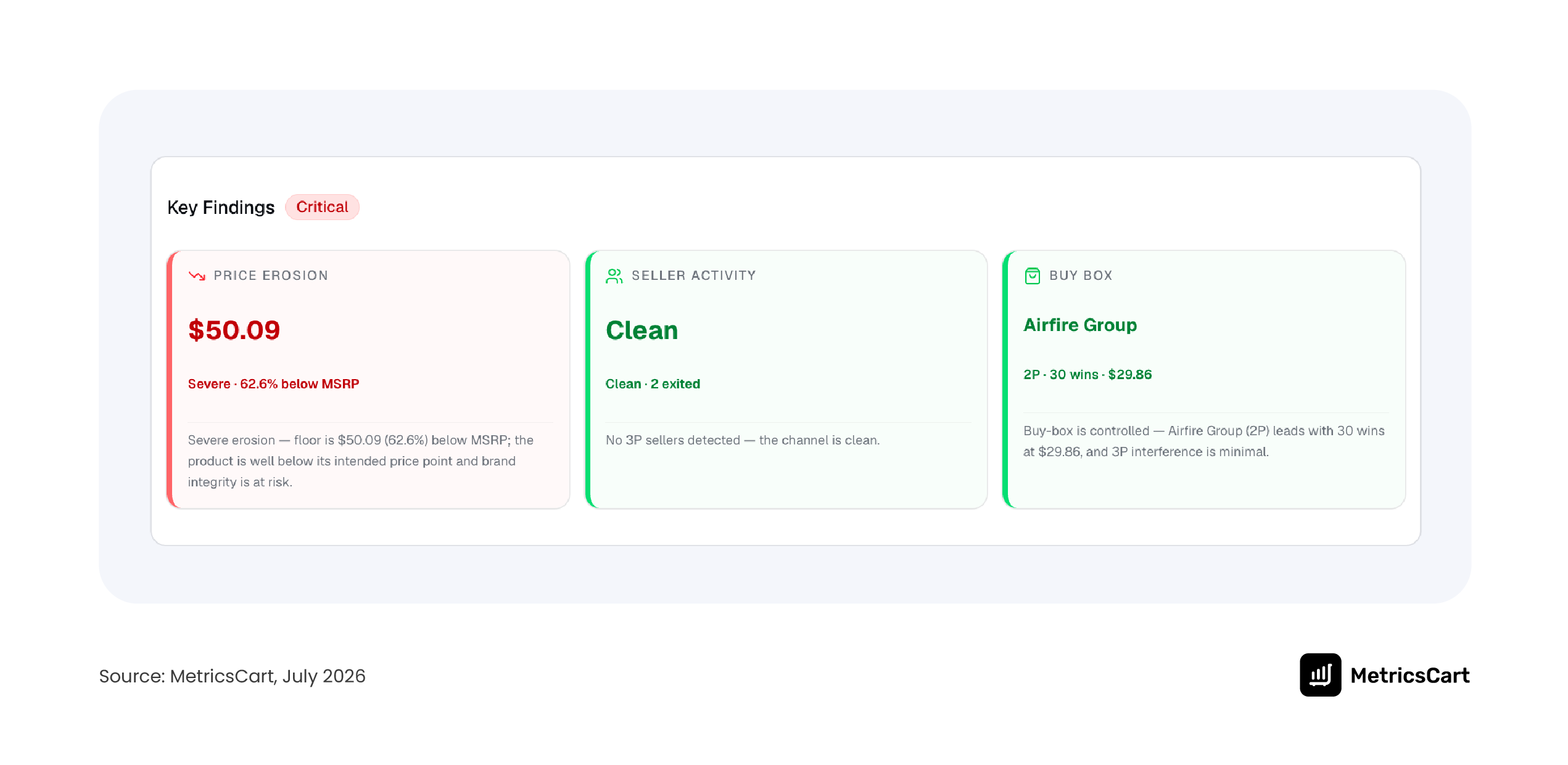
- The AIRFIRE AP202 traded at $29.86 to $29.99 for 30 consecutive days against a $79.95 MSRP, a price erosion of the AIRFIRE air purifier listing running at 62.65% below MSRP and flagged as critical.
- Airfire Group, the brand’s own account, held the Buy Box for all 30 tracked days at $29.86.
- Only 3 sellers competed on the listing across the window, and two of them never won a single Buy Box day.
- Two sellers exited during the tracking window with zero new entrants, showing the DSV floor left no operating margin for other resellers.
- Because Walmart sets the retail price under DSV agreements, the corrective lever runs through a direct escalation with Walmart.
When price erosion of AIRFIRE air purifier listings shows up in a monthly revenue review on Walmart, the number usually reflects weeks of activity that already trained shoppers on a lower price point. Buy Box algorithms have absorbed the new floor, resellers have adjusted, and any recovery toward MSRP starts to look like a price hike to customers who have been seeing the lower figure.
Tracking Summary
This MetricsCart price erosion report for air purifier listings focuses on the AIRFIRE Air Purifier AP202, a HEPA unit sold through Walmart US, which remained at 62.65% below MSRP for a full 30 days in July 2026, with no meaningful movement. The seller pattern behind that number points to a specific corrective playbook that a surface reading of the erosion percentage would miss.
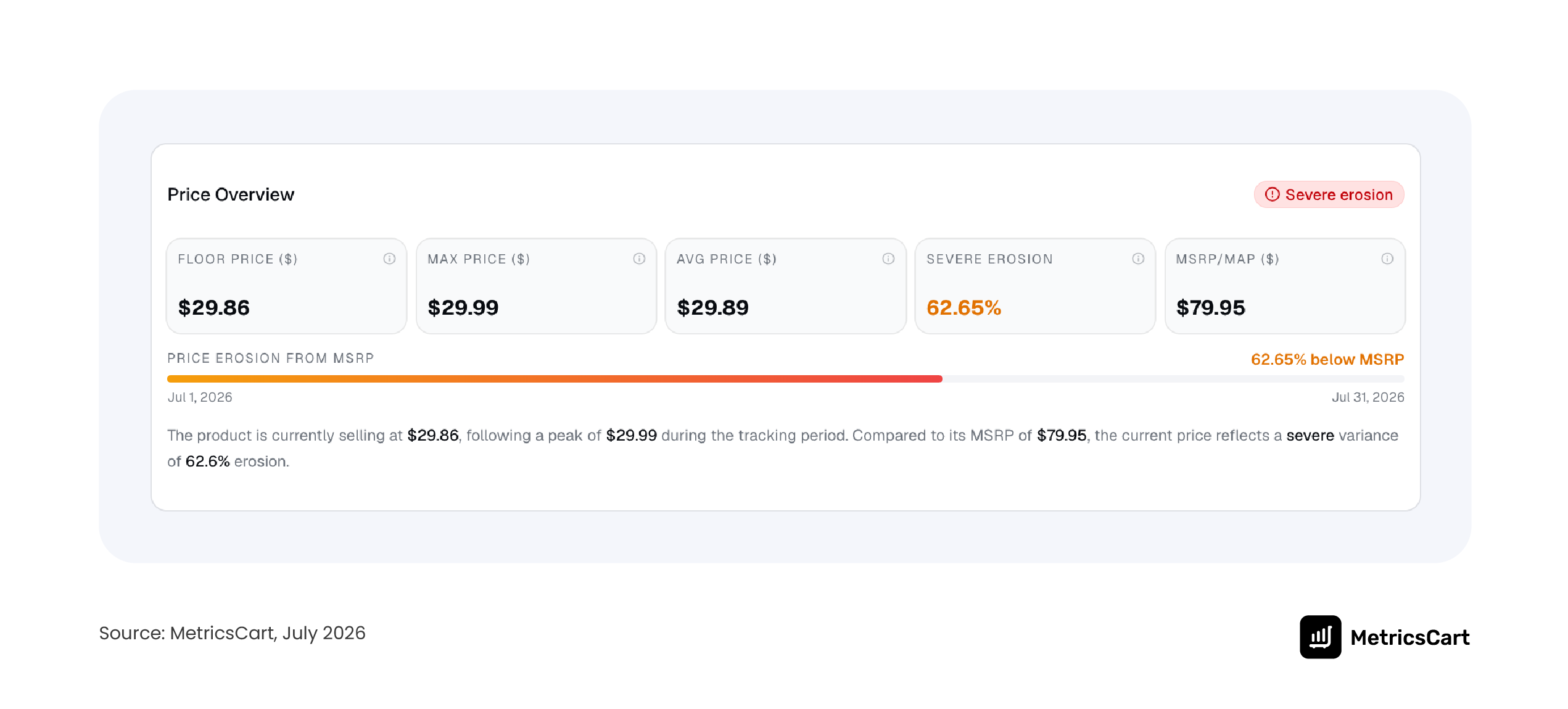
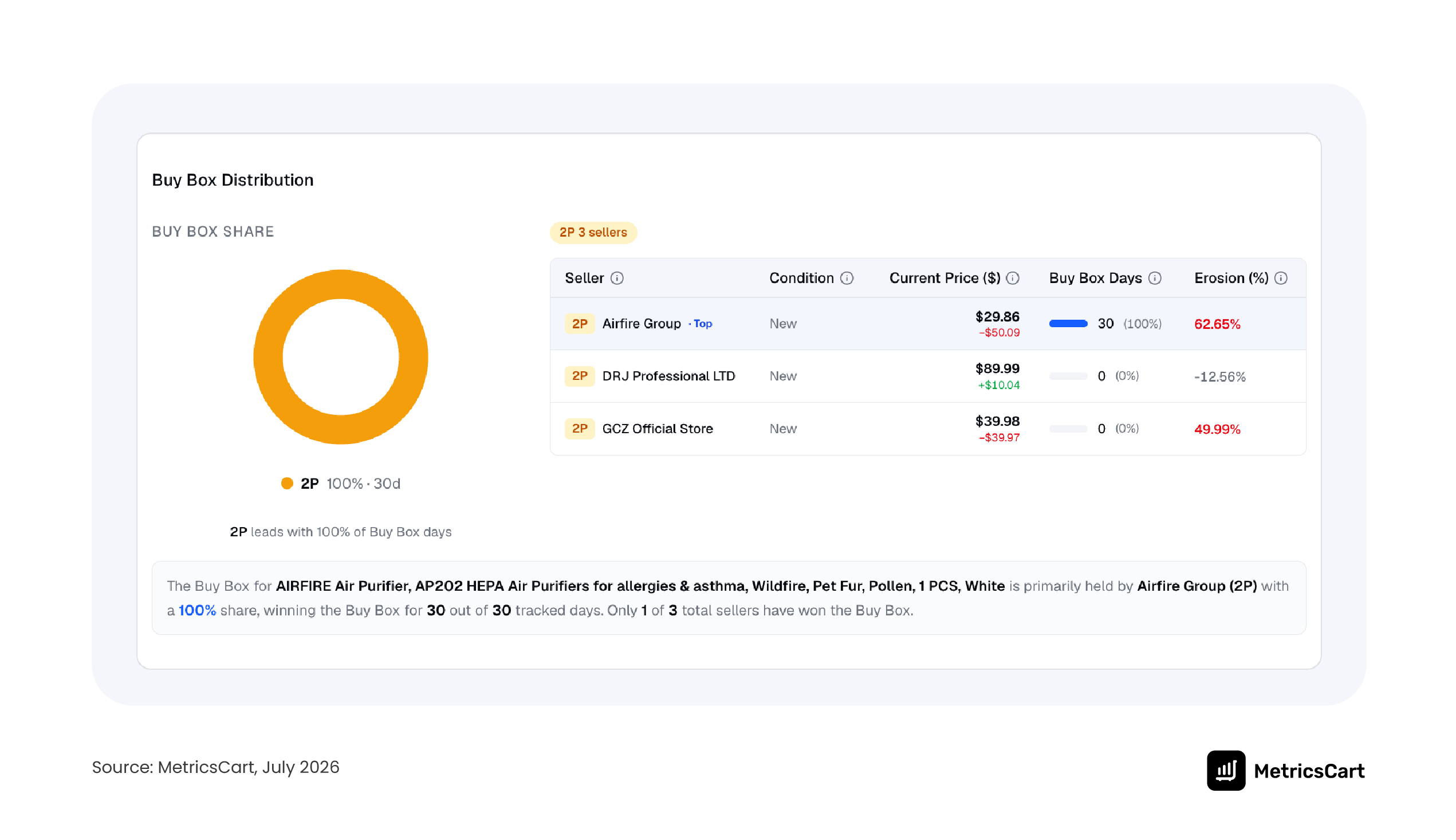
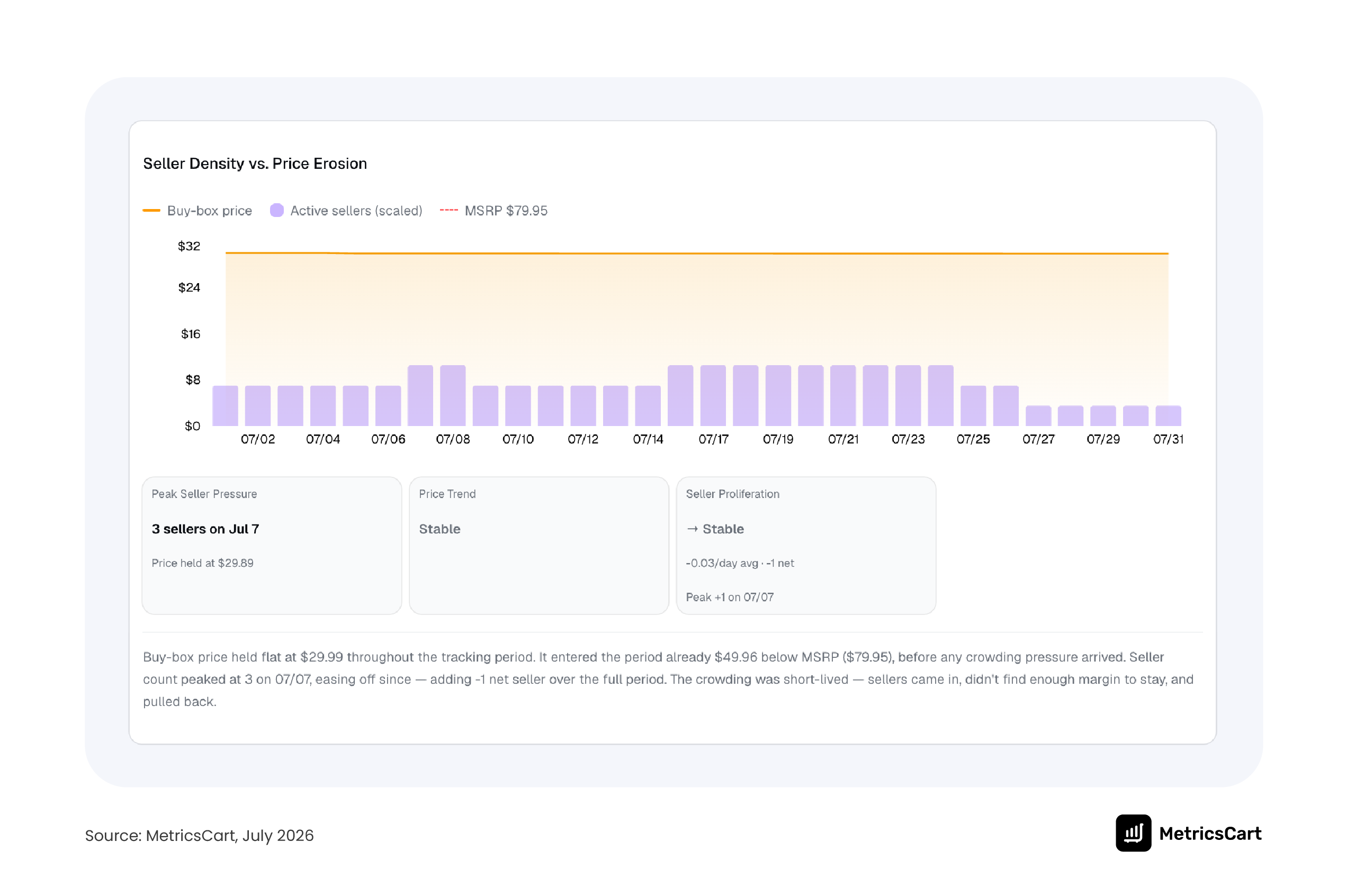
MetricsCart tracked the AIRFIRE AP202, a single-serve coffee machine, on Walmart US for 30days from July 1, 2026 to July 31, 2026 to assess MAP compliance and price erosion against MSRP. The product is currently selling at $29.86, following a peak of $29.99 during the tracking period. Compared to its MSRP of $79.95, the current price reflects a severe variance of 62.6% erosion. Price Erosion: how the Buy Box price compared to MSRP across the tracking window Buy Box Ownership: who held the offer and at what price Seller Model: what type of Walmart seller controlled the price, and what that means for enforcement Seller Density and Price Movement: whether crowding pushed the price down or the floor kept crowding out Seller Churn: who joined, who left, and who stayed Findings and Recommended Actions: where the listing stands and what to escalate first MAP policies are not public. MetricsCart uses MSRP as the reference denominator for erosion calculations when no MAP figure has been supplied by the brand. That approach means the 62.65% figure in this AIRFIRE air purifier price analysis should be read as MSRP-relative erosion rather than a literal MAP violation. If the brand’s actual MAP sits lower than $79.95, the true MAP-relative erosion is smaller than the reported figure. If it sits at or near MSRP, the reported figure holds. Air purifier pricing on marketplaces breaks into three broad models. The model behind a specific SKU shapes how much its retail price can move before the underlying business comes under strain, and it changes how a price erosion report for air purifier SKUs should be read. HEPA filter replacements every 6 to 12 months function as a soft razor-and-blades model. The purifier serves as the gateway to recurring filter revenue, and brands with proprietary filter formats absorb some hardware margin compression as long as filter attach rates hold. Coway, Levoit, and Blueair operate close to this model at various price tiers. Premium brands like Dyson and Molekule anchor on hardware margin. Design language, sensor sophistication, and multi-stage filtration performance carry the retail price, and there is no consumable lock-in strong enough to subsidize the machine on its own. Erosion at this end of the category is a direct margin event. Budget HEPA units compete on shelf price and unit volume across mass retailers. Filter economics matter less here because customers often replace whole units rather than maintaining them across a long life. The AIRFIRE AP202 sits closest to this segment. In penetration pricing, hardware price is where most of the margin lives, which makes SKU-level erosion a direct margin issue rather than one softened by downstream consumable revenue. For the AIRFIRE AP202, the listing opened the tracking period at $29.99 and closed at $29.86, a movement of $0.13 across 30 days. The gap against MSRP ($79.95) was already $49.96 on July 1. MetricsCart found that the erosion on this SKU was fully in place before the tracking window began and stayed there through the month. AIRFIRE air purifier price analysis shows that the listing traded in a narrow band between $29.86 and $29.99, averaged $29.89, and closed at $29.86. That gives a floor price of $29.86 and a ceiling price of $29.99 across the full 30-day window, a spread of $0.13. The pattern here shows a settled, eroded price, not an actively falling one. A price that is still moving down calls for immediate intervention to stop the slide. A price that has been flat at a low floor for 30 days calls for a different response, since the underlying cause has already produced its full effect and is now holding steady. The corrective work in the second case is diagnostic first (why is the floor set here, and by whom) and remedial second. MetricsCart’s MAP tracking software found that the Buy Box for the AIRFIRE AP202 was held entirely by Airfire Group for 30 of 30 tracked days at $29.86. The remaining two sellers on the listing never won a single Buy Box day during the window. Airfire Group is the brand’s own DSV account on Walmart. That single fact anchors the entire diagnosis. Under a DSV agreement, Walmart lists the item, sets the retail price, and routes the customer order to the brand’s warehouse for fulfillment. The Buy Box is held by the DSV entity by design, and the price attached to that Buy Box is the price Walmart’s algorithm defaults to based on the cost input, promotional flags, and competitive matching rules on the account. 100% Buy Box concentration on a DSV account produces what many monitoring frameworks read as clean channel control. On a channel-integrity view, the observation stands. The complication sits one layer deeper, in the price at which that control is being exercised. DRJ Professional LTD priced at $89.99, which is 12.56% above MSRP. GCZ Official Store is priced at $39.98, which is 50% below MSRP. Their prices give a useful read of what the listing might look like without a DSV floor pulling it down. DRJ’s above-MSRP pricing points to a reseller working on scarcity or convenience margin. GCZ’s 50% below MSRP price is closer to typical marketplace behavior for a budget HEPA unit, though still well above the DSV floor. Neither could win the Buy Box at those figures, which confirms where the pricing entity actually sits on this listing. Airfire Group owns the Buy Box across the full tracking window, and it owns it at 62.65% below the brand’s own MSRP. Both statements are true. Only one of them describes a sustainable channel position. For channel and marketplace managers, MetricsCart research shows that Buy Box percentage should always be read alongside the price at which the share is being held. A 100% Buy Box share at MSRP indicates channel control. A 100% Buy Box share at 37% of MSRP indicates a pricing problem that channel structure is quietly amplifying. MetricsCart‘s Buy Box tracking surfaces both dimensions in one dashboard across 150+ global retailers. The right corrective action for the AIRFIRE AP202 depends on which Walmart seller model holds the Buy Box, because the price-setting entity changes across models. Any AIRFIRE air purifier price monitoring program that skips this framework risks recommending the wrong lever. Under 1P and 2P arrangements, Walmart is the pricing entity. The brand supplies inventory (1P) or maintains it (2P) but hands the retail price decision to Walmart’s merchandising and algorithmic systems. Under 3P, the seller controls the retail price directly, with the brand’s leverage over that price defined by whatever MAP policy the seller has agreed to. The Buy Box holder on the AIRFIRE AP202 across all 30 tracked days is Airfire Group, ideally, the brand’s DSV account. Walmart is therefore the pricing entity on this SKU. The corrective lever is a Walmart merchant conversation, and any escalation drafted as a MAP enforcement action would land in the wrong channel. The $50.09 gap between the DSV price and MSRP is large enough that, whether the true MAP is $79.95 or somewhat lower, the retail price still runs well below any plausible MAP floor. The magnitude of the gap justifies the merchant conversation independent of MAP resolution. MetricsCart’s AIRFIRE air purifier price monitoring across July 2026 shows the following seller density pattern: A stable Buy Box price at low seller density often reads as a healthy signal on a channel dashboard. On this SKU, the same pattern reflects a floor that has effectively closed the listing to other sellers, since resellers cannot operate profitably below the DSV price. MetricsCart categorizes sellers on the listing into three groups: New Entrants, Exited, and Persistent. No new sellers appeared on the AIRFIRE AP202 listing during the recent comparison window. The listing did not attract fresh competition across 30 days, which is unusual for an air purifier SKU in a category that typically sees active reseller interest. DRJ Professional LTD was last seen on July 24 priced at $89.99, with zero Buy Box wins across its time on the listing. GCZ Official Store was last seen on July 26 priced at $39.98, also with zero Buy Box wins. Both sellers left the listing without ever winning a share of demand. Their exits point to the DSV floor as the reason. Neither seller could price competitively against $29.86 while maintaining any margin on a budget HEPA unit, and both chose to redirect inventory rather than continue holding a listing they were not winning. The only seller present throughout the tracking window is Airfire Group. The DSV is the sole structural presence on the listing, averaging $29.89 across 30 days with 30 Buy Box wins and a stable price trend. Here’s what needs to be done: The pricing entity on this SKU is Walmart under the DSV agreement. The corrective lever is a Walmart Retail Link conversation about the retail price the algorithm is defaulting to. A MAP policy escalation drafted for reseller enforcement would not apply here. A retail price this far below MSRP often traces back to one of three sources: a cost input set too low when the DSV file was originally configured, a lingering promotional flag that Walmart’s algorithm continues to read as a permanent markdown, or a competitive matching rule pulling the price down against a benchmark listing that has since moved or been delisted. All three are correctable through the merchant conversation, and each requires a specific fix on the account file. The current channel is clean by seller count, but a low Walmart price does not stop unauthorized resellers from listing the SKU elsewhere. Automated repricers on Amazon and other marketplaces often scrape Walmart as a benchmark, and a DSV price set this low can pull the AIRFIRE AP202 down across other channels within weeks unless the DSV price is corrected upstream. Monthly monitoring across marketplaces catches that leakage before it becomes structural. MetricsCart checked the AIRFIRE AP202 listing on Walmart US every day for 30 days, from July 1 to July 31, 2026, using its Digital Shelf Analytics and MAP Monitoring software. For each daily check, the Buy Box holder was recorded against the seller showing at that moment. Every seller on the listing was logged by type (1P, 2P, 3P), along with days active, price, and Buy Box wins. Prices were captured daily in US dollars, including coupon and promotional prices where they appeared on the listing. All comparisons use the $79.95 MSRP as the reference denominator, since no MAP floor was supplied for this SKU.Product Overview
What This Buy Box and Pricing Intelligence Report Covers
Methodology Note on MSRP as a Proxy for MAP
Understanding Air Purifier Pricing Strategy
Filter and Consumable Model
Value-Based Pricing
Penetration Pricing
Price Health of the AIRFIRE AP202
Price Erosion of the AIRFIRE AP202 Against MSRP
Buy Box Ownership Analysis of the AIRFIRE AP202
Airfire Group Holds 100% of Buy Box Days as the Brand’s DSV Account
The Two Non-Winning Sellers Show the Ceiling and Mid-Band
Why 100% Buy Box Share by a Brand-Linked Account Is Not Automatically a Good Outcome
Why Seller Model Matters on Walmart for MAP Escalations
Applying the Framework to the AIRFIRE AP202
Seller Density of the AIRFIRE AP202 and Its Effect on Price
Seller Churn on the AIRFIRE AP202: Entrants, Exits, and Persistent Sellers
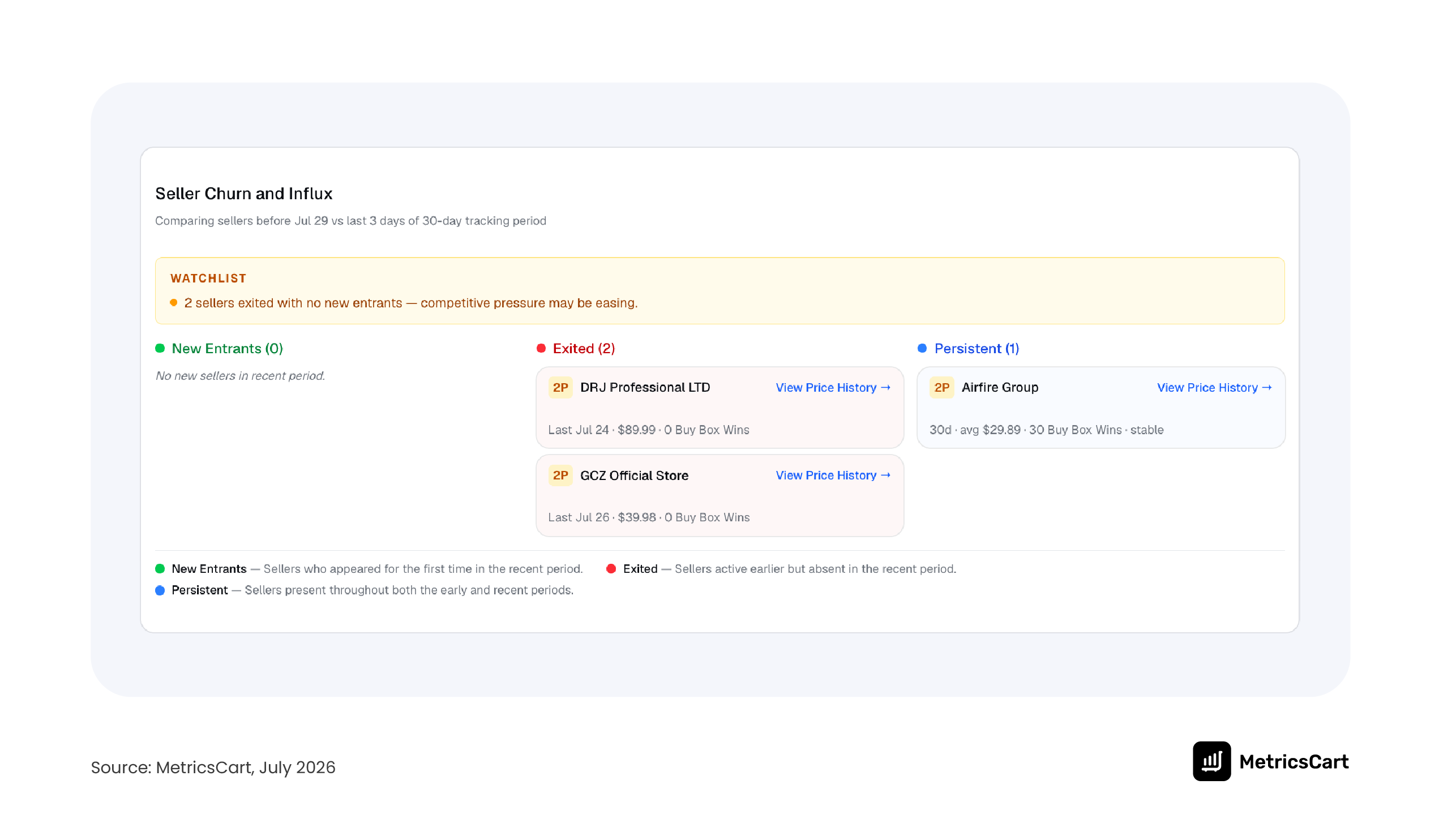
New Entrants: None
Exited: DRJ Professional LTD and GCZ Official Store
Persistent: Airfire Group Only
Recommended Actions for AIRFIRE and Similar Air Purifier Brands
1. Escalate Through Walmart Merchant Channels
2. Review the DSV Cost Input and Promotional Flags
3. Monitor for 3P Entrants and Cross-Marketplace Leakage Monthly
Appendix A: How This Was Tracked
Appendix B: Evidence and Limitations