Consumers no longer view online and offline shopping as two distinct activities, but as something that goes hand-in-hand. In fact, 81% of consumers today conduct online research even though they make purchases in-store, while 28% of US shoppers use mobile phones in-store to look up discounts, compare prices, and read product reviews.
This shift means retailers must ensure a consistent experience across all channels, especially in pricing, to build trust, enhance customer loyalty, and ultimately drive sales across all touchpoints.
MAP (Minimum Advertised Price) data is a powerful tool to achieve this alignment. Beyond enforcement, MAP data also acts as a strategic signal, revealing where pricing discipline breaks down, which sellers disrupt the channel, and how digital pricing behavior influences physical retail performance.
This article explores how brands can use MAP data to align digital and physical retail pricing.
Why Digital and Physical Retail Pricing Alignment is Essential
Today’s shoppers move seamlessly between online and in-store channels. They expect the same prices, offers, and availability wherever they choose to buy. Consistent pricing is now a baseline expectation, not a nice-to-have.
When prices don’t match across channels, trust erodes quickly. A shopper who sees one price online and another in-store questions the brand’s fairness and reliability. This confusion directly impacts conversion and long-term perception.
According to PwC, 32% of consumers abandon a brand after just one bad experience, and pricing inconsistency is a common trigger. And, this erosion doesn’t stop with shoppers.
Persistent online price instability also weakens a brand’s credibility with retail buyers. When store teams are forced to explain lower online prices or unauthorized discounts, it strains buyer relationships and complicates future negotiations around promotions, shelf placement, and pricing agreements.

In Episode 40 of the Digital Shelf Insider Podcast, Michael R. Murphy, Partner at K&L Gates explains why most brands are using the term MAP incorrectly, how unilateral pricing policies really work, and where brands accidentally cross into antitrust risk without realizing it.
Watch the full episode here:
Price misalignment also creates internal friction. Disconnected pricing systems often require manual updates across e-commerce platforms and in-store POS systems, increasing effort and the risk of errors.
There is also a compliance angle. In some regions, unexplained price differences across channels can raise regulatory concerns.
Consumer protection and price fairness laws may apply if discrepancies are perceived as misleading. Aligning pricing across digital and physical retail reduces this risk and supports ongoing compliance.
READ MORE | Overcoming Price Erosion: Strategies for Brands on Online Marketplaces
Challenges in Online vs In-Store Pricing
While digital and physical retail pricing alignment is critical, putting it into practice is far from simple. Most retailers struggle with structural, technical, and behavioral factors that naturally create price gaps across channels. The most common challenges include:
- Dynamic Pricing and Online Flexibility: E-commerce platforms often use algorithms that adjust prices based on factors like demand, competitor pricing, and customer browsing behavior.
For example, if a product is frequently searched for or added to a shopping cart, the price may increase due to perceived demand. In contrast, physical stores generally have fixed pricing that doesn’t fluctuate as quickly.
Without MAP guardrails, this volatility often spills into physical retail, creating confusion at the shelf and pressure on store teams.
- Regional Pricing Variations: Online retailers may adjust prices based on geographic factors, such as shipping costs or local taxes.
Physical stores also experience price differences depending on local market conditions and competition, such as the cost of operating in different areas or special in-store promotions.
These regional pricing strategies can make it difficult to maintain a consistent price across both channels. MAP data helps separate acceptable regional variance from true advertised price conflicts.
- Promotions and Discounts: Retailers may offer exclusive online discounts or in-store promotions that don’t align with each other.
For example, a limited-time online discount or promotional pricing may not be available in-store, or an in-store clearance event might not be reflected in online pricing.
- Different Cost Structures for Online vs In-Store Operations: The cost structure for online and in-store retail is often different, which can affect pricing decisions.
For example, e-commerce platforms may have lower overhead costs in terms of store rent, staffing, and utilities, allowing them to offer more competitive prices.
On the other hand, physical stores have higher fixed costs, such as rent, utilities, and in-store staff, which are factored into product prices.
Navigating these challenges requires retailers to adopt a unified pricing strategy. MAP pricing data analysis helps retailers overcome these obstacles and create a more seamless, trustworthy experience for their customers.
When done right, MAP data doesn’t just flag issues; it explains why they happen, helping teams respond without creating channel conflict.
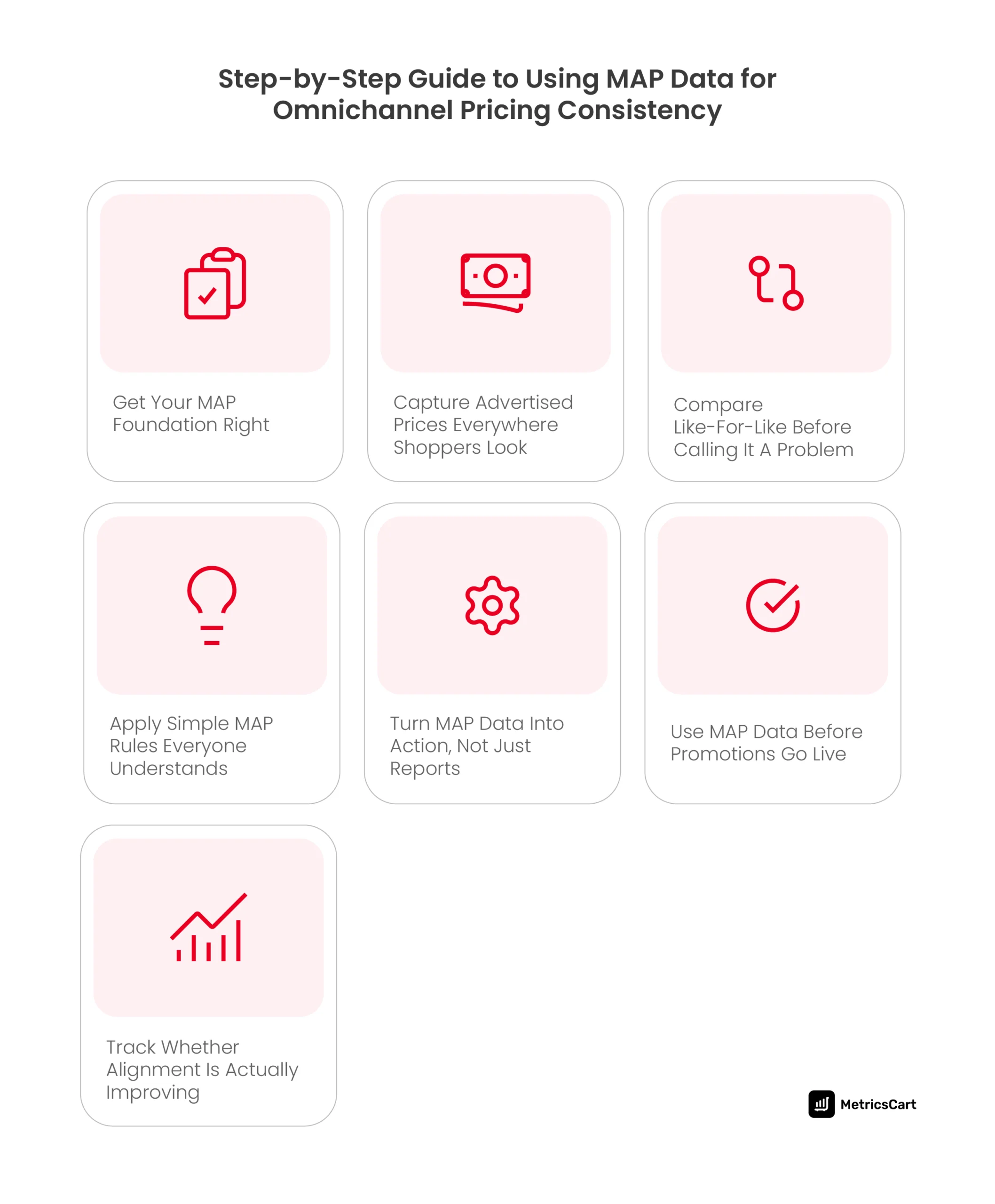
Step-by-Step Guide to Using MAP Data for Omnichannel Pricing Consistency
MAP data gives a clear reference point for what can be publicly advertised, across marketplaces, retailer websites, ads, and even in-store signage. It does not control the final checkout price.
It controls what the shopper sees before they decide to buy. That distinction is important. Here’s how you can use MAP data to align digital and physical retail:
Step 1: Get Your MAP Foundation Right
Before you look at any data, make sure the basics are in place. Most MAP problems start with unclear rules, not bad execution.
At a minimum, your MAP foundation should cover:
- Which SKUs are included, the minimum advertised price for each, and whether rules change by region or channel
- What qualifies as an advertised price, such as that on PDPs, visible coupons, strike-through pricing, paid ads, emails, and in-store shelf signage.
- A clean SKU master where pack sizes, variants, and UPCs are correctly mapped across systems.
Many pricing issues that appear to be violations are actually catalog mismatches. Getting this step right reduces noise and ensures your teams spend time fixing real MAP risks rather than chasing false alarms.
READ MORE | 10 Common MAP Policy Loopholes that Would Cost Your Brand
Step 2: Capture Advertised Prices Everywhere Shoppers Look
Shoppers do not think in channels. They compare. As mentioned above, 28% of US consumers use their phones during their last store trip to compare prices and look up reviews.
That means you need real-time visibility into how prices appear both online and in-store.
- Digital: retailer PDPs, marketplaces, paid ads, and price feed surfaces
- Physical: store signage, shelf labels, circulars, in-store promo boards (even a weekly store audit sample helps)
MAP visibility across both environments ensures that digital price changes don’t silently undermine in-store confidence.

Step 3: Compare Like-For-Like Before Calling It A Problem
Not every price difference is a MAP issue.
Before flagging a violation, confirm that the product is truly the same. Check size, count, bundle structure, and variant. Then separate visible discounts from in-cart or loyalty-based discounts, if your MAP policy allows those.
This simple step eliminates a large share of false alerts and keeps teams focused on real issues. It is also critical for root-cause analysis.
MAP pricing data analysis can explain why a discrepancy exists, whether it’s a rogue reseller, a regional promo, or a marketplace algorithm, before enforcement begins.
Step 4: Apply Simple MAP Rules Everyone Understands
MAP enforcement does not need to be complex to be effective.
Most teams start with three clear states.
- Prices at or above MAP are compliant.
- Prices slightly below MAP go on watch.
- Prices clearly below MAP are violations.
Once that is in place, add context to each violation, such as visible coupons, aggressive strike-through pricing, reseller undercutting, or regional promotions. This makes it easier for teams to act rather than debate the MAP data for retail alignment.
Clear categorization prevents over-enforcement and reduces unnecessary partner friction.
Step 5: Turn MAP Data Into Action, Not Just Reports
At this stage, MAP data becomes a coordination tool, not just a compliance report, aligning ecommerce, retail, and sales teams around one pricing truth.
Seeing violations is not enough. Someone must own the resolution.
Set up alerts to route the issues to the right team.
- Marketplace issues go to marketplace operations.
- Retail promotions go to sales or trade marketing, and so on.
Also, define response timelines so issues do not linger and repeat week after week.
READ MORE | How To Strengthen MAP Enforcement in 2026: A 5-Step Action Plan
Step 6: Use MAP Data Before Promotions Go Live
The best time to fix pricing misalignment is before shoppers see it.
Check planned promotions against MAP thresholds before they launch. Make sure online prices, in-store signage, and ad messaging tell the same story, with the same timing and end dates.
This avoids last-minute corrections and awkward customer conversations at the store counter.
Step 7: Track Whether Alignment Is Actually Improving
Finally, close the loop.
Look at how often violations occur, how quickly they are resolved, and which sellers or retailers repeat the same issues. Over time, this data should show fewer conflicts, faster fixes, and more consistent pricing across channels.
When MAP data is used this way, it becomes a coordination tool. It helps digital, retail, and sales teams stay aligned on a single pricing truth.
READ MORE | What Brands Miss When They Don’t Monitor MAP Weekly
Automate MAP Monitoring and Enforcement Using MetricsCart
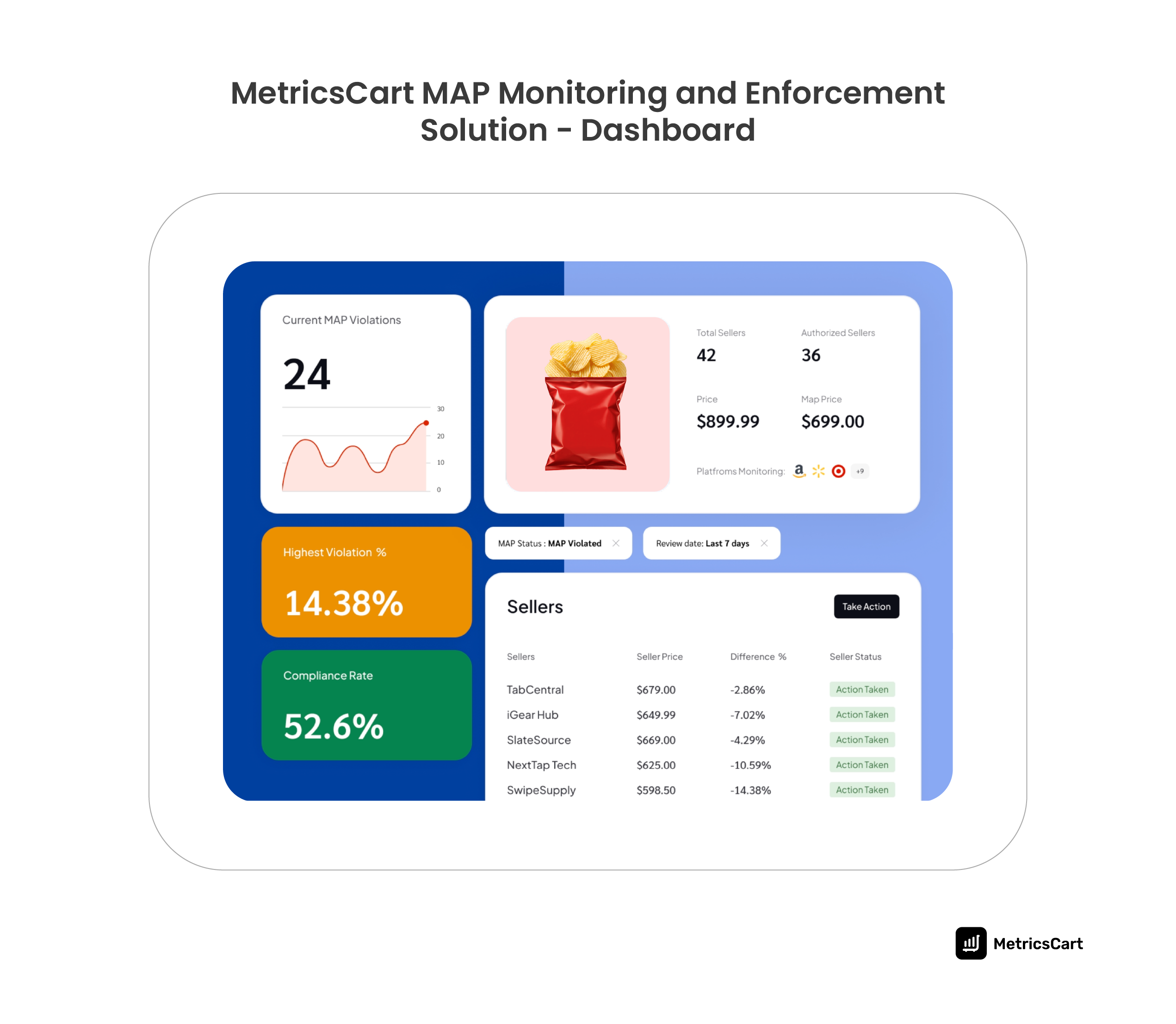
Manually monitoring and enforcing MAP rules isn’t feasible, especially when you sell multiple SKUs across different online and offline channels.
That is why MetricsCart offers a fully automated MAP Monitoring and Enforcement solution built to deliver MAP data insights for retail brands.
MetricsCart continuously tracks advertised prices across all selling channels, helping you identify violations the moment they occur. This allows you to maintain pricing consistency, protect margins, and deliver a reliable customer experience without relying on manual checks or spreadsheets.
And, when a violation occurs, MetricsCart automatically:
- Captures proof of the violation with timestamps and source details
- Identifies the seller responsible, including unauthorized sellers
- Sends warning emails based on your predefined enforcement rules
This removes guesswork from enforcement and helps you turn MAP monitoring from reactive policing to controlled pricing governance.
Every seller interaction is backed by clear evidence, which makes conversations faster and more effective.
MetricsCart also helps teams enforce MAP consistently over time. You can track repeat violators, monitor resolution timelines, and identify which SKUs or retailers pose the greatest pricing risk.
The result? Fewer pricing conflicts, stronger retailer trust, reduced operational drag, and consistent shopper experience across every channel.
Enforce MAP Automatically and Keep Every Channel Aligned.
FAQs
MAP data creates a single reference point for advertised prices across e-commerce platforms and physical stores. By monitoring how prices appear wherever shoppers look, brands can spot mismatches early and correct them before they confuse shoppers or strain relationships with retailers.
Omnichannel shoppers expect consistency. When online and in-store prices don’t match, trust drops and conversion suffers. MAP pricing protects brand credibility, supports retailer confidence, and reduces internal friction caused by manual pricing corrections.
No. MAP only governs what price can be advertised publicly. Retailers may still apply private discounts, loyalty pricing, or in-cart promotions if the MAP policy allows it. This distinction is critical to avoid enforcement errors and antitrust risk.
Brands should first confirm that the products are truly identical in size, count, and bundle structure. Then, separate visible discounts from hidden or loyalty-based discounts. MAP pricing data analysis helps explain whether a difference is caused by a rogue seller, a regional promotion, or platform-driven pricing changes.
Yes, and this is one of its biggest advantages. By checking planned promotions against MAP thresholds in advance, brands can ensure online prices, in-store signage, and ads launch with consistent messaging and timing, avoiding last-minute fixes.
MAP data reduces in-store friction caused by shoppers referencing lower online prices. It also helps store teams avoid awkward conversations, supports fair margin protection, and strengthens trust with retail buyers during negotiations.