Minimum Advertised Price, or MAP, is the lowest price a retailer is allowed to advertise for a product. It protects brands from discount wars, safeguards margins, and keeps competition fair across channels. However, simply having a MAP policy is not enough. Experienced sellers know exactly how to work around vague clauses, incomplete definitions, or blind spots in an MAP policy.
In this article, we’ll explore the 10 most common MAP policy loopholes that resellers exploit, and explain how your team can close those gaps before the damage happens.
What a MAP Policy Covers and Where Loopholes Begin
A MAP policy governs one thing: the price a retailer is allowed to advertise publicly. This includes the numbers shown on product detail pages, search results, comparison tables, retail media ads, emails, landing pages, and any promotional banners a shopper can see before beginning checkout. When MAP works, it keeps every seller aligned, protects your price position, and gives your retail partners confidence that they are competing on equal terms.
But there’s a challenge. MAP only applies to the advertised price. It does not control what happens once a shopper clicks Add to Cart, enters a coupon code, logs into an account, receives a private offer, or interacts with personalized ads. It also has no effect on unauthorized sellers who never agreed to follow your rules in the first place.
This blind spot is where most loopholes emerge. Sellers can keep the visible price compliant while quietly lowering the actual selling price through hidden discounts, value shifting, or checkout-only incentives. Without clear definitions and proactive monitoring, these tactics slip through unnoticed and undermine the very protection MAP is meant to provide.
READ MORE | What Every CPG Brand Should Know About MAP Pricing and Monitoring
10 Common MAP Policy Loopholes That Brands Often Miss
A Harvard Business Review study found that unauthorized retailers violated MAP policies roughly 50% of the time, and even authorized sellers broke them about 20% of the time. And interestingly, not all of these violations show up as an obvious price drop on the product page. Many happen quietly through tactics that exploit tiny gaps in MAP policies, lowering the shopper’s effective price while keeping the advertised price technically compliant.
Here are 10 MAP policy loopholes sellers commonly exploit, grouped into three major buckets that every brand should watch closely:
Pricing and Discount Loopholes
MAP violations come in different forms, and the most common by retailers are direct price violations. It is when a retailer displays a price on the product page that is clearly below your MAP threshold without any workaround. It is an outright violation sitting in plain view.
But not all MAP violations look this obvious. Many retailers hide lower prices behind “private” touchpoints that do not appear on the public product page. These tactics avoid direct detection and still erode your price floor. They include:
1. In-Cart Pricing or The “Add to Cart for Price” Tactic
When doing add-to-cart violations, the retailer keeps everything on the product page perfectly compliant, so at first glance, it looks like they are playing by the rules. But the moment a shopper adds the item to the cart, the price quietly drops below MAP. Retailers defend it by saying a cart is a “private space” and not an advertisement.
2. The Private Email Offer
In this case, retailers send shoppers on their email lists with exclusive promotions and discount coupon codes with lower prices, sometimes even time-bound flash drops. Since emails don’t appear on public product pages, retailers claim these aren’t “advertised prices.” But they still influence shopper behavior and can trigger price-matching pressure across marketplaces.
3. The Secret Discount Code Applied at Checkout
This is one of the fastest-spreading MAP enforcement issues. Sellers issue discount codes through influencers, affiliates, loyalty programs, or even customer service chats. The product page stays MAP-compliant, but once the code is added at checkout, the price dips below your threshold.
The problem escalates when these codes leak to public coupon aggregators, leading to widespread price erosion.
4. Targeted Retargeting Ads With Lower Prices
These ads only show discounted prices to selected shoppers, like cart abandoners or repeat visitors. Because the lower price isn’t visible to the general public, retailers argue it doesn’t violate MAP. But these targeted ads reach the exact shoppers most likely to buy, giving sellers an unfair and often invisible advantage.

Value-Based Loopholes
Value-based loopholes are where sellers shift value around through bundles, store credits, or order-level incentives without touching the MAP price. It includes:
5. Value Swapping Through Bundles
Instead of discounting the product, sellers create bundles that inflate the value.
For example, a $199 bottle bundled with $40 worth of free accessories. The MAP price stays intact, but the shopper feels like they’re getting a better deal than anyone selling the standalone product. This tactic erodes perceived price parity without technically touching the listed price.
6. Discounts on Order Totals (Not the Product)
This is the “loophole hiding in plain sight.” A retailer keeps the product at MAP but offers a cart-wide discount: “$100 off on orders above $500.” On paper, the product didn’t drop in price. In practice, shoppers still end up paying less.
High-volume marketplaces like Amazon and Walmart use these promotions aggressively during events like BFCM, making it nearly impossible for compliant sellers to compete.
7. Store Credit and Loyalty Rewards
Instead of an upfront price reduction, the retailer gives the customer a reward, a coupon, or store credit to be used on a future purchase. The current transaction is recorded at the full price, satisfying MAP requirements, but the customer still receives value back for their purchase. This builds loyalty and encourages repeat business.
8. Free or Heavily Discounted Shipping/Installation
MAP agreements typically govern the price of the product itself, not related services. By absorbing the costs of shipping, handling, or installation, the retailer significantly lowers the customer’s total out-of-pocket expense without formally dropping the product’s advertised price.
READ MORE | Amazon MAP Policy Violation Is Killing Your Brand Value: Learn How To Detect and Prevent
Inventory and Channel Loopholes
Inventory and channel loopholes are where unauthorized sellers or condition-based listings offer discounted units that appear legitimate but sit outside your policy coverage, such as
9. Gray-Market Sellers Operating Without Oversight
A gray market refers to the sale of products through channels that are legal but unauthorized by the original manufacturer. These sellers often acquire genuine inventory through liquidation, international channels, or other means and are not bound by the manufacturer’s MAP policies or other retailer agreements. They can then offer the items at a steep discount, often without the standard warranty or service.
10. The “Open Box” Escape
An “open box” item is a product that has been returned, displayed, or had its seal broken, but is still functional (sometimes referred to as refurbished, used, or like-new). Manufacturers generally only enforce MAP policies on new, factory-sealed products. By selling the item as “open box,” the retailer is selling a different class of inventory that is exempt from the standard price restrictions, allowing for a deep, non-MAP-violating discount.
The Most Damaging Loophole: Internal Misalignment
You might have a policy that is strong enough to close every loophole listed above. But none of it matters if your internal teams are not aligned. This is the one failure point that can quietly undo even the most well-designed MAP framework.
When sales, marketing, e-commerce, and legal each operate with their own interpretation of the policy, enforcement becomes inconsistent. Retailers notice this faster than anyone. The moment a seller realizes that one team is strict while another is flexible, they push the boundaries. Some ask for exceptions. Others test how far they can go without consequences. Over time, the entire structure of enforcement weakens because the brand itself is sending different signals.
You can usually spot internal misalignment through patterns like:
- Sales approving promotions or discounts that undercut MAP to protect revenue targets
- Marketing launching campaigns that unintentionally contradict MAP rules
- Legal assuming enforcement sits with e-commerce, while e-commerce thinks the opposite
To fix this you must work on strengthening the internal coordination of your team. Every team that touches pricing and retail communication needs to share the same understanding of what the policy covers, how violations are handled, and who has final authority.
When internal alignment is strong, enforcement stays firm and predictable. Without it, even the best-written policy will struggle to hold.
How to Close MAP Policy Loopholes
According to McKinsey, 40% of consumers instantly switch retailers to get better deals. That’s why, if even one retailer advertises below your minimum advertised price (or MAP), the drop can trigger a chain reaction across every marketplace you sell on.
To effectively mitigate MAP compliance risks early, you must shift from simply monitoring the product page (PDP) to enforcing compliance across the entire shopper journey, as retailers hide true discounts in multiple places. This requires a dual approach: advanced technological detection and strong, legally reviewed policy enforcement.
Using Advanced MAP Monitoring Software
Technology plays a crucial role in closing MAP policy loopholes because it can track what human teams simply can’t see. For instance, MAP monitoring and enforcement software like MetricsCart provides automated systems that follow the full checkout flow, and you can detect the true price a shopper pays, whether it drops inside the cart, after a coupon is applied, or through a targeted offer meant for a specific segment. This level of visibility makes it possible to catch violations the moment they occur, not days later when retailers have already reacted.
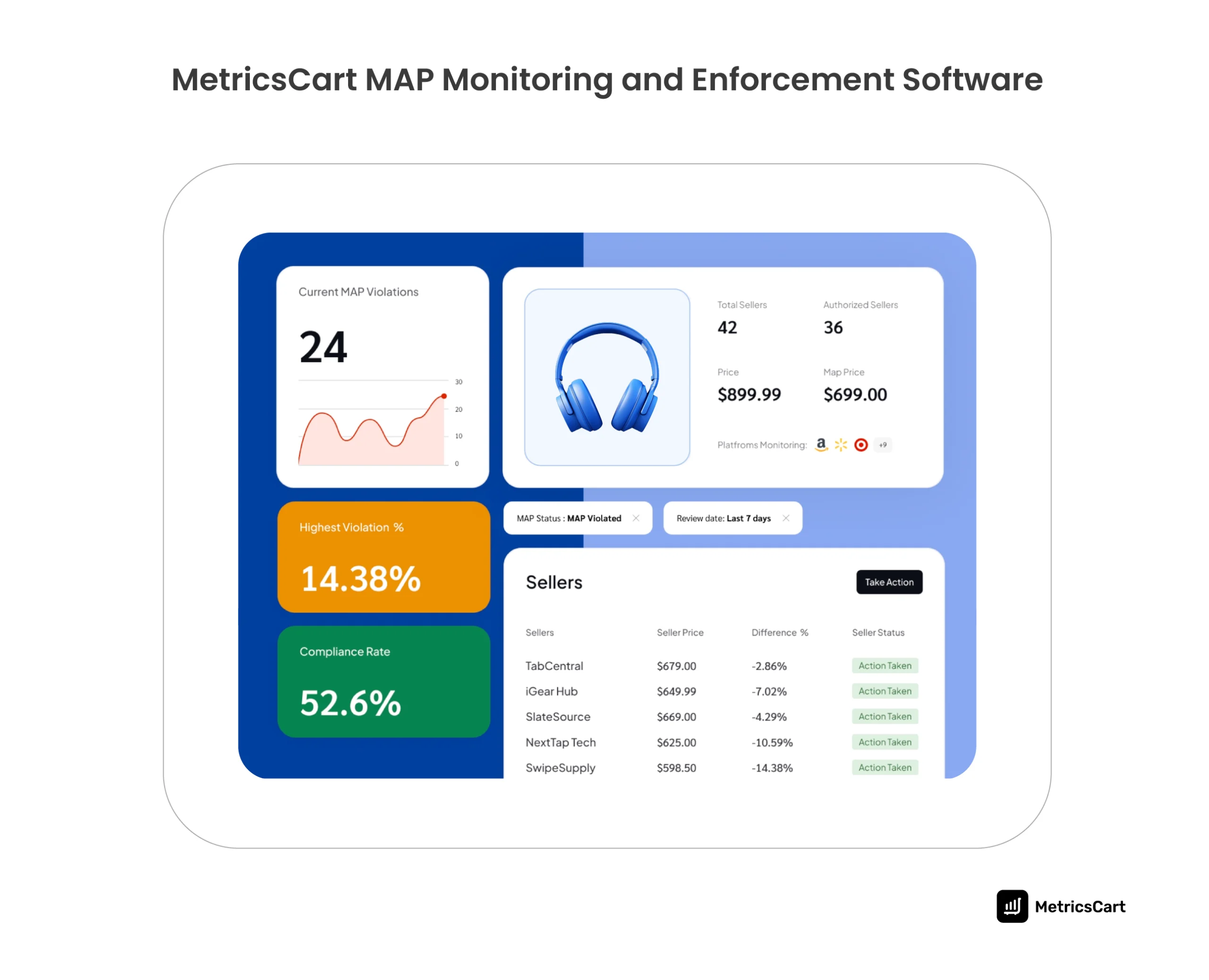
Some advanced tools also track hidden incentives like discount coupons and targeted ads quickly, so you can step in before they cause broader price erosion.
Strong MAP Policy Terms
Alongside detection, tighten your policy language. Redefine “advertised price” to include any price shown before payment, whether it appears on the PDP, in the cart, through an email, in a retargeting ad, or via a coded offer. Make sure it also has clear rules around bundles, store credits, shipping incentives, and loyalty rewards, removing the ambiguity that sellers rely on.
Combined with a consistent enforcement process, this gives your brand the leverage to act quickly before a single hidden discount turns into a marketplace-wide price drop.
READ MORE | How To Strengthen MAP Enforcement in 2025: A 5-Step Action Plan
Closing the Loop
The strength of your MAP policy relies on its definition, its enforcement, and how well your team is aligned and aware of its terms. Simply dictating a price floor is no longer sufficient when experienced sellers are masters of exploiting policy blind spots.
To stay ahead of these tactics, you need to move from passive monitoring to proactive, evidence-driven enforcement. Tools like MetricsCart give your teams real-time visibility into hidden discounts, documented proof for every violation, and automated steps that remove delay and ambiguity. And technology works best when each of your team, like sales, marketing, and legal, is aligned on how MAP is defined, what counts as a violation, and how enforcement should be executed.
The goal is not just to maintain a number on a page, but to preserve the perceived quality and consistent pricing that define a strong brand.
Stop Unauthorized Price Drops Instantly Using MetricsCart.
FAQs
Most violations don’t appear on the product page. Retailers hide price drops inside carts, private emails, coupon codes, targeted ads, or through unauthorized sellers, making them invisible to manual checks. Without full-journey monitoring, you only see the problem after damage is done.
Gray-market sellers don’t follow your MAP rules. They acquire genuine inventory from non-approved channels and sell aggressively below MAP, dragging down prices for compliant retailers. They are often the starting point for marketplace-wide price crashes.
MetricsCart gives brands a structured, proof-driven way to enforce MAP firmly and fairly across every channel. It gives real-time visibility into every place a retailer can hide a price drop by accurately tracking product pages, cart reveals, coupon codes, targeted offers, and gray-market activity and sending alerts the moment a violation occurs.
Also, every violation is captured with screenshots, timestamps, seller details, and the specific breach type, giving your internal teams the evidence they need to act without delay. The platform can also send automated warning emails to sellers the moment a violation is detected, ensuring the first line of action happens instantly and without manual effort.
With this setup, MetricsCart helps you:
1. Respond quickly with real-time alerts and automated warning emails
2. Use clear evidence through stored screenshots, timestamps, and seller information
3. Apply escalating penalties such as warnings, temporary suspensions, and account reviews
4. Empower teams to act without waiting for exception-based approvals
5. Enforce policies consistently across all retailers, regardless of size or influence
Modern MAP tools follow the entire purchase flow — PDP, cart, coupons, emails, and targeted offers. They alert you the moment a seller drops below MAP, even if it happens privately. This makes it possible to act before the violation spreads.
Yes. MAP policies are legal in the United States when written and enforced correctly. They are unilateral policies, meaning the brand sets advertised price standards without entering into a price-fixing agreement with retailers.