Highlights
- Buy Box loss hits every authorized seller on the ASIN simultaneously, including the brand’s own listing, regardless of whether they violated MAP.
- Unauthorized sellers have no obligation to follow your pricing policy, which makes them the most persistent source of MAP violations on Amazon.
- The damage from a MAP violation outlasts the violation itself. Organic rankings can continue to slip for weeks after the Buy Box returns.
- Brands that hold their Buy Box over time don’t just respond to violations faster. They catch them before Amazon has a reason to act.
- Tightening your authorized seller network and monitoring advertised prices in real time are the two most effective steps a brand can take to prevent Buy Box suppression before it starts.
The Buy Box Does Not Disappear on Its Own
On Amazon, one seller pricing below your floor is all it takes. Sales start falling, the listing looks untouched, and there is no clear explanation to point to. By the time your team figures out what happened, a seller in your network has already advertised below your MAP floor, Amazon’s algorithm has already picked it up, and the Buy Box has already been pulled from the entire listing.
The stakes behind that sequence are significant. Between 80 and 83% of all Amazon sales flow through the Buy Box, and when it goes away, most customers don’t look further. They see “See All Buying Options” where the Add to Cart button used to be, and they move on. The sale is lost there and rarely comes back.
With nearly 1.9 million active third-party sellers on Amazon as of 2025, the chances of someone in your network pricing below your floor on any given day are higher than most brands want to admit. The ones that hold onto their Buy Box over time are not just quicker to jump on violations. They have systems in place to pick them up before Amazon ever has to weigh in.
Speed of Detection Is Everything
The difference between those brands and the ones constantly playing catch-up comes down to how fast a violation gets flagged. A violation that sits undetected for even 24 hours gives Amazon’s algorithm enough time to act, pulls authorized sellers into a price drop they never initiated, and burns ad spend on a listing that can no longer convert.
Manual checks and weekly audits simply cannot keep pace with a marketplace that reprices millions of times a day. And honestly, no team has the bandwidth to watch every seller on every listing every hour of the day. MAP Monitoring from MetricsCart handles that, so when a violation occurs, your team already knows.
In this blog, we break down how MAP violations on Amazon can lead to Buy Box loss and what brands can do to prevent it.
What Is Buy Box Suppression on Amazon?
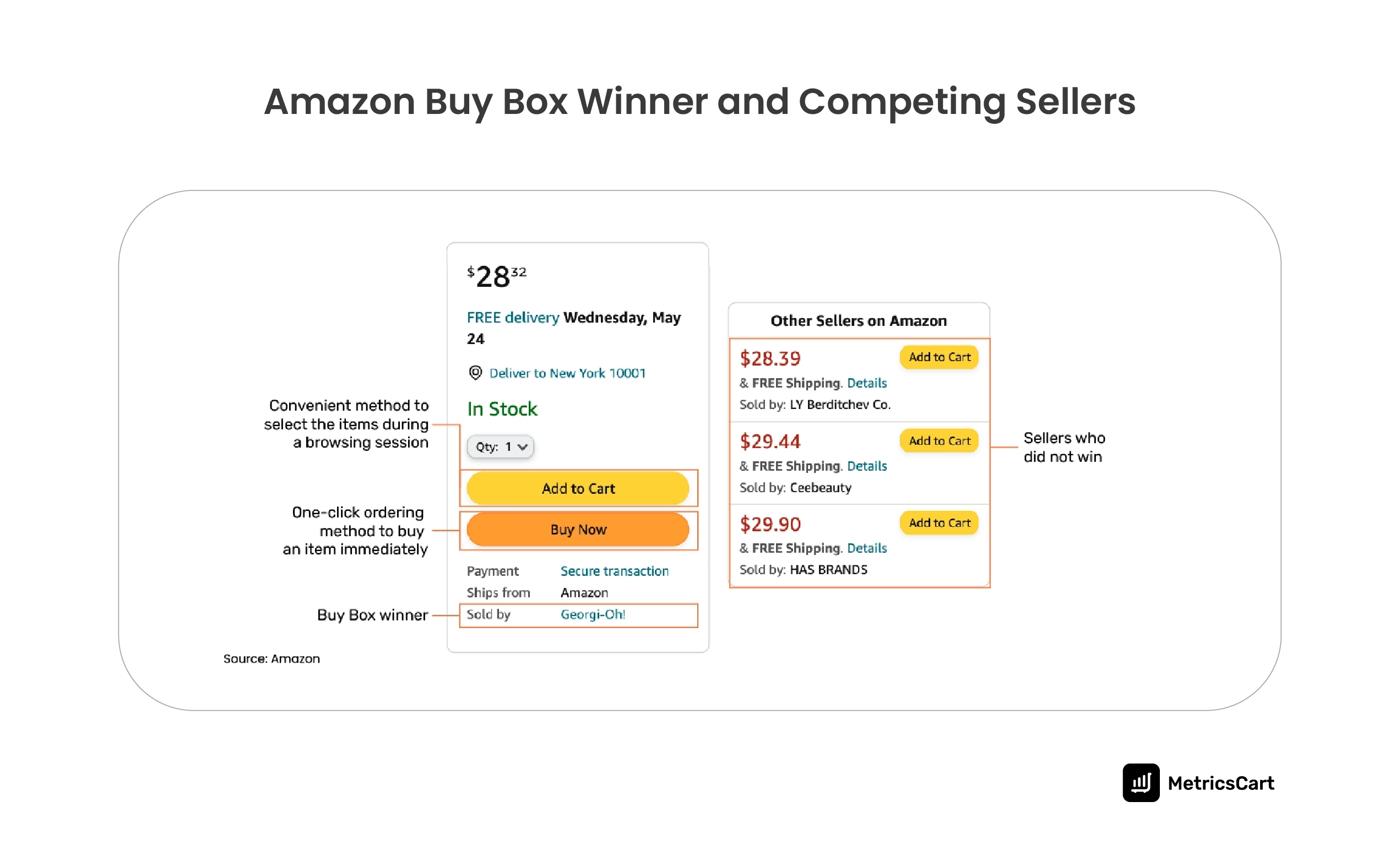
The Buy Box is the Add to Cart button on an Amazon product listing. It is where the overwhelming majority of purchases happen. When a customer visits a listing and clicks Add to Cart, they are buying from whichever seller currently holds the Buy Box.
They rarely scroll down to compare other offers. Amazon knows this, which is why holding the Buy Box is one of the most critical factors in a brand’s performance on Amazon.
What Causes Buy Box Loss?
Amazon does not always send a heads-up when the Buy Box loses. The Add to Cart button disappears when Amazon’s pricing algorithm determines that pricing across the listing is no longer reliable or fair to customers.
The product is still live, the listing looks the same, but the mechanism through which most sales happen is simply gone. For brands managing high-volume ASINs, even a 48-hour window without the Buy Box can mean significant revenue walking out the door.
Why Does It Affect the Whole Listing, Not Just One Seller?
Most brands assume that when a seller violates MAP, only that seller’s listing takes the hit. That is not how Amazon works. Buy Box loss plays out at the listing level, not the individual seller level. When one seller on an ASIN advertises below MAP, Amazon’s algorithm flags the entire listing as pricing-unreliable. Every seller on that ASIN loses the Buy Box at the same time, including the brand’s own authorized listing, even if they did nothing wrong and are fully compliant with MAP.
This matters because the brand has no control over what initiates the suppression. A single rogue seller, someone the brand may not even recognize, can pull the Buy Box from every compliant seller on the listing within minutes.
Why This Matters More Than Most Brands Realize
The revenue loss due to Buy Box suppression is evident. The compounding costs underneath it are not. When the Buy Box disappears, brands running Sponsored Products or Sponsored Brands campaigns continue paying for ad clicks on a listing from which customers can no longer buy directly. A shopper clicks the ad, lands on the page, sees no Add to Cart button, and leaves. The brand has paid for that click and received nothing in return.
At the same time, slower sales velocity signals to Amazon’s algorithm that the listing is underperforming. Organic rankings begin to slide, and that slide does not stop the moment the Buy Box comes back. Ranking recovery can take weeks, meaning the consequences of a single MAP violation stretch well beyond the violation itself.
That is the direct link between a MAP violation and Buy Box loss, and why catching violations early is not just about pricing. It is about protecting every channel the brand is investing in.
READ MORE | Frequently Asked Questions About Amazon Buy Box
How MAP Violations Lead to Buy Box Loss on Amazon
Amazon’s pricing algorithm does not simply reward the lowest price. It rewards pricing reliability across the listing. When a Minimum Advertised Price (MAP) violation occurs, the algorithm identifies a “conflict in price signals,” signaling that the listing’s marketplace health is unstable. To protect the customer experience from volatile pricing, Amazon triggers ASIN-level Buy Box suppression.
Here is how that sequence plays out in practice:
Step 1: MAP violation: An unauthorized or non-compliant seller advertises a price below the established MAP floor.
Step 2: Amazon picks it up: Amazon’s automated crawlers detect a discrepancy between the brand’s “Suggested Price” and the “Active Offer.”
Step 3: Buy Box goes away: Amazon removes the Featured Merchant Algorithm (Buy Box) from all ASINs. This affects all sellers, including the Brand Owner.
Step 4: Buyer sees “See All Buying Options”: The “Add to Cart” button is replaced by “See All Buying Options.” This extra click-step typically reduces conversion rates by over 80%.
The revenue impact compounds quickly. Brands running Amazon Sponsored Products or Sponsored Brands campaigns continue paying for ad clicks on a suppressed listing. A customer clicks the ad, lands on the product page, sees no Buy Box, and leaves. The brand has paid for that click and received no conversion.
The advertising cost remains the same while sales drop sharply, meaning the true cost of a suppression event is always higher than the direct revenue loss alone would suggest.
Organic ranking is also affected. Amazon’s algorithm places heavy weight on sales velocity in search placement. When Buy Box suppression slows sales, the ASIN’s ranking begins to slip. That ranking decline can persist for weeks after the Buy Box is restored, meaning the damage from a MAP violation does not end when the violation is corrected.
READ MORE | Amazon MAP Monitoring: What Every Amazon Seller Needs to Know
How do unauthorized sellers cause buy box suppression on Amazon?
Unauthorized sellers are the primary drivers of MAP violations on Amazon, and understanding their origins helps brands address the root cause rather than just reacting to symptoms.
Retail Arbitrage Sellers
These sellers purchase products during clearance or promotional events at below-wholesale prices and relist them on Amazon. Because their acquisition cost is lower than a standard wholesale price, they can profitably list below MAP. They have no brand relationship and no reason to protect the integrity of your pricing.
Gray Market Sellers
These sellers source products through channels the brand never intended for resale on Amazon. A product sold at a lower price point in another region may be imported and relisted on Amazon US at a price well below the MAP floor. The product is authentic, which makes removal harder, but it sits entirely outside the brand’s authorized distribution.
Wholesale Account Leakage
This is the version of the problem that originates inside the brand’s own distribution network. A brand sells to a regional distributor. That distributor sells to a smaller wholesaler. That wholesaler sells to an Amazon reseller. The brand has no visibility into this chain and no direct relationship with the end seller. By the time a MAP violation is flagged, the product has passed through multiple hands.
Liquidation Channel Leakage
This happens when a brand sells excess inventory to a liquidator to recover value on overstock. That inventory finds its way to bulk buyers who rely on Amazon at prices well below MAP because they acquired the stock at a fraction of wholesale cost.
The common thread across all of these is that none of these sellers has any incentive to protect the brand’s pricing floor. Their goal is a per-transaction margin, and undercutting MAP is often the fastest way to move inventory. That is why brands that rely on reactive enforcement, catching violations after they happen, always stay one step behind.

How Brands Can Prevent Buy Box Loss Due to MAP Violations?
Build a Clean, Authorized Seller Network
The fewer unauthorized pathways a product has to reach Amazon, the fewer unauthorized sellers appear on the listing. Audit distributor and wholesaler agreements regularly and include explicit restrictions on unauthorized Amazon resale. A tighter, well-managed authorized network reduces exposure to MAP violations at the source.
Monitor Minimum Advertised Prices in Real Time, Not Weekly
Prices on Amazon shift multiple times a day for competitive listings. A violation that goes undetected for three days can suppress the Buy Box and cost significant revenue before anyone on the team is aware. Weekly manual checks are structurally inadequate for a marketplace that moves this fast. MetricsCart monitors advertised prices around the clock and flags violations within minutes, giving your team the window to act before Amazon’s algorithm does.
Act on MAP Violations With Documented Evidence
When you reach out to a violating seller or escalate to Amazon, the strength of your case depends on what you can prove. MetricsCart captures the exact listing URL, the price shown, and a timestamp the moment a violation is detected, giving you a ready-made evidence package for every enforcement action. That documentation speeds up resolution and backs up your enforcement if it is ever questioned.
Use FBA to Strengthen Your Own Buy Box Position
Brands that fulfill through FBA hold a structural Buy Box advantage that unauthorized sellers using FBM cannot easily match. Amazon weighs FBA fulfillment positively because it controls the delivery experience and guarantees Prime eligibility. A MAP-compliant FBA listing with strong seller metrics raises the suppression threshold, even when unauthorized sellers are active on the same listing.
Escalate to Amazon When Unauthorized Sellers Persist
Amazon’s Brand Registry and report-a-violation tools exist for this purpose. Reports that include the listing URL, seller name, price shown, and a timestamp move faster than vague complaints. If a seller is also violating listing policies or using brand assets without authorization, include that in the escalation, as a well-documented case that combines MAP evidence with other policy violations gets handled more quickly.
READ MORE | Amazon MAP Enforcement: A Complete Guide for Sellers and Brands
How MetricsCart Keeps Your Buy Box Protected
A MAP policy is only as strong as the enforcement behind it. If violations are being caught days after they occur, the Buy Box is already gone by the time action is taken.
MetricsCart monitors minimum advertised prices across Amazon listings and retailer websites around the clock. The moment a seller drops below your MAP floor, it picks up the violation and delivers the exact listing URL, the price shown, and a timestamp. That is the evidence package you need to reach out to the seller directly or file a report through Amazon’s Brand Registry without delay.
Because monitoring automatically covers your entire seller network, there are no gaps between check cycles, and no violations go undetected over the weekend or during peak sales periods. Every seller is held to the same standard, which is what makes enforcement consistent and defensible when it matters most.
Take Back Your Buy Box Before the Next Violation Does the Damage.
FAQs
Buy Box suppression is when Amazon removes the Add to Cart button from a product listing. Customers see “See All Buying Options” instead, and most don’t click through. It happens when Amazon determines that the pricing across a listing is unreliable or unfair to customers.
When a seller advertises below your MAP floor, Amazon picks up the pricing inconsistency and removes the Buy Box from the entire listing. This affects every seller on that ASIN, including your own authorized listing, even if you did nothing wrong.
It means the Add to Cart button is gone. Customers can still find the product, but have to take an extra step to buy it. Most don’t bother, which leads to an immediate drop in sales for as long as the Buy Box remains unavailable.
Unauthorized sellers have no obligation to follow your MAP policy. They undercut your price floor to move inventory quickly, creating pricing inconsistencies that can cause Amazon to remove the Buy Box from the entire listing.
Real-time monitoring tools that track advertised prices across Amazon listings and flag violations the moment they appear are the most effective option. Manual checks are too slow for a marketplace where prices shift multiple times a day. The right tool catches violations within minutes and provides the listing URL, price, and timestamp needed to act immediately.