Highlights
- ABSA scores each product feature in a review separately. Brands see exactly which attributes drive praise and which drive complaints, not just an overall rating.
- A single star rating hides conflicting opinions about the same product. ABSA scores each one separately, giving product and content teams a specific brief rather than a blended number.
- ABSA detects feature-level sentiment drops weeks before they appear in star ratings, giving brands time to act on formulation, packaging, or supplier issues.
- ABSA maps review language directly to listing content. Features with the strongest positive sentiment belong in bullet points, titles, and A+ content.
- Cross-retailer ABSA shows where the same product gets different feature-level feedback on Amazon versus Walmart, a gap that star ratings alone will not catch.
“Love the formula, but the pump broke after two weeks.” That is what a four-star review says. It has three different opinions packed into one sentence: the formula works, the packaging does not, and the product still gets a decent rating. But the star rating captures none of that.
Reviews tell you exactly what customers like and dislike. Star ratings squeeze all of it into one number. A Forrester Consulting study found that 42% of brand and marketing teams struggle to make sense of the feedback they already collect. The reviews are there. The ability to act on them fast enough is not.
That gap is what MetricsCart’s review monitoring solution is built to close, turning scattered review data into something brands can actually act on.
Aspect-based sentiment analysis helps to read reviews differently. It picks out every product feature a customer mentions and scores each one as positive, negative, or neutral. This guide covers how it works, why it beats basic sentiment scoring, and how brands use it for sharper product, listing, and decision-making.
What Is Aspect-Based Sentiment Analysis?
Aspect-based sentiment analysis (ABSA) is a way to read customer reviews feature by feature. Instead of giving one overall score to a review, it breaks the review into parts and scores each part separately.
Take this review: “Love the taste but the bag is hard to reseal.” ABSA reads that as two separate opinions. “Taste” gets a positive score. “Bag resealability” gets a negative score. Multiply that across thousands of reviews, and a brand can see exactly which features customers love and which ones need fixing.
Three things make up ABSA.
Aspect
An aspect is any product feature a customer mentions in a review. In a skincare review, that could be “scent,” “moisturizing effect,” “pump quality,” or “price.” In a cereal review, it could be “taste,” “sugar content,” or “freshness.”
Sentiment
Sentiment is the opinion tied to each aspect. Positive, negative, or neutral. “The scent is amazing” is positive. “The pump broke after a week” is negative. Both can show up in the same review, and ABSA scores them separately.
Feature-Level Analysis
Feature-level sentiment analysis adds up aspect scores across all reviews for a product. A brand can see that 74% of “taste” mentions are positive, while 61% of “packaging” mentions are negative. That tells product teams exactly what to fix and what to protect. A star rating cannot do that.
READ MORE | Who’s Leading Sentiment Analysis in 2026? A Tool-by-Tool Breakdown
How Does Aspect-Based Sentiment Analysis Work in Customer Reviews?
The process follows a consistent sequence. Earlier ABSA systems relied on rule-based models with fixed word lists. Modern systems use machine learning classifiers or large language models that can read context, pick up on sarcasm, and handle complex multi-part sentences.
Here is how the pipeline works, using a real review as an example:
Input review: “Love the flavor, but the bag is impossible to reseal and it goes stale within two days.”
- Review ingestion: The system pulls in the raw review text.
- Aspect extraction: The system identifies the mentioned product features. Here, those are “flavor,” “bag resealability,” and “freshness.”
- Sentiment scoring: Each aspect gets its own sentiment score. “Flavor” scores positive. “Bag resealability” and “freshness” both score negative.
- Cross-review pattern building: Results are combined across hundreds or thousands of reviews. If 400 reviewers mention “resealability” and 82% of those mentions carry negative sentiment, that is a product problem the star rating alone would never isolate.
This combining step is where review sentiment analysis becomes practical. A single negative review about packaging is noise. Four hundred negative mentions about packaging is a signal that connects directly to product development, supplier conversations, and listing content updates.
The same logic applies across retailers. A product might receive praise for its scent on Amazon, but complaints about scent intensity on Walmart. The reviews reflect different customer bases, different expectations, or even different product batches. Without cross-platform analysis, that gap stays invisible.
Why Is Aspect-Based Sentiment Analysis Better Than Basic Sentiment Analysis?
Basic sentiment analysis scores an entire review as positive, negative, or neutral. It answers one question: Did this customer like the product overall? That is useful at a high level, but it loses too much information to guide specific decisions.
ABSA answers a different and more practical question: what exactly did the customer like or dislike, and how often does that opinion appear across the full review set?
The table below outlines the core differences:
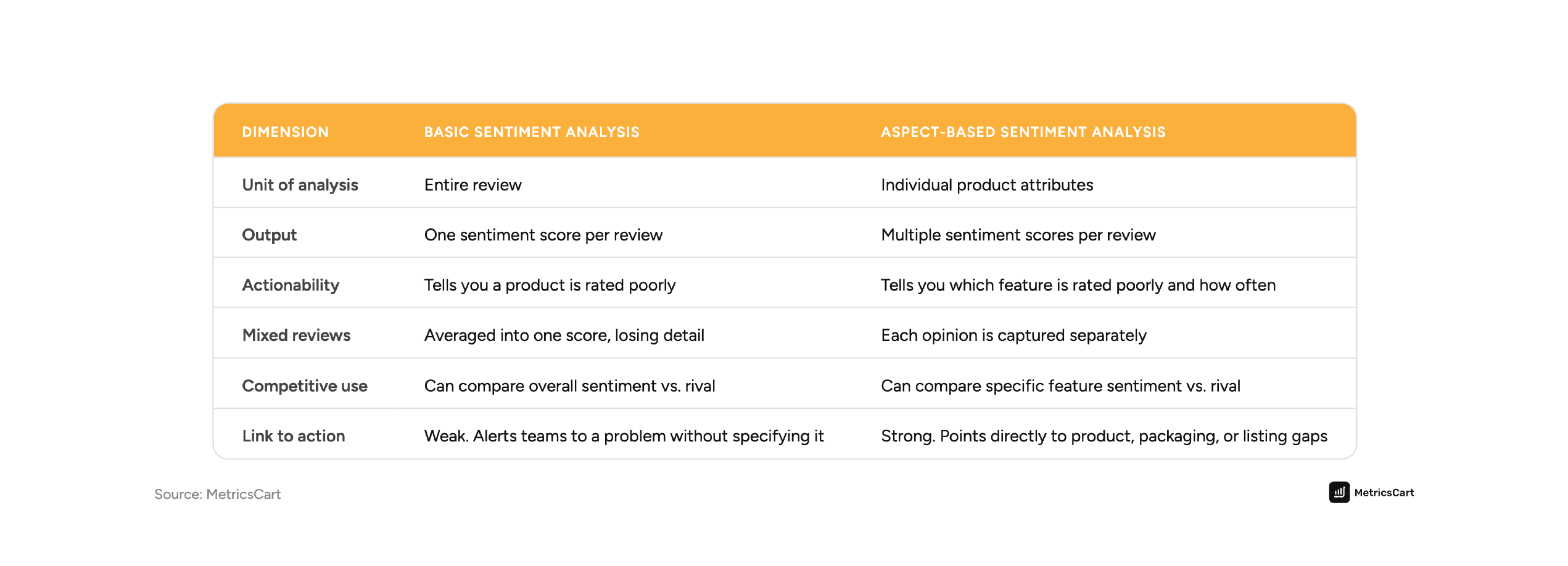
Basic sentiment analysis is the equivalent of knowing a restaurant got a 3.5 on Google. ABSA knows the food scores high, but the wait times and parking score low. One is a signal. The other is a brief.
For brands managing dozens of SKUs across multiple retailers, that difference is the distance between reading reviews for mood and reading reviews for decisions.
What Aspect-Based Sentiment Analysis Looks Like in Practice?
A 2-star review does not always mean a bad product. Sometimes it means one specific thing failed while everything else held up. Here is a real example that shows exactly how ABSA reads differently from a star rating.
A verified buyer reviewing a lipstick in the shade Prosecco left this comment:
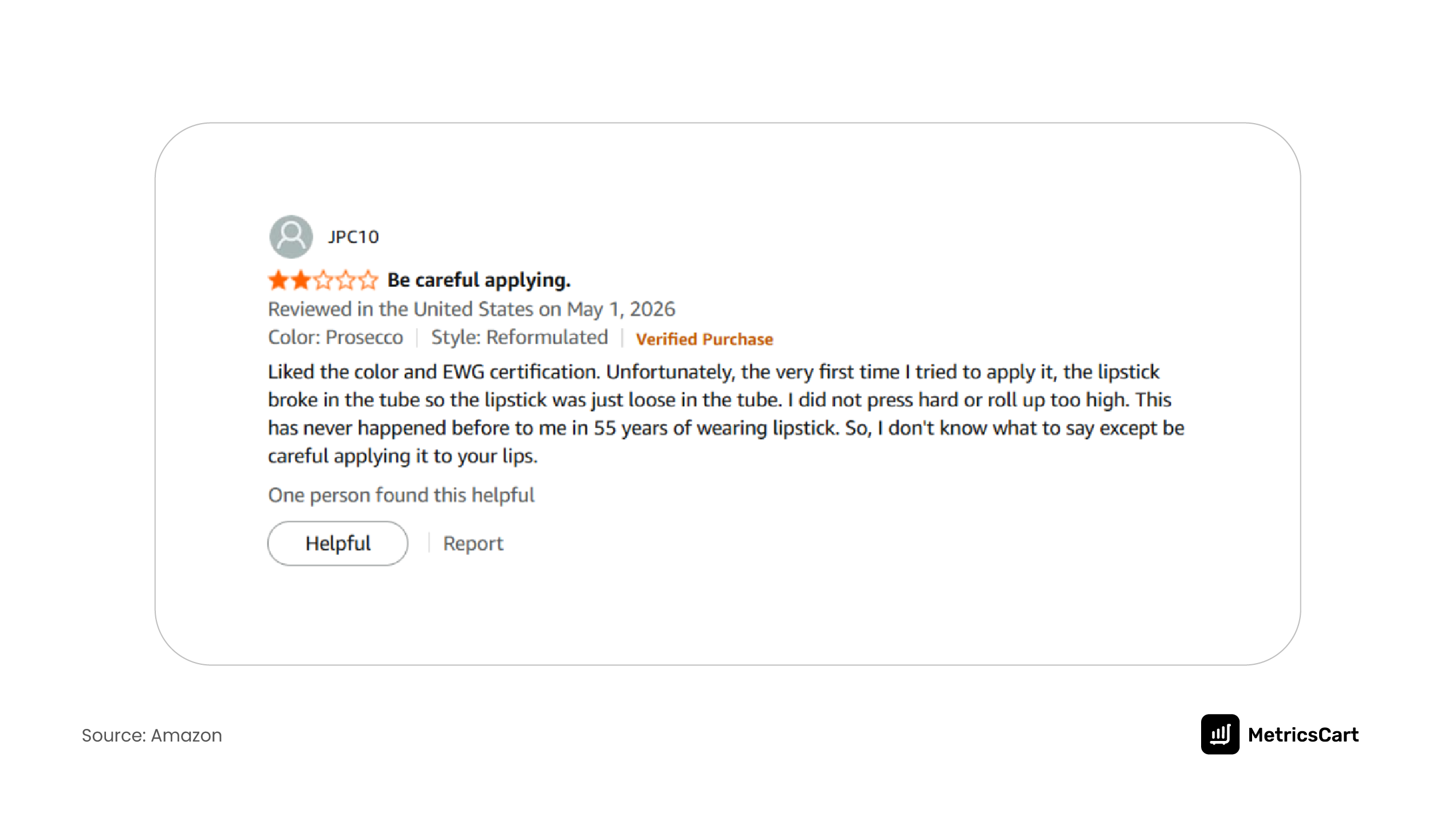
The star rating: 2 out of 5. On paper, that looks like a product failure across the board.
Here is what ABSA actually reads:
| Aspect | Sentiment | What the Customer Said |
| Color | Positive | Liked the color |
| EWG(Environmental Working Group) Certification | Positive | Appreciated the certification |
| Product Durability | Negative | Broke inside the tube on first use |
| Application Experience | Negative | Lipstick is loose and unusable |
Two positives. Two negatives. One star rating that collapses all four into a single number.
The star rating tells the brand that the product is underperforming. ABSA tells the brand something more specific: the color and clean-ingredient story are landing, but the reformulated variant has a structural problem that surfaced on first use.
That is a different brief entirely. Instead of revisiting the formula or pulling the shade, the product team investigates packaging integrity on the reformulated SKU. The content team keeps EWG certification and color range messaging prominent in the listing because customers are responding to both. And if “broke in tube” starts appearing across dozens of reviews tied to the same variant, that pattern becomes a supplier conversation, not a listing fix.
A 2-star average would have flagged a problem. ABSA told the brand exactly where to look.
The value of aspect-based sentiment analysis lies in what happens afterward. Five use cases appear most consistently across consumer brands.
How Do Brands Use Aspect-Based Sentiment Analysis to Make Better Decisions?
Product Improvements Driven by Review Data
When ABSA shows a repeated negative sentiment around a specific attribute, it gives product teams a clear starting point. A snack brand might discover that “texture” sentiment has dropped 15 points over six months, even though overall ratings held steady. That drop, invisible in star averages, points to a formulation or supplier change that customers noticed.
Unstructured feedback analysis at this level replaces the slow, manual process of reading individual reviews and hoping someone catches the pattern. The insight moves directly from review data to product development without requiring a separate survey or focus group.
READ MORE | How Smart Brands Identify Critical Customer Insights Through Online Reviews
Listing Content Aligned to What Customers Care About
Review data tells brands which product features customers talk about most. If “long-lasting hold” leads positive sentiment for a hair styling product, that phrase belongs in the bullet points and A+ content, not buried in a secondary image. If “easy to apply” appears frequently with positive sentiment but is absent from the listing, the content has a gap.
ABSA gives content teams a language map pulled directly from customer vocabulary. That match between what customers say and what the listing communicates improves conversion because the listing speaks to the attributes buyers actually care about.
Retail Media and Competitive Positioning
Retail media spend works harder when it points to attributes customers already respond to. If “long wear” sentiment is strong for a product, that attribute is worth bidding on in sponsored search and featuring in ad creative. If a competitor’s “scent” sentiment runs ahead of yours, that gap shows where to defend spend and where to lean into a different attribute instead.
Star ratings make this kind of comparison shallow. One brand sits at 4.3, the competitor at 4.1, and the difference tells you almost nothing about where to invest. Aspect-level data turns that into a usable map: which attributes to promote, which to fix before spending against them, and which gaps are real versus noise in the overall score.
READ MORE | Consumer Sentiment Analysis for CPG Brands: 2026 Growth Guide
Assortment Optimization for Category Managers
When ABSA breaks a product down by attribute, category managers get a clearer picture than an overall rating can give. A skincare SKU might show strong sentiment on “value for money” but weak sentiment on “size,” and that points to a packaging fix rather than a delisting decision. This kind of attribute intelligence changes what “underperforming” actually means for a product.
The same product data helps when deciding which variants to expand into new retailers or regions. A flavor or scent with consistently strong aspect-level sentiment is a safer bet for expansion than one that merely carries a high average star rating.
Catching Emerging Issues Before They Hit the Star Rating
Star ratings are slow-moving. By the time a product drops from 4.2 to 3.8, the damage is spread across months of reviews. ABSA picks up the shift earlier because it tracks aspect-level sentiment more closely in real time.
A brand might see “taste” sentiment drop from 78% positive to 54% positive over three weeks while the star rating holds at 4.1. That early signal gives the team time to investigate whether the issue is a recipe change, a seasonal ingredient variation, or a manufacturing inconsistency.
Identifying sentiment drivers in customer reviews at this speed is the difference between catching a problem early and scrambling after the star rating has already dropped. The brands that spot the issue in aspect trends, rather than in a decline in ratings, spend less and recover faster.
How MetricsCart Turns Review Sentiment Into Shelf Decisions
Most brands already know their reviews contain a useful signal. The hard part is pulling that signal across retailers, categories, and time periods without it turning into a manual project that takes weeks.
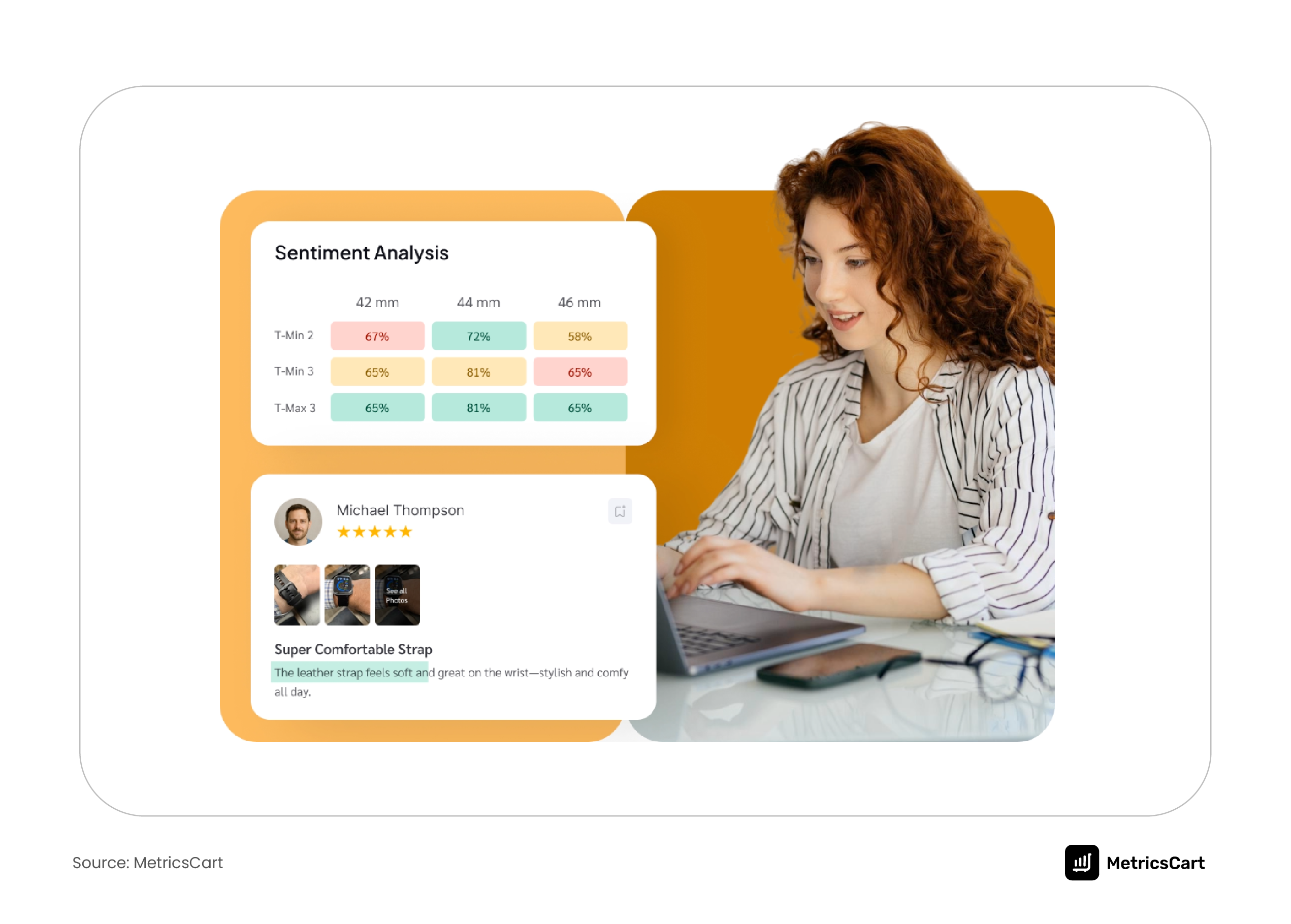
MetricsCart runs review sentiment analysis across 150+ global retailers, including Amazon, Walmart, Target, Kroger, and Instacart. The platform pulls review data at the aspect level, so teams can track how sentiment shifts on specific product attributes over time, compare those attributes against competitors, and connect the findings to listing content, product development, and category strategy.
Every review is a product roadmap someone wrote for free. Most brands never read it. Aspect-based sentiment analysis changes that; not by summarizing what customers said, but by turning thousands of scattered opinions into decisions that move fast enough to matter. The brands that treat reviews as data, not just feedback, are the ones building products customers keep buying.
Track what customers say about every feature, across every retailer.
FAQs
Yes. Customer reviews are voluntarily posted on public platforms. No personal data is extracted in the process. Brands should follow each retailer’s terms of service, but analyzing public review sentiment is standard practice across the industry and widely accepted under GDPR.
It is the process of collecting and making sense of customer feedback to understand how buyers feel about a product or experience. In e-commerce, customer reviews are the richest source of this data, and ABSA is the most precise way to read them at scale.
Yes, and this is where it adds the most value. The same product often gets different aspect-level feedback on Amazon versus Walmart. Cross-retailer ABSA lets brands see those gaps by platform and act on them before they affect ratings.
Opinion mining is a broad term for pulling opinions out of text. ABSA is a specific type of opinion mining that scores sentiment at the feature level. Instead of flagging that a product has negative reviews, it tells you exactly which feature is driving them.
Brands choose between flexible analytics platforms like MonkeyLearn or open-source libraries, and specialized ecommerce tools like MetricsCart, Bazaarvoice, and Yotpo. Specialized tools are built around retail review feeds and require less technical setup.