Highlights
- 85% of brands now report AI-accelerated attacks, and 78% are losing 5% or more of annual revenue to counterfeits and impersonations.
- AI-generated content is now roughly 3% of front-page Amazon reviews and about 5% in beauty and baby categories.
- LLM visibility is now a brand protection responsibility. What ChatGPT, Perplexity, and Gemini say about a brand is shaped by inputs the brand does not control.
- Agentic commerce is already a material channel. AI-driven retail traffic grew 805% year-over-year during Black Friday 2025, and AI-influenced spend touched one in five Cyber Week orders.
- The biggest fix for most brands is consolidating brand protection under a single owner; the quarterback model.
The State of Brand Protection Post AI in 2026
For as long as brand protection has been a formal discipline, it has rested on three assumptions.
- Counterfeiting was a legal problem.
- Reviews and search results reflected real buyer behavior.
- And if a brand controlled its authorized distribution, it controlled its market.
All three of these assumptions have been rattled over the past 24 months. AI has changed the economics of impersonation, the reliability of trust signals, and the mechanics of buying itself.
MarqVision’s 2026 State of Brand Integrity Report, released in February and based on 96 US brands with more than $10 million in annual revenue, found that 85% now say they are facing AI-accelerated attacks, that 82% believe counterfeit and impersonation problems have worsened over the past two years, and that 78% estimate they are losing 5% or more of annual revenue to fakes and impersonators combined.
It is a visible, material drag on the P&L, and it explains why 82% of the same brands say they intend to increase brand protection investment over the next 12 months.
At the same time, AI is not only on the counterfeiter’s side of the ledger. Agentic commerce has become an active channel. Adobe Analytics reported an 805% year-over-year increase in AI-driven retail traffic during Black Friday 2025, and Salesforce’s Cyber Week 2025 data attributed roughly $67 billion in influenced spend to AI, touching one in five orders.
Consumer behavior is shifting fast. Enforcement mechanics have not moved at the same pace, and the widening gap between the two is where most brand protection failures are now originating.
Megan Harmon, Managing Partner at ThornCrest, has spent 18 years running brand protection programs for consumer brands. On Season 2, Episode 1 of the Digital Shelf Insider podcast, she walked through what has changed at the practitioner level, and much of what follows is built around that view.

What Does Brand Protection After AI Really Mean for Consumer Brands?
Brand protection post-AI is best understood as three connected shifts rather than a single new discipline.
- AI is generating and distributing counterfeit assets at speed.
- Large language models are now surfacing, misrepresenting, or omitting brands in the answers consumers see when they research a purchase.
- And agentic AI is beginning to filter which brands even make it into the shortlist an AI shopping assistant presents.
Any framework built before 2023 was designed for a slower, more static threat surface, and it is straining because the shape of the problem has changed underneath it.
The traditional IP toolkit itself has not become irrelevant. Trademarks, copyrights, and patents still form the legal foundation for enforcement. They now sit inside a larger operating layer that includes seller intelligence, review monitoring, LLM visibility auditing, and MAP monitoring and enforcement, and the balance of investment across those layers is where the practical shift is happening.
How AI Has Rewritten the Threat Landscape in the Last 24 Months
Two years ago, producing a passable knockoff of a hero product image required a designer, a stock library, and a working day. Today, a generative model produces a workable variant in seconds. Harmon describes the operational reality better than the legal one:
Trade dress infringement scales faster. Fake reviews land at higher volume. Rogue websites appear and disappear inside a single holiday season.
AI-driven brand threats grew more than 16x in the first quarter of the year alone, with 57% of surveyed brands seeing fake content appear within a week of a brand going viral, and nearly a quarter reporting it within 48 hours.
With AI influencers, agents, and deepfake, the volume of impersonation attempts has moved past what manual review can absorb, and the enforcement stack has to move with it.
Why Traditional IP Protection Is No Longer Enough
Trademarks and copyrights protect specific assets. Duplicate likeness sidesteps them by construction. A model swap, a nail color change, or a gradient shift can push a knockoff image outside the legal reach of copyright while keeping it well inside the perceptual reach of the original brand.
For an e-commerce team, that means the static IP chest becomes table stakes, and the effective defense layer sits in AI counterfeit detection, seller intelligence, MAP monitoring, and review monitoring working together as one operating system rather than four separate ones.
Duplicate Likeness: The New Face of AI Counterfeiting
Harmon uses “duplicate likeness” to describe assets that are legally distinct from the original but are perceived by consumers as identical, capturing the fastest-growing category of counterfeit and copycat activity. This is where AI brand protection meets the limits of copyright law.
How AI-Generated Images Bypass Copyright Protection
When a counterfeiter takes a brand’s PDP hero shot, changes one visual element, and republishes it, the new image is legally distinct even though the source is obvious to any human eye. The commercial effect is what matters more than the legal theory.
The consumer sees a shot that looks like the brand, the listing sells as if it were the brand, and the brand carries the review and returns consequences for a product it did not make. Static copyright registrations do not solve for this.
Trade Dress Infringement on Social Commerce Platforms
Trade dress covers the overall look and feel of packaging, and on social commerce platforms like TikTok Shop, trade dress infringement is now a volume problem.
“They changed one letter on the box or the gradient is a slightly different color. We’re seeing this in beauty. We’re seeing this in skin care happen really fast.” Harmon pointed out.
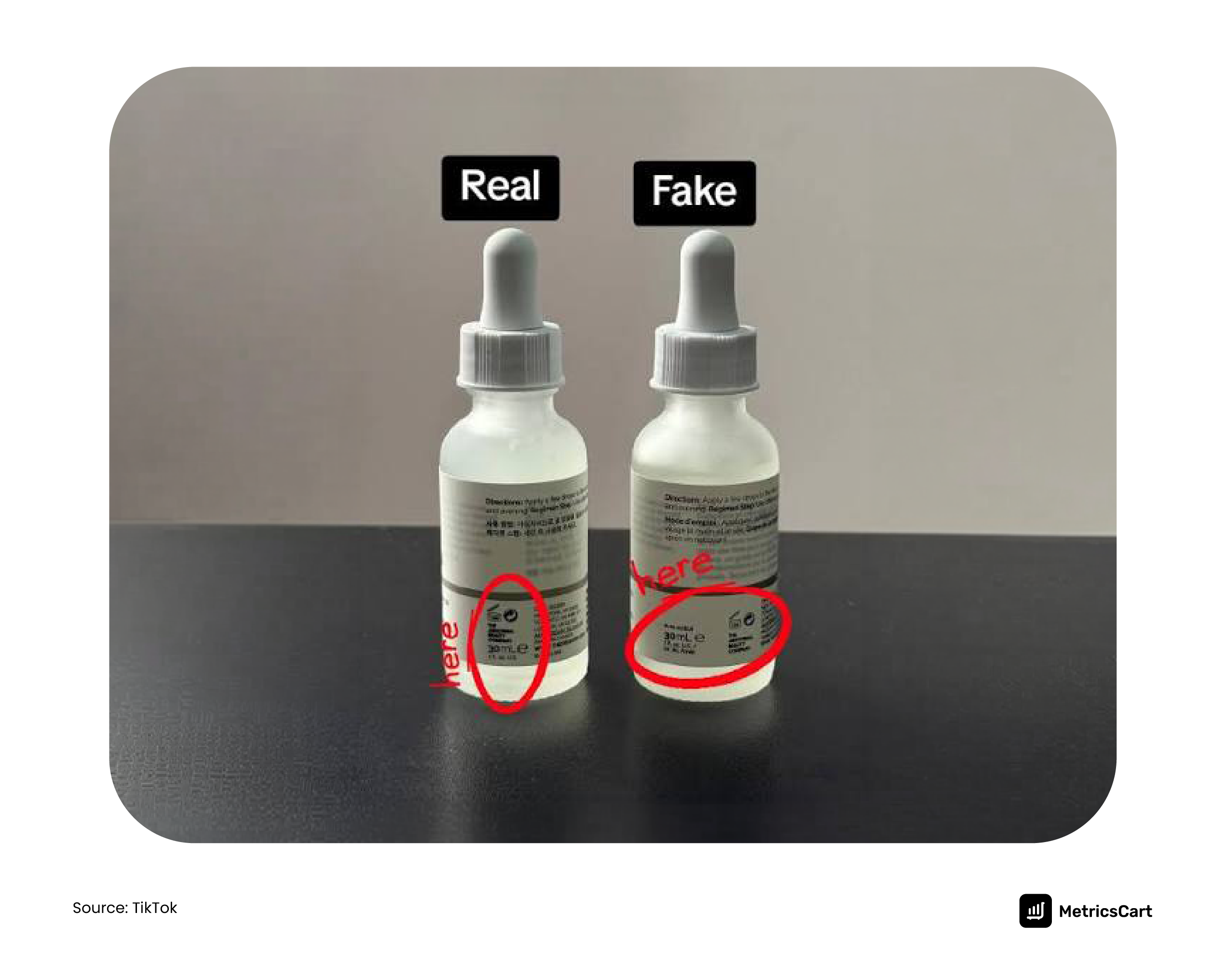
Physical retail teams have spent years designing packaging for a 3- to 5-second in-store decision window, and social commerce has compressed the window further still. On a phone screen, a bright blue N in the corner of the packaging is either instantly recognizable or invisible.
Beauty, skin care, and small-ticket consumer electronics are seeing the highest volumes, partly because those are the categories where impulse purchasing through social commerce concentrates, and partly because the visual cues consumers use to identify authenticity are the easiest for a generator to approximate.
How Fake Reviews and Aged Inventory Are Destroying Online Brand Reputation
Brand reputation management is now merging into the brand protection function, because the trust signals consumers rely on, most obviously reviews, have been corrupted by two forces at once: AI-generated review content and unauthorized reseller inventory.
An unauthorized reseller sitting on aged stock will eventually sell through, and the reviews from that aged stock end up on the brand’s product page. The brand rarely knows the aged stock existed until the reviews arrive. The consumer, understandably, blames the brand rather than the reseller.
Losing that customer is often permanent, and recovering them is expensive enough that most brands do not attempt it.
How AI-Generated Reviews Distort the Signal
In Pangram Labs’ May 2026 analysis of nearly 30,000 Amazon reviews across 500 best-selling products, 3% of front-page reviews were AI-generated with high confidence, rising to around 5% in beauty, baby, and wellness categories.
Of those AI-generated reviews, 74% gave 5-star ratings compared with 59% for human reviews, and 93% carried the Verified Purchase badge, which historically was the trust anchor of the entire review system.
Amazon blocked more than 275 million suspected fake reviews in 2024 and has secured court orders against dozens of fake review brokers, while the FTC’s 2024 rule banning fake reviews explicitly covers AI-generated content and carries penalties of up to $51,744 per violation.
The LA Times reported on the wider AI tax on brand protection, which captures the point that the operational cost of policing AI-driven distortion is now a fixed line item rather than a side project.
This is why AI brand protection in practice includes review monitoring, seller identification, and unauthorized listing removal as a single connected workflow rather than three separate ones.
MetricsCart’s ratings and reviews monitoring surface customer sentiment and quality-signal shifts across 150+ retailers, where most PDP damage begins.
The Unauthorized Seller Problem: Why MAP Alone Will Not Save You
MAP monitoring tends to be the piece of online brand protection most brands feel confident about, and it is also the piece that fails first when unauthorized sellers enter the channel.
Why MAP Is Irrelevant to Unauthorized Resellers
MAP policy applies only to the sellers who signed it. Everyone else is playing a different game.
The consequence is that a MAP notice sent to an unauthorized seller carries no contractual weight, because the strike system that governs authorized retailer behavior has no equivalent for a rogue seller. The solution is to remove the seller from the channel entirely, which is a different tool and often a different team.
Supply Chain Leaks and the Gray Market Trail
Unauthorized inventory has to come from somewhere, and almost always it comes from an authorized distributor further up the supply chain who is either offloading stock or has lost control of it.
Harmon’s practitioner checklist for enterprise brands includes:
- authorized reseller agreements with defined consequences rather than guidelines
- monthly sell-through audits at the distributor level
- named DBAs and address tracking including for related-party businesses
- and serialization from the door of the warehouse to the door of the retailer
She notes that a recurring pattern is family members opening businesses under different DBAs to sell backdoor stock, which is difficult to catch without disciplined address and entity tracking.
Retail Arbitrage and the Legitimate-Inventory Gray Zone
Not every unauthorized listing is counterfeit or diverted. Retail arbitrageurs buy legitimate inventory at member-club or clearance prices and resell it online. The product itself is real, but the warranty status, freshness controls, and packaging condition often are not.
For CPG categories where freshness matters, or for consumer electronics where warranty registration ties to the original retail transaction, retail arbitrage is a brand protection issue rather than a pricing issue, even though the listing is legal on its face. The brand experience is what suffers.
The Dynamic Pricing Domino Effect
Most major retailers now run dynamic repricing that matches the lowest visible online price. When one unauthorized seller drops the price on Amazon, authorized retailers with dynamic repricing catch up within hours, and the brand ends up with a marketplace-wide MAP collapse from a single trigger.
Harmon calls it the domino effect of MAP pricing. MAP enforcement without unauthorized seller removal is a rearguard action. Removing the trigger sits upstream of managing the fallout, and that is the right sequencing for most brands.
MetricsCart’s MAP monitoring and enforcement platform covers 150+ global retailers with real-time MAP violation alerts and seller identification.
LLM Optimization Is a Brand Protection Function, Not a Marketing One
LLM optimization and AI brand visibility have moved from the marketing team’s roadmap into brand protection post-AI.
What ChatGPT, Perplexity, and Gemini say about a brand depends on inputs the brand does not fully control, including unauthorized seller reviews, Reddit threads, and aggregator sites, and the enforcement responsibility for those inputs sits in brand protection rather than in content marketing.
Why AI Brand Visibility Depends on What Reddit Says About You
Large language models draw heavily from Reddit, forums, and product review aggregators, which means a cluster of negative posts, whether they reflect real quality issues or unauthorized-seller experiences, can push a brand into the worst-of column of an AI-generated answer.
Brand protection post AI now includes monitoring how the brand is described across the models consumers use to research purchases, and closing the loop with whatever brand teams need to influence those inputs.
LLM Optimization as a Defensive Discipline for Digital Brand Protection
The Harvard Business Review argued in March 2026 that brands preparing for agentic AI need structured, machine-readable content across every property a model might crawl. Clean product data, consistent brand descriptions, and structured schema feed the model’s ability to represent the brand accurately, and they do so defensively as much as offensively.
Defensively, the brand is less likely to be misrepresented by a model that has fewer high-quality signals to work with. Offensively, the brand is more likely to appear in the shortlist an AI agent presents to a shopper.
The Agentic Commerce Layer
Kearney’s research on agentic commerce makes the point that AI shopping agents present users with a smaller, filtered set of options than a search page does, which changes the visibility economics for brands.
Salesforce’s Cyber Week 2025 data confirmed the direction of travel by attributing roughly $67 billion in influenced spend to AI-mediated purchases and touching one in five orders, and Bain forecasts that the US agentic commerce market will be worth $300 to $500 billion by 2030, or 15 to 25% of total e-commerce sales.
For brand protection teams, that adds a new layer to the remit. Alongside MAP monitoring and unauthorized seller removal, brands need to audit whether their assortment, pricing, and positioning are being represented accurately in the environments where agents will source information, because the prompt is replacing the search bar and the model is becoming the intermediary.
READ MORE | Amazon Digital Shelf Analytics Software: 10 Top Picks of 2026
What Brand Leaders Should Do Right Now: The Quarterback Model
You need to fix the fragmentation problem!
Most brand protection programs fail for a structural reason rather than a technical one, and the fix does not require a new tool. It requires a decision about ownership. You fix the siloes by having a single source of truth, or as Harmon calls it, a brand quarterback.
The quarterback holds counterfeits, unauthorized sellers, MAP, review integrity, LLM visibility, and rogue website monitoring in a single view.
When a counterfeit surfaces on Amazon, the quarterback checks Walmart, TikTok Shop, and the aggregator sites for the same DBA before the seller has time to redistribute inventory. When Reddit sentiment shifts, the quarterback traces the source rather than escalating it to customer service.
This is where AI counterfeit detection, MAP violation detection and enforcement, and digital shelf analytics come together operationally under different tools but one owner.
Designed for Amazon P&L managers, channel leads, and omnichannel directors, MetricsCart’s MAP Compliance Reports deliver actionable data for monthly and quarterly price health strategies, tracking key metrics like SKU margins, seller density, buy box distribution, and Net PPM impact. (Note: To ensure data consistency across channels, publicly available MSRP is used as the baseline evaluation metric.)
Why MetricsCart is the Quarterback Tool for Brand Protection Post AI
Brand protection in the age of AI needs an operating layer.
MetricsCart gives brand protection leads a single view of pricing, availability, sellers, and reviews across 150+ global retailers.
We cover MAP monitoring and enforcement with real-time violation alerts and automated notice workflows; seller intelligence that distinguishes authorized from unauthorized sellers; review and content monitoring at the SKU level to catch quality-signal shifts before they scale; and digital shelf analytics that connect pricing, availability, and content health into one operational view.
For brands building the quarterback model, MetricsCart is the visibility layer that makes single-team ownership operationally possible.
Protect Your Brand Reputation Online!
FAQs
Brand protection post AI is the discipline of defending a brand across counterfeits, unauthorized sellers, review manipulation, LLM misrepresentation, and agentic commerce. Traditional IP tools remain the foundation, and the surface area now also includes what AI models say about the brand and how AI-generated assets copy it.
AI compresses the time and cost of creating look-alike images, packaging, and product listings from days to seconds. The most common threat is duplicate likeness, which describes assets that are legally distinct from the original but consumer-perceived as identical, and it is spreading fastest on social commerce platforms like TikTok Shop.
Brands optimize for LLM visibility by auditing how ChatGPT, Perplexity, and Gemini describe them, structuring product data for machine readability, monitoring Reddit and review aggregators for negative aggregation, and keeping owned properties like PDPs and category pages consistent and current.
Yes. When AI agents make purchases on behalf of consumers, they pull from a smaller, filtered subset of options than a search page provides. Brands that are misrepresented, invisible, or poorly structured in the model’s retrieval layer risk losing the sale before it reaches a human decision.
The quarterback model consolidates brand protection under a single owner or team accountable for the full threat surface, from counterfeits and unauthorized sellers to MAP enforcement and LLM visibility. It replaces the fragmented ownership model where sales, legal, and compliance each hold a piece, and no one owns the outcome, with a single source of truth the brand can rely on.