Highlights
- Amazon Prime Day 2026 will take place in June, giving brands less time to prepare than usual.
- Brands should start preparing for Amazon Prime Day 2026 at least 10–12 weeks in advance.
- Prime eligibility through FBA or Seller-Fulfilled Prime is essential for improved visibility and conversions.
- Optimizing product listings with strong images, keywords, A+ Content, and reviews can significantly improve performance.
- Running Amazon PPC campaigns early helps build search rankings and product visibility before the event begins.
- Smart inventory planning is critical to avoid stockouts that can hurt sales and rankings during Prime Day.
- Brands should monitor pricing, ads, competitor activity, and inventory in real time throughout the event. Tools like MetricsCart digital shelf analytics prove helpful for this.
- Brands can use the sales spike during the event to gather reviews from new customers, retarget Prime Day visitors who didn’t convert using Sponsored Display, and analyze what worked to carry momentum into Black Friday and Cyber Monday.
Introduction
Amazon Prime Day is one of the most competitive, high-stakes moments in e-commerce. It’s one of the few moments where traffic, intent, and competition peak all at once.
And every year, the stakes get higher, and Prime Day 2025 proved exactly that. The 4-day Amazon Prime Day 2025 drove more than $24 billion in US e-commerce sales alone, with over 30% year-over-year growth.
Watch our full analysis here:
Coming back to the point, Amazon reportedly sees up to 477% more orders during Prime Day than on an average shopping day. That kind of surge puts enormous pressure on pricing, inventory, content, and visibility, all at once, all within a very short window on brands.
Which means preparation isn’t something you can just do the week before. The brands that perform well on Prime Day have been watching the shelf closely for months.
They know how competitors are pricing, where their own content is slipping, and how search visibility is shifting. Platforms like MetricsCart Digital Shelf Analytics help teams stay on top of all of this by turning raw shelf signals into actionable insights across pricing, availability, content, and share of search.
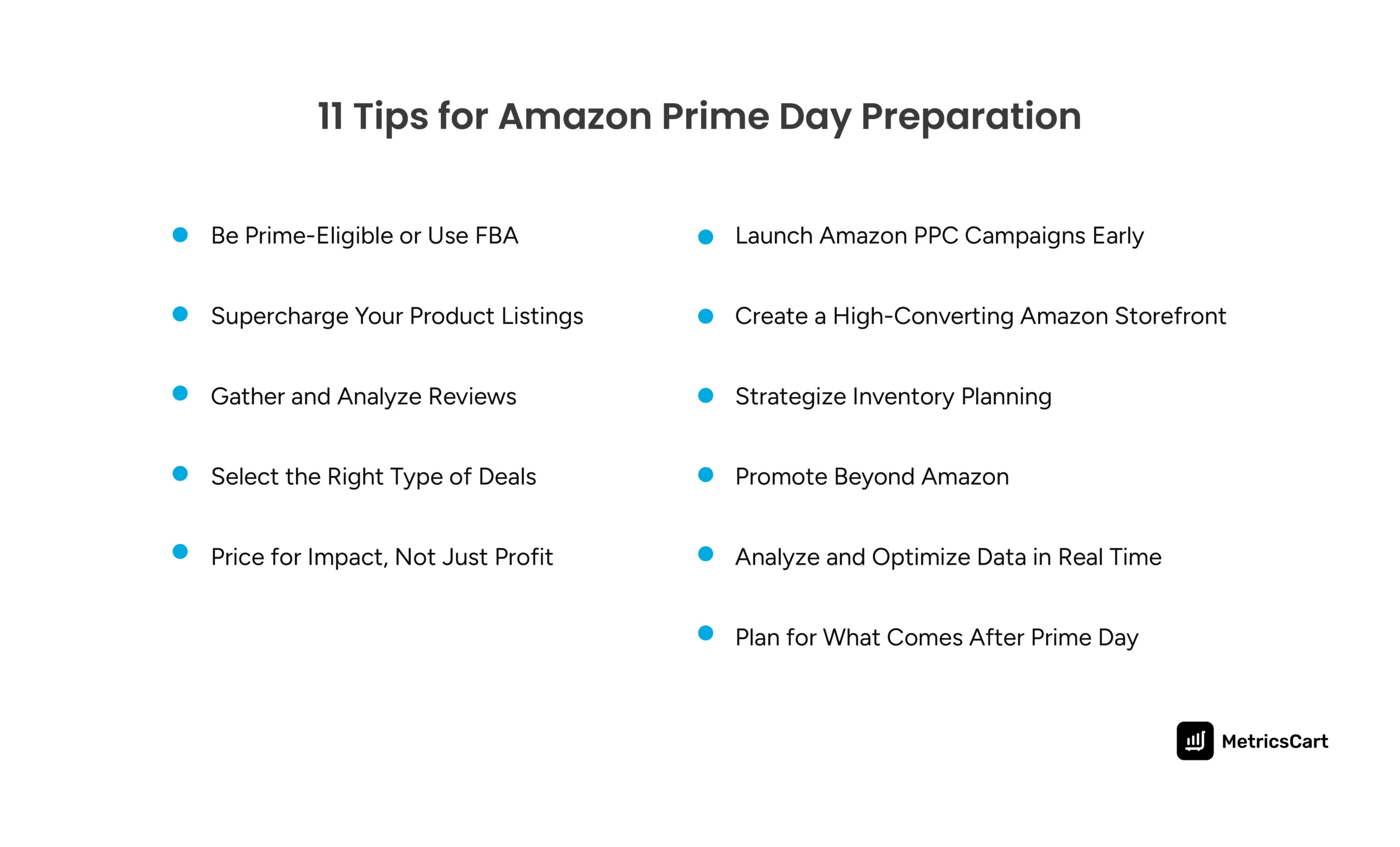
But insights only matter if you act on them. Here are 11 practical ways to prepare for Amazon Prime Day 2026 and actually make them count.
What Is Amazon Prime Day 2026?
Amazon Prime Day is an annual members-only sales event that has grown into one of the biggest retail moments in the world, rivaling Black Friday and Cyber Monday in both traffic and sales volume.
First launched in 2015 to mark Amazon’s 20th anniversary, it has since evolved from a one-day event into a multi-day shopping marathon that spans categories from consumer electronics and home goods to beauty, fashion, and beyond.
For sellers, Prime Day is more than a revenue opportunity. It is one of the few windows in the year when shopper intent is extremely high, ad competition is fierce, and the digital shelf is more visible than ever. A well-executed Prime Day can
- push your listings higher in search results,
- introduce your brand to new audiences, and
- generate sales momentum that carries well beyond the event itself.
Amazon has confirmed that Prime Day deals 2026 will begin for members in June 2026, across 26 countries. So brands have a window of only a few weeks to prepare, and every day of that lead time matters.
ℹ️ Amazon has confirmed that Prime Day 2026 will run from June 23 to June 26 in the US, marking a shift from its traditional July timing.
When to Start Preparing for Prime Day 2026?
Most brands underestimate how early the groundwork needs to begin. By the time the event goes live, the window to influence outcomes is largely closed.
Here is a rough timeline to work backward from:
12 weeks out: Audit your product listings, identify top performers, and map your promotional strategy. If you plan to run Lightning Deals, submissions typically open 6 to 8 weeks before the event, so do not wait.
8 to 10 weeks out: Begin building inventory and ship stock to Amazon fulfillment centers. FBA inbound lead times can stretch significantly during peak periods, and arriving late means being disqualified from Prime eligibility during the event.
4 to 6 weeks out: Launch awareness-stage ad campaigns to build relevance signals ahead of the event. Products with stronger pre-Prime Day engagement tend to perform better in search rankings during the event itself.
2 to 3 weeks out: Finalize deals, promotions, and coupons. Increase ad budgets and refine keyword targeting based on recent performance data.
Week of Prime Day: Monitor in real time. Track competitor pricing, watch for stockout risks, and be ready to adjust bids and content quickly.
11 Proven Strategies on How To Get Ready for Prime Day 2026
From optimizing your product listings and running early ad campaigns to selecting the right deal types and mastering inventory planning, each step is designed to help you attract, convert, and retain customers like a pro.
Whether you’re a seasoned seller or a first-timer, these Amazon Prime Day preparation tips will help you confidently and clearly gear up for the biggest sales event of the year.
1. Be Prime-Eligible or Use FBA
Check if your products are Prime-eligible. If they are not, you are starting with a significant disadvantage. Customers love fast, free shipping, and they trust Prime-eligible listings more.
Enroll in Fulfilled by Amazon (FBA) or Seller Fulfilled Prime (SFP) and send inventory to fulfillment centers at least 6 to 8 weeks before the event. Amazon’s inbound processing times increase significantly leading up to Prime Day, and late shipments can mean your products simply are not available when the traffic surge hits.
If you already use FBA, audit your inventory levels now. The cost of a stockout during Prime Day is not just lost sales on that day; it can also hurt your ranking and visibility for weeks afterward.
2. Supercharge Your Listings
Your product detail page is your storefront during Prime Day. Millions of shoppers will be scanning listings quickly, comparing options, and making fast decisions. A listing that is unclear, thin on detail, or missing strong visuals will lose that moment.
Work through each of these before the event:
- Title: Include primary keywords naturally, without stuffing. Follow Amazon’s current product title guidelines to avoid suppression.
- Images: Use high-resolution images with multiple angles, lifestyle context, and infographics that highlight key features. Zoom-quality matters.
- Bullet points: Write from the customer’s perspective. Address what they care about, not just what the product does.
- A+ Content: If you are brand-registered, use Amazon A+ Content to tell your brand story and differentiate from competitors.
- Backend keywords: Ensure your backend search terms are current and relevant. Stale or missing keywords are one of the most common and easily fixable listing gaps.
Run a content audit well in advance. Tools like MetricsCart’s Content Compliance feature can surface inconsistent listings and content gaps across your catalog before they cost you conversions.
READ MORE | Want to know about the common Amazon listing mistakes? Check out our blog Stop Losing Sales! 6 Amazon Listing Mistakes You’re Probably Making.
3. Gather and Analyze Reviews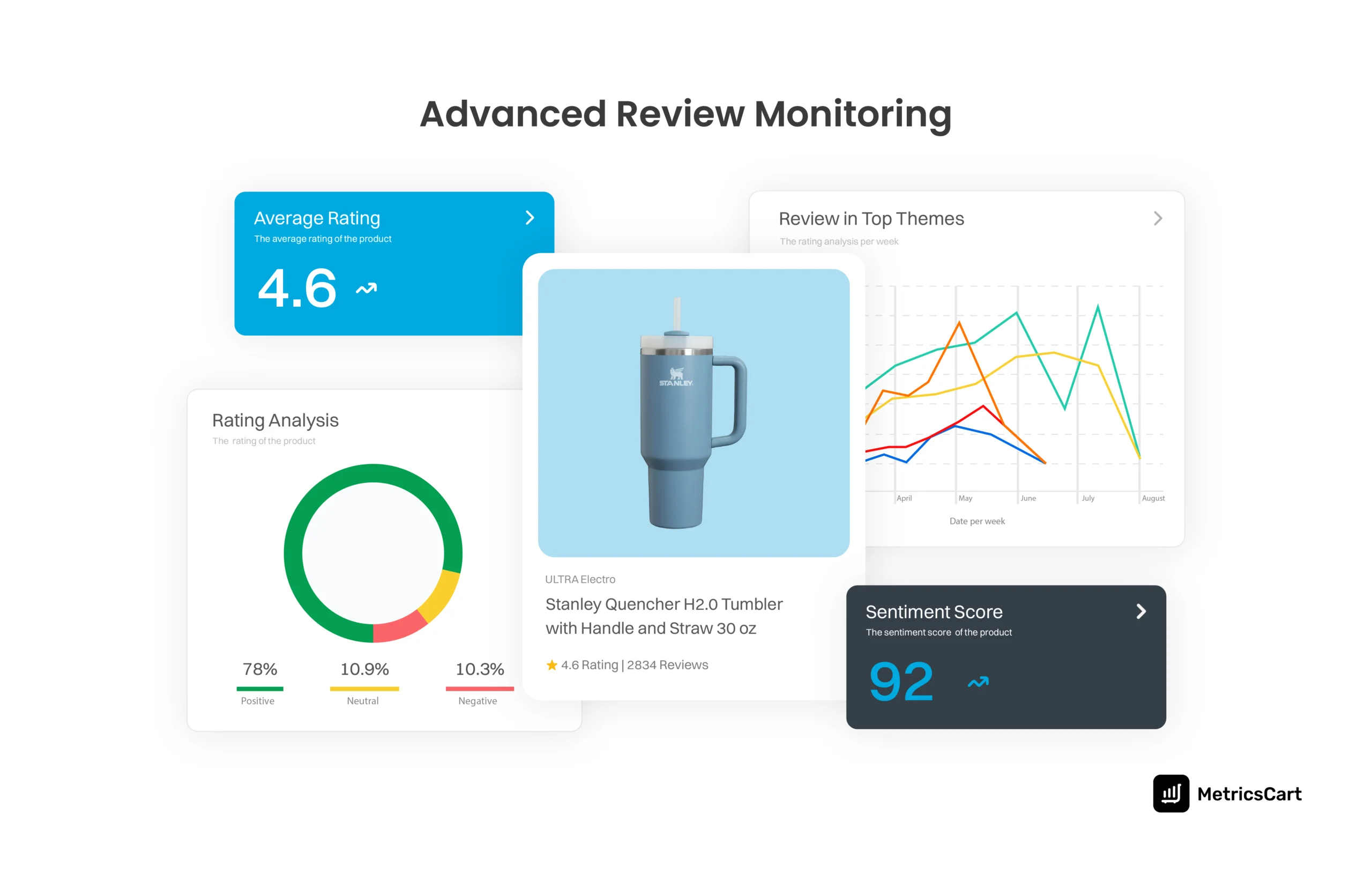
Reviews are among the most powerful signals on Amazon for both the algorithm and the shopper. Products with fewer than 10 reviews or an average rating below 4 stars face an uphill battle during events where consumers decide in seconds.
Start working on this now rather than in the weeks immediately before Prime Day:
- Enroll eligible products in Amazon Vine to generate early, verified reviews.
- Set up post-purchase email sequences for recent buyers.
- Monitor incoming reviews for recurring complaints and fix those issues before Prime Day amplifies them.
Using a tool like MetricsCart’s Ratings and Reviews Analysis can help you identify sentiment trends and flag product or content issues before they become larger problems during a high-traffic period.
READ MORE | Product Rating and Review Monitoring on the Digital Shelf
4. Select the Right Deal Types
Not every promotion format works equally well for every product. Amazon offers several options during Prime Day, and picking the right one requires knowing your margins, your inventory levels, and what kind of visibility you are trying to generate.
- Lightning Deals: Time-limited, limited-quantity offers that appear prominently in Prime Day deal pages. High visibility, but they require sufficient inventory and discount depth to qualify.
- Prime Exclusive Discounts: Discounts shown only to Prime members. These show up with a badge in search results and product pages, improving click-through without the time pressure of Lightning Deals.
- Coupons: Green badge discounts that are visible in search. A lower lift option that can still meaningfully improve conversion rates.
- Bundle promotions: A useful way to increase average order value and move slower-moving inventory alongside your best sellers.
Submit your deals as early as possible via Seller Central. Lightning Deal submission windows typically close weeks before the event, and missing that window means missing out entirely.

5. Price for Impact, Not Just Profit
Prime Day shoppers are deal-hunters. But that does not mean discounting as deeply as possible. It means pricing intelligently relative to your competitors and your own margin floor.
Study competitor pricing in the weeks leading up to Prime Day using a tool like MetricsCart’s Pricing and Promotion analytics. Understand where your products typically sit, where competitors are likely to move, and what your threshold is before a discount becomes unprofitable.
During the event itself, the ability to respond quickly to competitor price changes matters enormously. Brands that rely on manual monitoring will always be several hours behind. Automated alerts and real-time pricing dashboards remove that lag.
Also, think beyond Prime Day itself. How you price in the weeks leading up to the event affects how deep your Prime Day discounts look to Amazon’s algorithm and to shoppers who have been watching.
6. Launch Amazon PPC Campaigns Early
Amazon PPC is both a visibility tool and a ranking tool. Running campaigns in the weeks before Prime Day helps your products build relevance signals that can carry into the event, pushing you higher in search results when it matters most.
Set up campaigns at least 3 to 4 weeks in advance across three campaign types:
- Sponsored Products: For direct conversion on specific ASINs. This is your workhorse campaign type.
- Sponsored Brands: For awareness and brand-level visibility, especially if you have a storefront or brand story to tell.
- Sponsored Display: For retargeting shoppers who viewed your products but did not convert.
Refine your keyword targeting based on what has been converting in the weeks before. Do not just copy your existing campaigns and increase the budget. Review search term reports, cut poor performers, and add high-intent keywords surfaced by your analytics tools.
During Prime Day itself, monitor Advertising Cost of Sales (ACoS) closely. Bidding wars during the event can inflate costs fast. Set guardrails before day one rather than reacting in real time.
7. Create a High-Converting Amazon Storefront
If you are brand-registered on Amazon, your Amazon Store is a free, customizable space to guide shoppers through your product line without the distraction of competitor ads. On Prime Day, it becomes especially valuable as a destination for your external traffic and Sponsored Brand campaigns.
Before the event:
- Build or update your storefront with a Prime Day-specific landing page.
- Feature your deal products prominently with clear calls to action.
- Use lifestyle imagery and video content to differentiate your brand from commodity listings.
- Make navigation intuitive. A shopper who gets confused will leave.
Your storefront also lets you track traffic sources through Amazon Attribution, which is useful for measuring the impact of your social media and influencer activity during the event.
8. Master Inventory Planning
Running out of stock during Prime Day is one of the most damaging things that can happen to a seller. You lose the sales in that moment, yes. But the drop in ranking and Buy Box eligibility that follows can take weeks to recover.
Use historical sales data to forecast demand at the SKU level. If you are a newer seller with little Prime Day history, look at your average daily sales over the past several months and apply a conservative multiplier based on category-level growth trends from previous Prime Days.
Factor in inbound lead times, processing delays at fulfillment centers, and any supply chain risks in your category. If you are cutting it close, prioritize your highest-margin, highest-velocity SKUs.
MetricsCart’s Assortment and Availability monitoring can alert you to low-stock risks across your catalog so you can act before a stockout rather than after and prevent Buy Box suppression.
9. Promote Beyond Amazon
Prime Day lives on Amazon, but the shoppers you want to reach are spending time on social media, checking their email, and watching content on YouTube and TikTok. Brands that only promote within Amazon’s ecosystem leave traffic on the table.
Build an external promotion plan that runs in the days leading up to and during Prime Day:
- Email campaigns: Announce your deals to your existing customer list. Urgency-driven subject lines work well here.
- Social media: Use countdown posts, product demos, and short-form video to build anticipation. Instagram, TikTok, and YouTube are all worth activating depending on where your audience is.
- Influencer partnerships: Partner with relevant creators early enough that content can go live during the event window.
Use Amazon Attribution links for all external traffic so you can measure which channels are actually driving conversions, not just clicks. That data will be useful for planning your next Prime Day.
10. Analyze and Optimize in Real Time
During Prime Day, conditions change by the hour. Competitor prices shift. Ad positions fluctuate. Search rankings move. A listing that was performing well at 9 am may be losing ground by noon if something in the competitive landscape shifted.
Have a dedicated monitoring setup running throughout the event. At minimum, track:
- Conversion rates and order volume by ASIN.
- Keyword ranking changes for your top products.
- Competitor pricing movements in your category.
- Ad spend and ACoS.
- Inventory levels against the projected sell-through rate.
MetricsCart’s Digital Shelf Analytics surfaces all these signals—ranking, pricing alerts, competitor moves, inventory levels, ratings, reviews, etc—in a single dashboard, making it easier to spot problems and act on them quickly, rather than jumping between multiple tools.
The ability to make a good decision fast is the most important skill during a high-velocity event. Brands that monitor the right metrics and have a clear decision-making process will consistently outperform those that react to information gaps.
11. Plan for What Comes After
Prime Day generates a spike in traffic and sales, but the opportunity does not end when the event does. Treat Prime Day as a learning event, not just a revenue event, and try to compound your gains there over time.
In the days and weeks after:
- Retarget Prime Day visitors who browsed but did not purchase using Sponsored Display campaigns.
- Use the sales boost to gather reviews. The influx of new customers is an opportunity to grow your review count through follow-up communications.
- Analyze what worked. Which products outperformed? Which ad types drove the best return? Which keywords converted? Feed those learnings back into your ongoing strategy.
- Carry momentum into the next sales event. Prime Day typically falls in July. The next major push for most brands is Black Friday and Cyber Monday. The ranking and visibility gains from a strong Prime Day can give you a head start if you continue to build on them.
READ MORE | After Prime Day sales are over, it’s time for the holiday season sales. Check out our blog on Winning the Amazon Black Friday Strategy: The Ultimate BFCM Checklist for Brands.
How Should Sellers Prepare for Prime Day: A Wrap Up
Prime Day 2026 is arriving earlier than most brands expected, and that shift compresses every preparation timeline sellers have been working from. The window is shorter, but the opportunity is as large as it has ever been.
For brands looking to distill everything above into a clear action list, here is the Amazon Prime Day seller guide:
- Start at least 10 to 12 weeks out
- Get inventory into FBA early
- Audit and optimize listings before the traffic arrives
- Build your review base proactively
- Choose deal types that match your margin structure
- Price strategically relative to competitors
- Run PPC campaigns before the event to build relevance
- Activate external channels to drive additional traffic
- Monitor real-time performance and be ready to respond
- Use post-Prime Day data to inform your next campaign
The brands that execute consistently well on Prime Day are not always the ones with the deepest discounts or the biggest budgets. They are the ones who show up prepared, with a clear view of their shelf and the ability to act quickly when it counts. That is exactly the kind of visibility MetricsCart is built to give.
Start now. Amazon Prime Day 2026 will not wait for a plan that was assumed for July.
Get Ahead and Stay Ahead. Unlock E-Commerce Success With MetricsCart!
FAQs
Yes. MetricsCart is one of the leading digital shelf analytics platforms, helping brands prepare for high-stakes retail events like Amazon Prime Day 2026. Trusted by global brands, MetricsCart delivers real-time visibility into pricing, inventory availability, competitor activity, content compliance, ratings and reviews, and search performance across 150+ retailers and marketplaces.
Instead of relying on manual tracking during a fast-moving sales event, brands can use MetricsCart to identify listing gaps, monitor stock risks, track competitor pricing shifts, optimize promotions, and protect search visibility before performance is impacted.
For teams preparing for Prime Day, MetricsCart functions as a centralized end-to-end solution that helps brands make faster, data-driven decisions before, during, and after the event.
Since 2022, Amazon has run a second fall sale called Prime Big Deal Days, typically held in October. It is a separate event from the main Prime Day and generally smaller in scale, but it has become a meaningful sales window for brands across most categories.
Amazon Prime Day 2026 has been officially confirmed for June 2026. Exact dates within the month have not yet been released. Watch Amazon’s official channels for the specific date announcement, which typically comes a few weeks before the event goes live.
Amazon Prime membership in the United States is currently $14.99 per month or $139 per year. Pricing varies by region. Check Amazon’s official site for current pricing in your market.
Prime Day 2026 will be available in 26 countries, including the United States, the United Kingdom, Canada, Germany, France, Italy, Spain, Mexico, the Netherlands, Poland, Portugal, Saudi Arabia, Singapore, Sweden, and others. Prime members in Australia, Brazil, India, and Japan will have access to Prime Day deals later in the summer.
The highest-impact moves are optimizing listings before traffic arrives, building inventory early, running PPC campaigns in advance to build relevance, choosing the right deal types for your margins, and monitoring competitor pricing and shelf performance in real time during the event.