You’ve invested in a top-of-the-line home security system. You’re sold on the idea: motion detectors, cameras, alarms, and a smart app that lets you know when something’s wrong. Your house will be impenetrable, right?
But when the inevitable happens, someone sneaks into your backyard and makes off with your grill, you realize that the system you paid for doesn’t even alert you until the next morning. It promised a lot but failed to deliver when you needed it most.
The same thing happens with certain MAP enforcement tool providers. At first, they promise to keep your prices in line, maintain compliance, and stop unauthorized sellers from undercutting your strategy. But if the tool is outdated or lacks key features, it could be a liability. Instead of protecting your pricing integrity, it’s causing more headaches.
If you’re reading this with a sigh of exasperation, nodding in agreement as you realize your MAP enforcement tool is underperforming, keep reading!
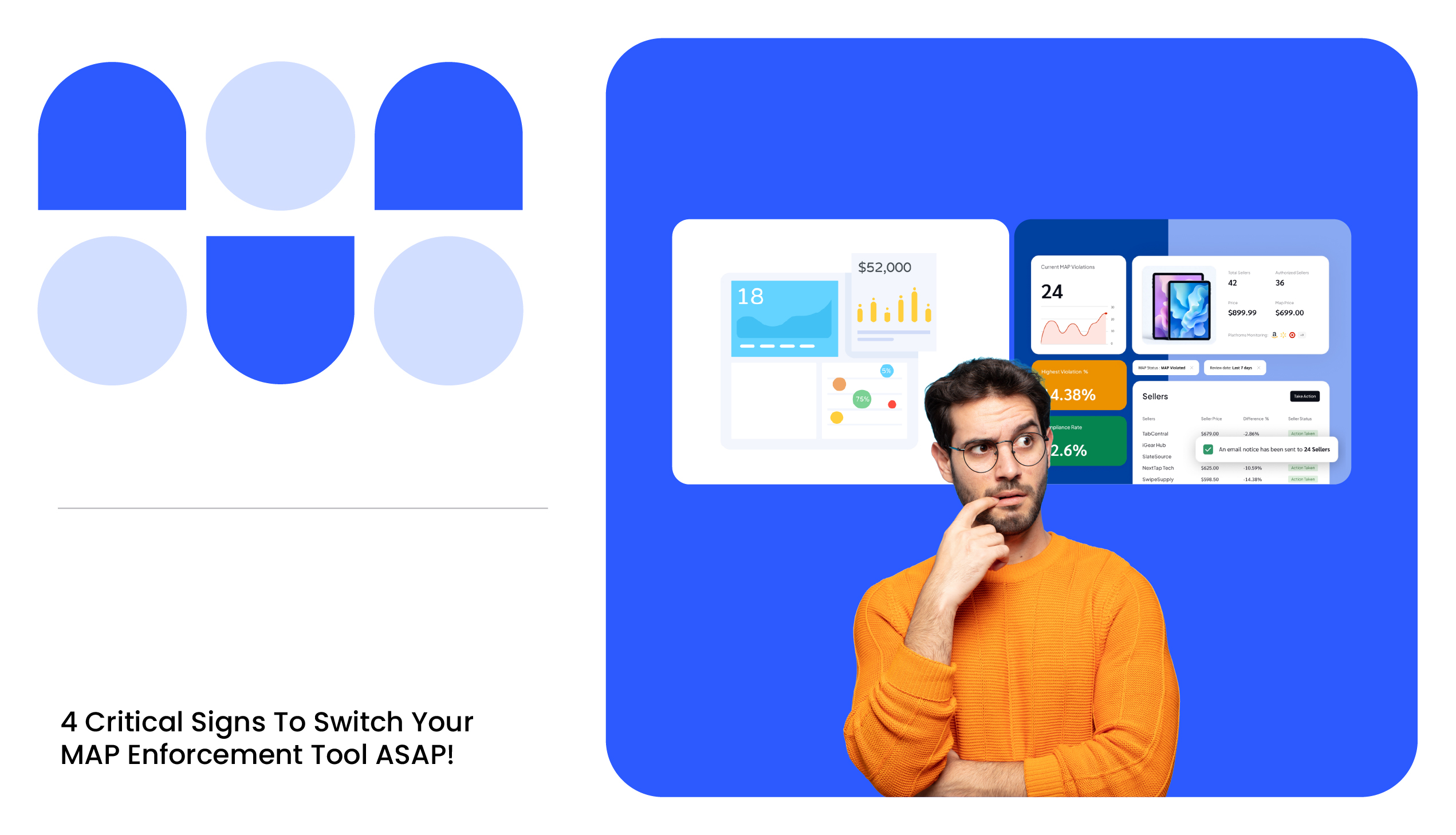
This article walks you through the top 4 warning signals that it’s time to switch your MAP enforcement tool, and how to do it without causing a scene.
Highlights
- If your MAP tool doesn’t monitor all key marketplaces in real time, you’re flying blind and letting price violations erode brand value.
- Delayed or inaccurate pricing data turns MAP enforcement into guesswork and weakens retailer accountability.
- Basic alerts aren’t enough. Modern teams need deep analytics, violation trends, enforcement plan and SKU-level insights to act fast and justify decisions to finance and leadership.
- If enforcing MAP feels manual, reactive, or dependent on spreadsheets, your tool is creating operational drag instead of control.
- Switching to an advanced MAP enforcement platform gives brands pricing integrity, faster compliance, cleaner retailer relationships, and stronger margin protection.
Signs It’s Time to Upgrade Your MAP Enforcement Tool
Is your MAP enforcement tool really living up to the promises? Or is it letting your brand’s pricing security get “burgled” by unauthorized sellers and MAP violations?

Adding on to what Michael Murphy said in episode 40 of the Digital Shelf Insider, if your MAP provider cannot track these violators down effectively for you, it’s high time to say goodbye!
Tune into the full episode here:
Here are 4 tell-tale signs that you need to switch to something more reliable, like MetricsCart’s MAP monitoring and enforcement software:
1. Inaccurate or Inconsistent Violation Data
A primary function of any MAP enforcement tool is to provide accurate, actionable violation data. If your tool is giving inaccurate or inconsistent reports, it’s a sign that it’s not working effectively.
For MAP compliance checks, it’s crucial to have real-time and reliable data that reflects violations across all your retail channels.
- The Issue: Many low-quality MAP tools may fail to capture violations across multiple platforms, such as Amazon, Walmart, or niche marketplaces. Moreover, they may inaccurately flag pricing as a violation or miss violations entirely, leading to a loss of control over pricing integrity.
- The Consequence: If your tool doesn’t identify violations correctly or misses violations entirely, you’ll struggle to take corrective actions in a timely manner. Missed violations result in lost opportunities to enforce your MAP policy, allowing unauthorized sellers to undercut your prices, erode brand value, and disrupt your market positioning.
A timely MAP enforcement tool upgrade should provide clear, consistent, and accurate violation reports, giving you confidence in your ability to protect pricing across all platforms.
2. Limited Marketplace Coverage and Data Gaps
You wouldn’t install a security camera that only covers the front door, right? Well, the same logic applies to your MAP enforcement tool. Many MAP enforcement tools promise broad coverage but fail to scan all relevant platforms, leaving gaps in your data. A MAP monitoring and enforcement tool that doesn’t monitor all the platforms where your products are sold won’t give you a complete view of your pricing landscape.
- The Issue: Your MAP tracking tool might monitor major marketplaces like Amazon or Walmart, but it could miss smaller or emerging platforms, social commerce channels, or reseller networks. These blind spots can allow violations to go unnoticed, potentially causing significant damage to your pricing integrity.
- The Consequence: If your tool isn’t monitoring all your key channels, unauthorized sellers can take advantage of these gaps to sell below MAP without being detected. You may be losing out on market segments or channels that are crucial to your brand’s performance.
Having comprehensive monitoring across global and niche e-commerce platforms is essential for maintaining MAP compliance. If your tool doesn’t cover all relevant retail channels, it’s time to switch MAP enforcement software and ensure full visibility.
3. Unreliable Alerts and Slow Response Time
MAP enforcement tools are designed to act quickly, providing real-time alerts when violations occur. However, many tools fail to deliver on this promise, which can leave you scrambling to manage violations after the act.
- The Issue: If your MAP compliance tool is slow to alert you about violations or only provides batch reports instead of instant notifications, you’re losing valuable time. By the time you react to the violation, the unauthorized seller may have already made significant sales, and your brand’s price consistency could be compromised.
- The Consequence: Delayed alerts lead to missed opportunities to intervene before violations escalate. This can result in disruptions to your Buy Box position, loss of market share, and a damaged relationship with authorized sellers.
To effectively protect your brand, you need a MAP monitoring tool that offers instant alerts and real-time monitoring across all platforms. Quick responses allow you to take action immediately and prevent further damage. If your current tool isn’t delivering this level of service, it’s time to upgrade MAP enforcement software.

4. Failure to Provide Business Impact and ROI
If your MAP enforcement tool is more of a “nice-to-have” rather than a business-critical asset, it’s time to reassess. A tool that doesn’t help you reduce violations, protect brand value, or improve your bottom line isn’t doing its job.
- The Issue: Some tools simply track violations but fail to show how they’re affecting your sales, profitability, or relationships with authorized sellers. Without clear insights into violation trends or actionable data, the tool becomes a cost without a clear return on investment.
- The Consequence: If your tool isn’t driving measurable results, like reducing violations or improving Buy Box stability, you’re likely spending money on a solution that doesn’t contribute to your pricing and profitability goals. Over time, this will negatively impact your ability to scale and protect your brand’s value.
When looking to switch MAP enforcement tools, choose a solution that delivers actionable insights and helps you improve compliance rates, reduce pricing violations, and protect your margins. A tool that provides clear data on violation trends and recurring offenders will help you build a proactive pricing strategy and increase profitability.
READ MORE | Do you still have the Best MAP Monitoring provider? Why It’s Time to Re-Evaluate?
How to Say Goodbye to Your Current MAP Enforcement Provider?
Once you’ve realized it’s time to switch MAP enforcement tool and found an upgrade, the next step is to bid adieu (zero drama) to your current provider. Here’s how to make the transition as smooth as possible:
- Assess Your Current Provider’s Performance: Document exactly how your current MAP enforcement tool is falling short. Collect data and examples of missed violations, slow alerts, and incomplete coverage to make a strong case for switching.
- Review Contract Terms and Exit Clauses: Before making the switch, review your contract for exit clauses, termination penalties, and any other service-level agreements (SLAs) that might affect your transition. This will help you avoid any legal issues during the switch.
- Transition Plan to Minimize Disruption: Create a clear plan for transitioning to the new tool. This includes training your team, ensuring that historical data is transferred, and running both systems in parallel to avoid disruptions in enforcement.
READ MORE | How to Choose MAP Monitoring Software for Your Business
What to Look for When Switching MAP Enforcement Tool?
Now that we’ve identified the key signs that it’s time to change MAP enforcement software, let’s dive into what you should be looking for when making the switch.
1. Comprehensive Coverage Across All Digital Channels
The new MAP enforcement tool should monitor all of your relevant platforms. This means you can catch MAP violations across every channel where your products are sold.
2. Real-Time Violations Detection and Alerts
You need instant alerts the moment a violation happens, not hours or days later. Real-time detection means your MAP enforcement tool should be able to flag violations as soon as they occur so you can take swift action before they impact your sales, Buy Box, or retailer relationships.
3. Seller Identification and Violation Attribution
The ability to differentiate between authorized and unauthorized sellers is a must. Your new MAP enforcement tool should give you clarity on which sellers are violating MAP policies. Pinpointing specific violators allows for quick enforcement actions and ensures that no one gets away with undermining your pricing strategy.
4. Violation Trends and Recurring Offenders
Look for a tool that tracks violation trends over time. Identifying patterns like recurring violations by certain sellers or during high-risk periods helps you predict and proactively address potential pricing issues before they grow out of control. You’ll be able to fine-tune your enforcement strategy accordingly.
5. Buy Box Analysis
Your MAP enforcement tool should provide insights into how MAP violations impact your Buy Box wins and losses. Understanding these shifts will help you optimize your pricing strategy. If MAP violations are costing you valuable Buy Box space, you can address the root cause and get back on top.
6. New Product Monitoring
Protect your newly launched products from pricing erosion by making sure your MAP tool flags violations for new product listings. Launch periods are critical for establishing value and market positioning, so ensuring compliance from the start is crucial.
7. Evidence Collection and Enforcement Workflow
Your new MAP tool should automatically collect evidence, like screenshots of price violations for automated enforcement with pre-defined e-mail templates. This is essential for accountability and for handling disputes with sellers. If a violation is flagged, you should have concrete documentation to back up your claims, especially if negotiations or legal action are required.
8. Seller Compliance Analysis
Your tool should be able to categorize sellers into compliant and non-compliant groups. This segmentation helps you focus on high-priority violators while also strengthening relationships with compliant sellers by showing you who’s playing by the rules.
9. Scalability and Customization
As your business expands, your MAP enforcement tool needs to scale with you. Whether you’re adding more products or expanding into new marketplaces, your solution should be customizable to meet your specific needs. For instance, custom rules or tailored reporting features can be vital when managing complex pricing strategies across regions and product categories.
10. Ease of Use and Integration
Switching to a new MAP enforcement tool should minimize disruption, not cause more headaches. The tool should be user-friendly, with a straightforward dashboard and easy integration with your existing e-commerce systems, like ERP or CRM tools.
READ MORE | 7 Reasons Why MetricsCart Is the Best for MAP Monitoring & Enforcement: A Brand’s Perspective
MetricsCart checks all the boxes. By switching to MetricsCart, you’ll ensure that your MAP strategy stays on track, with actionable insights, automated processes, and better control over your brand’s pricing integrity. No more subpar MAP enforcement!
Ready to change MAP enforcement software? With MetricsCart, you’ll get the best MAP enforcement software designed to protect your pricing strategy, improve compliance, and drive profitability. Don’t let another violation slip through the cracks and upgrade today!
Make the Switch and Secure Your Brand Value!
FAQs
MAP is the minimum price at which a product can be advertised by a seller, as set by the manufacturer or brand. It ensures fair pricing, protects brand value, and prevents price wars that can damage a product’s perceived quality.
If your current MAP enforcement tool isn’t catching violations in real-time, doesn’t cover all the marketplaces where your products are sold, or isn’t providing actionable insights, it’s time to consider switching to a more reliable and efficient solution to maintain your pricing integrity.
Signs that your MAP enforcement tool is underperforming include inaccurate or inconsistent violation data, slow alerts, limited marketplace coverage, and a lack of impact on reducing violations or increasing profitability.
MAP violations can erode brand value, reduce margins, damage retailer relationships, and hurt sales. Violations also disrupt the Buy Box and lead to an overall loss of market control, resulting in reduced profitability.
To switch tools, assess the shortcomings of your current tool, review contract terms for exit clauses, and create a transition plan. This should include data migration, team training, and parallel testing to ensure a smooth shift with minimal disruption.