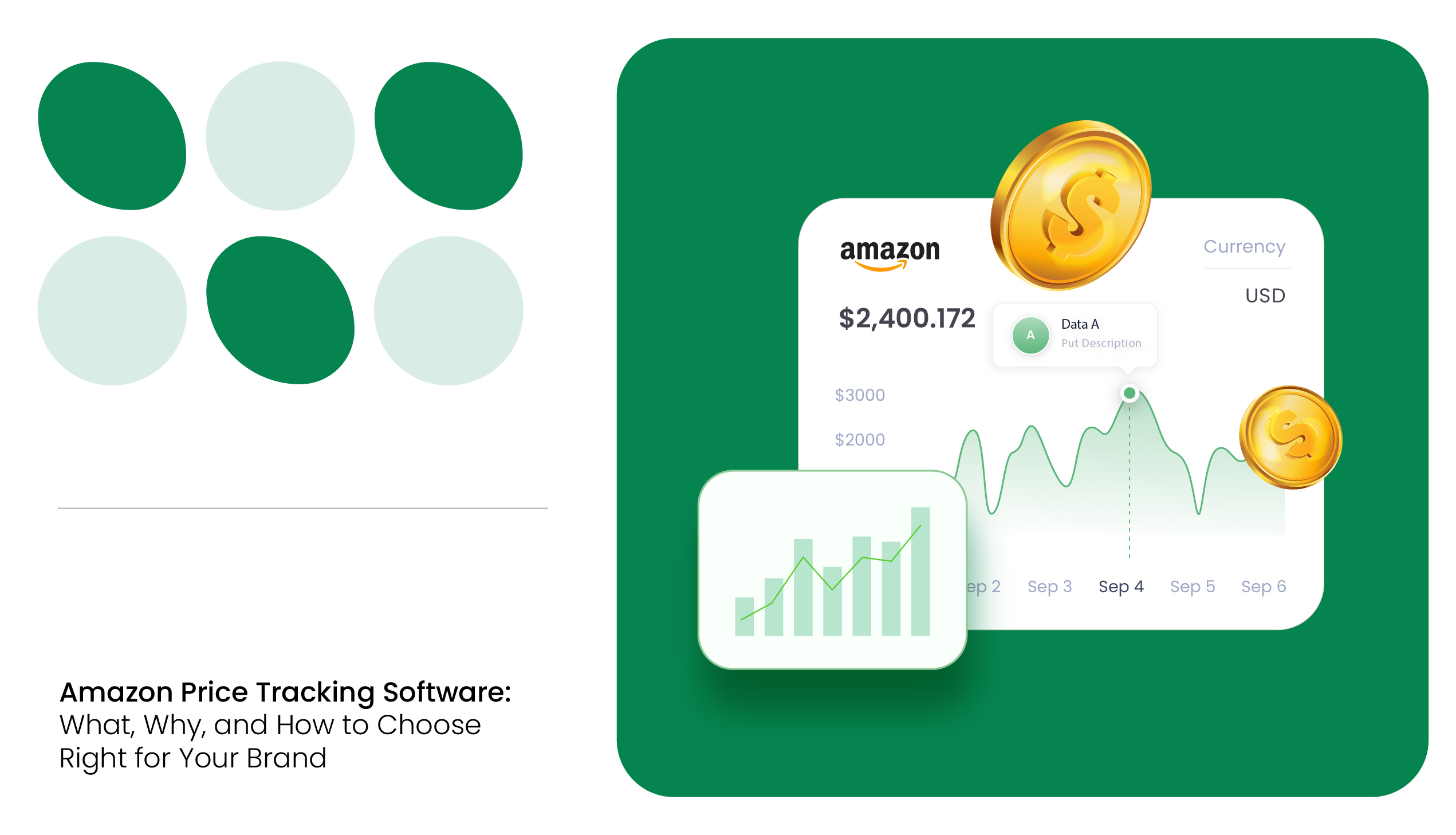
Amazon is not a stable shelf. Prices shift millions of times daily. Brands that have not built a real-time pricing intelligence layer into their operations lack price clarity! Amazon price tracking software closes that visibility gap.
Let’s see what the numbers indicate:
According to eMarketer, Amazon accounts for 40.5% of all US retail e-commerce sales in 2025, with total platform GMV hitting $830 billion.
And, consumers today are paying attention to every cent. McKinsey’s findings show that 40% of shoppers in advanced markets have switched retail channels purely for better prices. Bain’s Consumer Products Report 2025 found that insurgent brands now capture up to 40% of total US consumer product growth, powered in large part by sharper pricing and faster distribution decisions.
Brand loyalty is not protecting established players the way it used to. Clearly, price is the winning piece in the game.
This article explains what Amazon price trackers do, why brands across CPG and consumer goods need them now, which features actually matter, and why MetricsCart has emerged as the definitive choice for category leaders.
Highlights
- Amazon pricing is highly volatile, and without real-time tracking, brands lose visibility, control, and revenue impact from constant price shifts.
- Price monitoring is now a revenue function, driven by rising consumer price sensitivity, Buy Box dynamics (82% of sales), and increasing margin pressure.
- Amazon’s automated pricing ignores MAP policies, making continuous monitoring and enforcement essential to prevent price erosion and unauthorized seller activity.
- The right Amazon price tracker for brands must go beyond tracking price to include real-time data, Buy Box insights, historical trends, competitor pricing and promotions, and multi-marketplace coverage.
- MetricsCart stands out by connecting pricing data to business outcomes, offering enforcement workflows, competitor intelligence, and full digital shelf visibility for better decisions
What Are Amazon Price Monitoring Tools for Brands?
The purpose is simple and as straightforward as the name suggests. Amazon price monitoring software is a tool that tracks pricing activity across Amazon’s marketplace continuously, across your own listings, third-party seller offers, competitor ASINs, and Buy Box data.
Amazon moves at a speed that makes manual monitoring structurally impossible. The platform processes roughly 8,600 product sales per minute across hundreds of millions of listings. Prices on individual products change multiple times daily in competitive categories. One seller’s pricing decision triggers repricing tools on competing listings, and a price cascade can run its course before anyone on your team has opened their laptop.
A modern Amazon price tracker for brands does more than flag a low price. It maps every seller on your listings and identifies which ones are authorized and which aren’t. It tracks how pricing has moved over time, who owns the Buy Box and when, and how your prices compare to competitors on equivalent ASINs. It gives the data layer that connects pricing decisions to revenue outcomes in real time.
READ MORE | How To Choose The Best Pricing Intelligence Tool: 2026 Checklist
Why Brands Need Amazon Price Monitoring
Price monitoring is not a defensive, compliance-only activity. For brands serious about their Amazon performance, it is a revenue-protection function with a direct line to the P&L. The case spans three interconnected pressures: consumer behavior, marketplace mechanics, and competitive dynamics.
Consumer Price Sensitivity Has Reached a Structural High
McKinsey’s State of the Consumer 2025 report across Q1 and Q2 2025 found that more than one-third of consumers globally traded down in one category while planning to splurge in another. It is a structural reconfiguration of how consumers assign value.
Consumers are not spending less overall; they are reallocating with far more precision than before. This reconfiguration directly shows up in your Amazon conversion rates.
Brands need to grow on sharper pricing, tighter positioning, and faster commercial decisions. Established brands that cannot defend their price positioning on Amazon are most exposed to this shift. Price clarity on Amazon is now a prerequisite for conversion.
The Buy Box Business
Feedvisor’s 2026 Buy Box guide states that the Buy Box’s share of Amazon sales is roughly at 82%, with that proportion rising higher on mobile, which accounts for 67.2% of Amazon traffic. Brands that do not own or closely track their Buy Box position hand their primary revenue placement to whichever seller runs the lowest price.
Price is one of the most heavily weighted inputs in Amazon’s Buy Box algorithm. A brand that does not track Buy Box ownership in real time cannot model the revenue impact of losing it, identify which seller displaced them, or understand whether the cause was pricing, fulfillment quality, or unauthorized seller activity. For finance teams and category directors, Buy Box history has a direct, calculable P&L consequence.
READ MORE | Amazon Price Tracker You Need in 2026: A Seller’s Guide
Amazon’s Pricing Engine Does Not Account for Your MAP Policy
Amazon runs an automated pricing system that scans prices across its marketplace and the broader internet, then adjusts its own listings to match the lowest available competitive price.
MAP thresholds are not part of that calculation. When any seller anywhere online drops below MAP, Amazon’s algorithm may automatically match that price, and the drop spreads before your brand receives any notification.
MAP enforcement also remains entirely the brand’s responsibility. Amazon will not act on a MAP violation that your team has not documented and escalated.
Margin Pressure on Amazon Is Accelerating
Jungle Scout’s State of the Amazon Seller 2025 found that nearly 40% of enterprise brands expressed concerns about their profitability, driven by rising advertising costs, inflated shipping expenses, and ongoing pricing pressure from competitors.
For CPG and consumer goods brands in particular, pricing integrity on Amazon directly shapes whether consumers perceive your product as worth its price point or worth replacing with a faster-moving challenger. Your brand needs the right insights into Amazon’s pricing dynamics to make faster, more informed decisions than market moves.

Key Features to Look for in Amazon Price Tracking Software
Most Amazon price trackers for brands look similar on the surface. The differences emerge in data freshness, enforcement depth, and how well the platform connects pricing signals to adjacent business metrics your teams already track. These are the capabilities that separate a tool from the right tool.
1. Real-Time Price Tracking
Scheduled monitoring, whether daily or hourly, sounds workable until you consider the pace of Amazon’s pricing environment. Competing sellers run automated repricers that respond to price changes in minutes. A MAP violation can spread across multiple seller listings in under an hour. A once-a-day report delivers information about damage that has already compounded and is significantly harder to reverse.
Real-time Amazon price tracking catches price shifts and MAP violations as they happen. For high-velocity products or large catalogs, this is the only approach that enables proactive enforcement rather than post-facto cleanup.
When evaluating Amazon price monitoring tools for brands, confirm the exact data refresh rate across your full catalog size. Refresh frequency often degrades significantly at scale, and that degradation directly affects price visibility later.
2. MAP Violation Detection and Enforcement
MAP monitoring must be a core, native function at a higher pricing tier. The tool should automatically compare live seller prices against your configured MAP thresholds and generate an alert the moment a violation appears.
Each MAP violation alert needs to include the seller’s name or identifier, the specific ASIN, the exact price, and how long the violation has been active. Without that level of detail, an alert gives your team a data point with no enforcement target.
Alert delivery speed determines response speed. Email works for documentation and compliance trails. Slack integration keeps alerts inside the workflow your team already monitors throughout the day.
READ MORE | A Complete MAP Pricing Guide: Everything Brands Need To Know
3. Buy Box Monitoring
Real-time Buy Box monitoring tells you who holds the placement right now. Historical Buy Box data tells you the patterns behind ownership shifts: which sellers consistently claim the Buy Box during peak traffic periods, whether Buy Box loss correlates with specific price thresholds, and how ownership has distributed over the past 30, 60, or 90 days.
For finance and category teams, Buy Box history provides the evidence base for revenue impact modeling, seller negotiations, and authorization policy decisions. It also shows whether enforcement actions, once taken, actually moved the needle on ownership over time.
4. Historical Pricing Data and Trend Analysis
Historical data answers why price shifts happened and what conditions produced them. Price trend analysis across ASINs, seller populations, and time periods surfaces patterns that point-in-time monitoring misses: seasonal pricing risks, competitor promotional timing, and the downstream effects of previous enforcement campaigns.
Category managers and consumer intelligence teams use historical pricing data to sharpen promotional planning, identify distribution health problems before they become pricing problems, and measure how MAP enforcement programs perform over successive quarters. Without historical data, every new violation appears as an isolated event instead of part of a recognizable pattern.
5. Competitor Pricing and Promotion Monitoring
This is one of the most high-impact capabilities in Amazon price tracking software. Most brands monitor base prices, but far fewer track how competitors actually compete in the market. Competitor price monitoring on Amazon should go beyond simple price checks and continuously monitor competitor ASIN pricing, track how prices change over time, and measure relative price positioning and gaps against your products.
Just as important, it should capture promotion activity in real time, including coupons, percentage or dollar discounts, Lightning Deals, limited-time offers, bundle pricing, and Subscribe & Save incentives.
This matters because competitors rarely rely on base price alone to win. A 15% coupon can instantly undercut your effective price without changing the listed price. A short-term deal can shift Buy Box ownership within hours. Over time, repeated promotions can reset customer expectations for what a product should cost in a category.
It explains not just what changed, but why it changed, turning pricing data into clear, actionable competitive intelligence.
6. Multi-Marketplace Coverage
Brands with international distribution face a specific arbitrage risk: sellers exploit price gaps between Amazon’s regional marketplaces, buying at lower prices in one market and undercutting domestic pricing in another.
Amazon price monitoring tools with multi-marketplace coverage give global brands a unified view of pricing integrity across regions without requiring separate monitoring tools or manual reconciliation for each country.
7. Alerts and Notification Systems
A price monitoring platform’s operational value depends entirely on how quickly its signals reach the people who can act on them. Teams spread across functions and time zones need delivery that fits how they actually work.
Email covers documentation and compliance records. Slack keeps alerts visible in the tools your team already monitors continuously. API access supports brands that want to feed pricing data into automated workflows or internal analytics infrastructure, removing manual steps from the response process entirely.
8. Dashboard Reporting and Exportable Data
Leadership teams, retail partners, and legal counsel all need pricing data in formats they can use. A well-built dashboard centralizes MAP compliance rates, Buy Box ownership trends, violation summaries, seller counts by ASIN, and historical price charts in a single view.
Exportable data in standard formats lets brands bring pricing evidence into quarterly business reviews, authorized retailer conversations, and brand protection or legal proceedings without reformatting raw exports.
9. Integration with Other Retail Analytics Platforms
Pricing does not operate in isolation. A price drop affects advertising performance. Buy Box loss changes inventory velocity projections. A MAP violation can signal a distribution problem upstream of the listing itself.
For brands, Amazon price trackers that connect with advertising platforms, inventory systems, and retail analytics tools let pricing signals feed into broader operational decisions rather than sitting in a siloed alert stream that only one team sees and only one team can act on.
READ MORE | Price Intelligence 101: A No-Nonsense Guide
Why Choose MetricsCart for Amazon Price Monitoring?
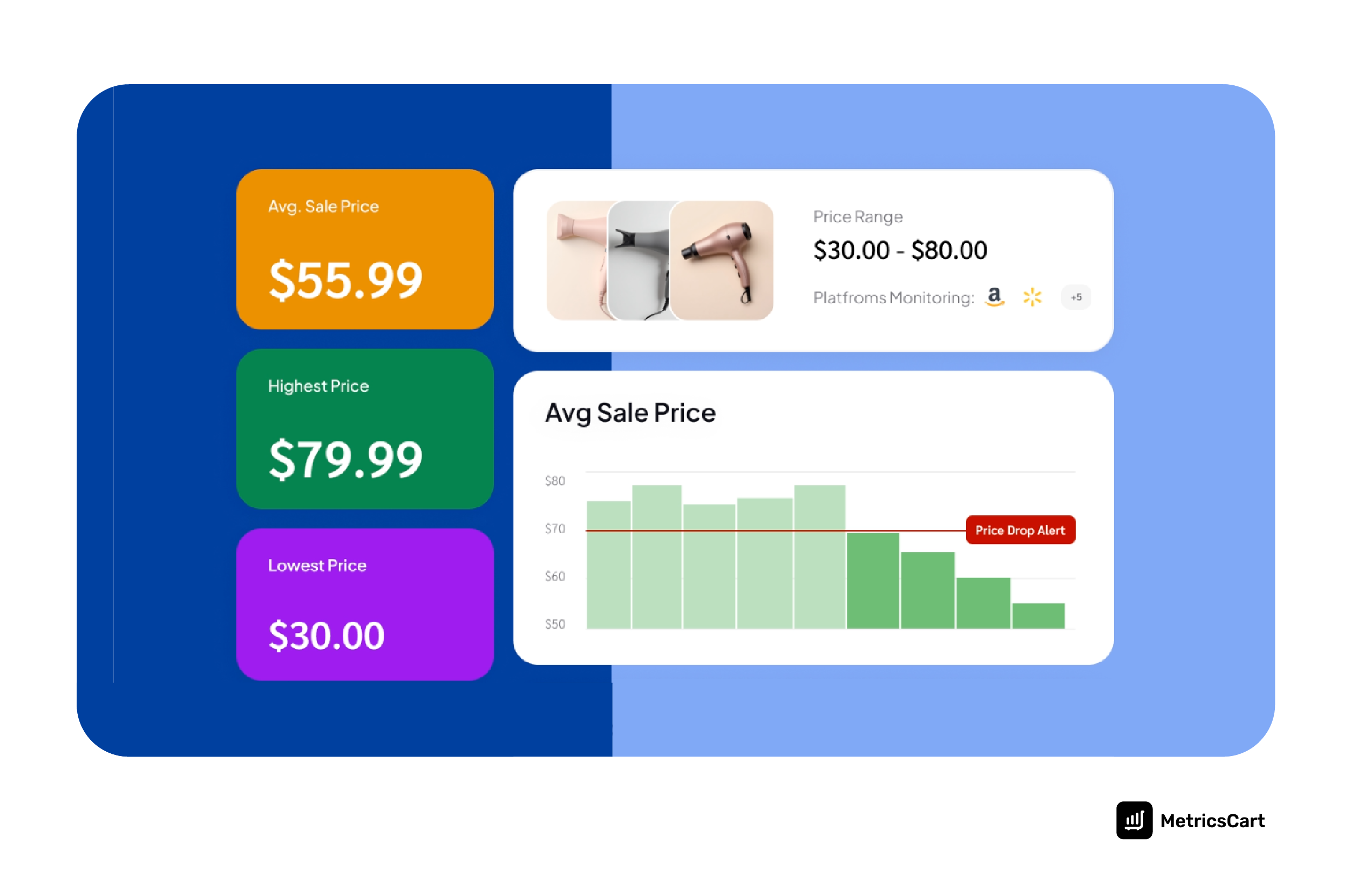
Most platforms in the market simply monitor a price number. MetricsCart is built to monitor holistic brand health on Amazon, identifying pricing as the most immediate and actionable signal within a broader commercial picture.
Engineered specifically for CPG manufacturers, consumer goods companies, and brands with complex catalogs and distributed seller networks, MetricsCart’s Amazon price-monitoring software goes beyond basic alerts to deliver true operational intelligence.
- Real-Time Benchmarking: Tracks competitor pricing and promotional cadences across thousands of ASINs simultaneously.
- Promotional Effectiveness: Monitors how aggressive competitor discounts actually impact your own Buy Box share and sales velocity.
- Deep Historical Benchmarking: Provides multi-year pricing history to identify seasonal risks and competitor patterns.
- Buy Box Analysis: Tracks wins and losses specifically caused by MAP violations, showing the direct impact on sales and consumer perception.
- Advanced Seller Identification: Unlike basic Amazon price trackers for brands, MetricsCart maps every seller’s identity, distinguishing authorized partners from unauthorized actors.
- MAP Violation Detection: Spots violations and retrieves and stores time-stamped screenshots of price violations, providing the documentation required for legal escalation or Amazon disputes.
- Automated MAP Enforcement: Provides a tiered enforcement action plan with pre-defined e-mail templates for escalation.
Strategic Benefits for Business Leaders
- P&L Protection: Enables strategic pricing decisions that balance the need for competitiveness with the necessity of maintaining margins.
- Brand Protection: Safeguards newly launched products, where pricing integrity is most crucial, from early-stage price erosion.
- Optimized Commercial Timing: By understanding competitor trend data, brands can optimize the timing and depth of their own promotions for maximum sales impact without over-discounting.
- Strengthened Channel Relationships: Equips Category Managers with exportable, documented evidence of MAP violations to support enforcement discussions with retail partners.
- Silo-Breaking Visibility: Provides a full suite of digital shelf analytics into content health, inventory availability, and advertising performance, ensuring you aren’t spending ad dollars on a “broken” shelf.
Take Control of Your Amazon Pricing
Every day you operate without Amazon price tracking software, unauthorized sellers dictate your market price, MAP violations accumulate unnoticed, and Buy Box losses go unexplained.
As challenger brands tighten their grip on market growth, maintaining pricing integrity is the key to protecting your margins and authorized retail partnerships.
MetricsCart provides the visibility and enforcement tools to move first. By integrating Amazon price tracking with broader retail analytics, your team can defend its price positioning and maintain the trust of your most valuable channel partners.
Get in touch with MetricsCart today to see exactly what is happening to your pricing on Amazon right now.
Ready To Take Your Amazon Price Control to the Next Level?
FAQs
Brands use automated tools that continuously scan Amazon listings, seller offers, and competitor ASINs. These tools track price changes, identify who is selling at what price, monitor Buy Box ownership, and send alerts when pricing shifts or violations occur. This replaces manual checks, which are too slow for Amazon’s pace.
Yes. Advanced Amazon price monitoring software like MetricsCart compares live prices against your set MAP thresholds and flags violations instantly. They also identify the seller responsible and capture proof for enforcement.
Price directly impacts visibility and sales on Amazon. Most purchases happen through the Buy Box, and pricing is one of the key factors that determines who wins it. Without proactive monitoring, brands lose control to competitors, unauthorized sellers, and automated repricing, which can erode margins and hurt conversion.
Yes. Strong tools track not just base prices but also coupons, Lightning Deals, bundle offers, and Subscribe & Save discounts. This helps you understand how competitors actually compete, not just what they list.
No. Amazon does not alert brands about MAP violations or competitor price changes. MAP Monitoring and enforcement are entirely the brand’s responsibility.